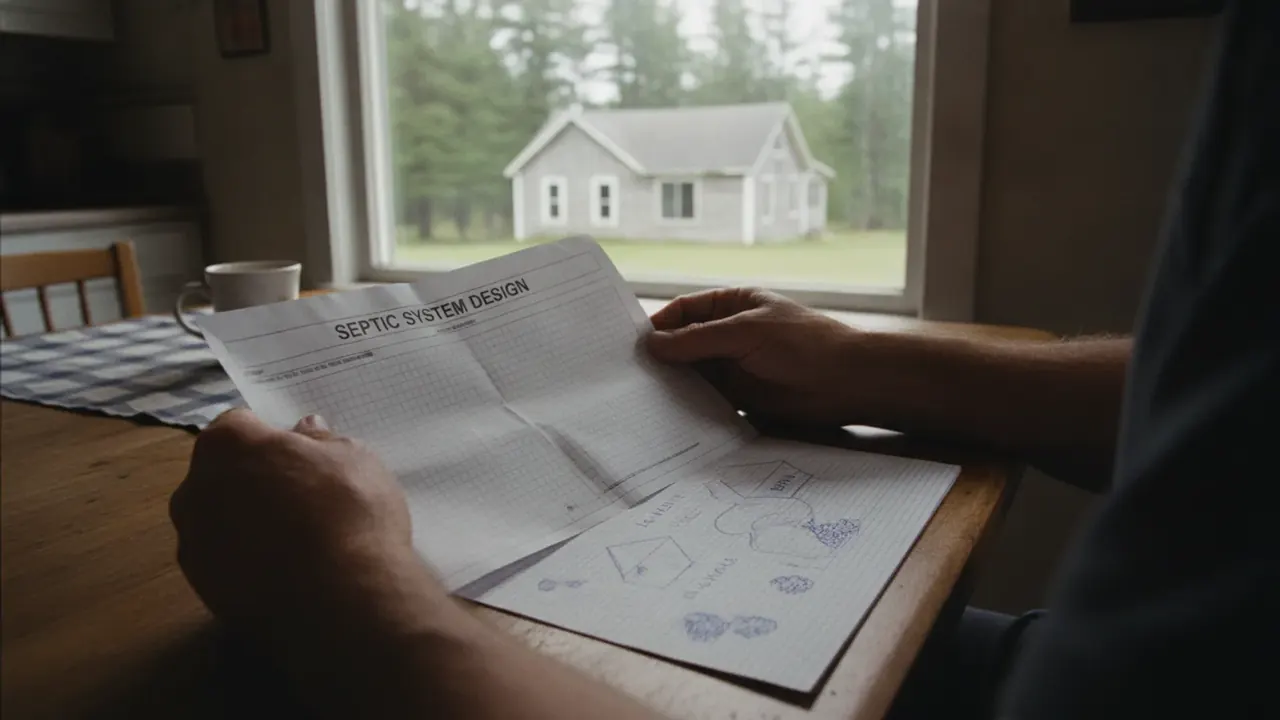
Mike in Brewer called us asking for a quote to pump his tank, and the first question we asked back was: do you know your tank size? He did not. Not unusual - most homeowners could not tell you if they have a 1,000-gallon tank or a 1,500-gallon tank, let alone whether it is concrete or a newer plastic model, or where exactly it sits under the lawn. There is a document that answers all of that in about thirty seconds of reading, and there is a good chance it is already on file with your town for free. It is called the HHE-200, and most people have never heard of it until they need it.
This is the record that matters most for anyone who owns, is buying, or is inheriting a septic system in the Bangor area. Here is what it actually is, what it tells you, how to get your copy, and why having it in hand before a truck shows up saves you real money.
What the HHE-200 Actually Is
The HHE-200, officially the Subsurface Wastewater Disposal System Application, is the design and permit form required any time a septic system is installed or replaced in Maine. A licensed site evaluator fills it out based on soil testing and a site survey, it gets submitted to your local code enforcement officer for approval, and a copy typically also lands with the state Subsurface Wastewater Program. Think of it as your septic system’s birth certificate - filed once, meant to last the life of the system.
The form itself is not glamorous. It is a few pages of boxes and a hand-drawn or CAD site plan, but tucked inside is essentially everything a pumping crew, an inspector, or a buyer would want to know before setting foot on the property.
What It Actually Tells You
A complete HHE-200 typically covers:
- System type. Whether you have a conventional gravity system, a pressurized bed, an engineered mound, or something else - a distinction we cover in more depth in our guide to types of septic systems in Maine.
- Tank size and design flow. Listed in gallons, based on the number of bedrooms the house had when the system was designed - not necessarily the number it has now.
- Soil test results. The percolation rate and soil profile that determined how the field was sized and laid out, which matters a lot on the ledge and heavy clay common across Penobscot County.
- A site sketch. A drawn plan showing the tank, distribution box, and field relative to the house, driveway, well, and property lines - usually with rough measurements.
- Install or replacement date. The date the system was permitted, which gives you a real number instead of a guess when you are estimating remaining lifespan. Our post on how long a septic system lasts in Maine leans on this exact date for its math.
- Designer and installer names. Occasionally useful if a warranty question or a design dispute ever comes up.
None of this replaces a hands-on look at the actual tank and field. But it tells a pumping crew or inspector exactly what to expect before they arrive, and it tells a buyer whether the system on paper matches what a home inspection finds in the ground.
Why the Site Sketch Alone Is Worth the Trip to Town Hall
The single most useful piece of the HHE-200, for day-to-day purposes, is the site sketch. If you have ever paid a locating fee because a pumping crew had to probe your entire yard to find the lid, that fee exists because nobody had this drawing in hand.
Dave in Hampden found this out the annoying way. He had lived in his house for six years, never needed a pump-out, and when the day finally came the crew spent forty-five minutes probing frozen ground in March before finding the tank under a spot he never would have guessed. He paid a locating fee on top of the pumping charge for something a five-minute call to the town office could have avoided. We go through the full mechanics of finding a buried tank, sketch or no sketch, in our guide to how to find your septic tank, but the HHE-200 is always the faster path when it exists.
| Locating method | Typical added cost |
|---|---|
| Site sketch from HHE-200 in hand | $0 - crew goes straight to the lid |
| Rough memory of location, minor probing | $0 - $75 |
| No records, full yard probe search | $100 - $200 |
| Camera trace down the sewer line | $150 - $250+ |
That’s the tell of a system that has been kept organized versus one nobody has thought about since installation: one call to the town office either produces a clean sketch, or it does not.
How to Get Your Copy
Start with your town office. For most Bangor-area towns, this means calling or emailing the code enforcement officer, since local plumbing permits including septic installations are filed there. Have your address and, if you know it, the approximate year the system was installed or replaced. Towns like Bangor, Orono, and Old Town tend to have decent records going back a couple of decades, sometimes digitized; smaller towns may still have everything in paper folders in a filing cabinet, which just means it takes a little longer.
Try the state if the town comes up empty. The Maine Subsurface Wastewater Program keeps records too, particularly for systems where the town did not retain its own copy or where the file has been lost over the years. You can find contact information and request forms through the Maine Subsurface Wastewater Program. Expect to provide the property address, current owner name, and ideally the approximate permit date.
Ask your realtor or the seller if you are buying. If you are in the middle of a purchase, the current owner may already have a copy from their own closing, or their file might sit with the same real estate agent who is handling the sale. It never hurts to ask before you go through official channels.
Check if there is no record at all. Systems installed before Maine’s statewide plumbing code took effect in the early 1970s, and some older camps around Eddington, Milford, Veazie, and Holden that were never formally permitted, may simply have nothing on file anywhere. That is not a crisis, but it means you are working with an unknown-history system, and it is worth budgeting and planning accordingly - our guide to buying a house with a septic system in Maine covers how to handle that gap.
Why This Matters More If You Are Buying or Selling
For buyers, the HHE-200 is one of the first things worth requesting once an offer is accepted, alongside pumping receipts and any prior inspection reports. It tells you the system’s real age, its design capacity versus the bedroom count you are buying into, and whether what is on paper matches what an inspector finds in the yard. State law around septic disclosure when selling a house in Maine has its own set of rules, which we cover separately in our post on Maine septic inspection laws when selling - this article is specifically about the paper trail, not the legal disclosure requirements.
For sellers, having your HHE-200 ready to hand over is a small thing that reads as a big signal. A buyer who gets a clean design record along with a recent septic inspection is far more likely to move forward without renegotiating over septic unknowns. A buyer who gets neither starts assuming the worst, and that assumption tends to show up as a lower offer.
What to Do Once You Have It
Once you have your HHE-200 in hand, the most useful thing is simply keeping it somewhere you will actually find it again - a folder with your other home records, a photo saved to your phone, whatever sticks. Cross-check the tank size listed against your household’s current bedroom count; a system designed decades ago for a smaller family can end up undersized after an addition or a basement bedroom, a mismatch we walk through in our septic tank size guide for Maine.
If the sketch shows a lid location with no riser installed, that is also worth flagging. Install a riser while you have the exact spot marked, and you will never need to locate the tank by probe again - see our breakdown of septic riser cost in Maine for the numbers.
When you are ready to schedule service, hand your HHE-200 or its site sketch to whoever is coming out. It saves them time and saves you the locating fee. Call us at (509) 351-8404 or book directly through /#book, and if you just want a ballpark number before you call, run it through our septic pumping cost calculator.
One last safety note, same as always: nothing in this article is a reason to open or climb into a septic tank yourself, even once you know exactly where it is. Locating the tank and reading the paperwork is homeowner territory. Opening the lid and working inside it belongs to a licensed pumper, every time - the gases that can build up inside are genuinely dangerous. For general background on how the whole system fits together, our guide to how septic systems work in Maine and the EPA’s septic system overview are both good starting points.
Frequently Asked Questions
What is the HHE-200 form in Maine?
The HHE-200 is the official Subsurface Wastewater Disposal System Application filed in Maine whenever a septic system is designed, installed, or replaced. It includes the system type, tank size, design flow, soil test results, and a site sketch showing where the tank and field sit on the lot.
Where do I get a copy of my HHE-200 form?
Start with your town office, usually the code enforcement officer, since local plumbing permits are filed there first. If the town does not have it on file, request a copy from the Maine Subsurface Wastewater Program, which keeps records for systems permitted at the state level.
Does every septic system in Maine have an HHE-200 on file?
No. Systems installed before the mid-1970s, or older camps that were never formally permitted, often have no record at all. Systems installed or replaced since then, especially anything done with a licensed site evaluator, almost always have one on file somewhere.
Why does pulling my HHE-200 form save money on septic service?
The form shows exactly where the tank and field are located, so a pumping crew can go straight to the lid instead of probing the yard, which typically saves 100 to 250 dollars in locating fees. It also confirms tank size and system type before a truck ever shows up.