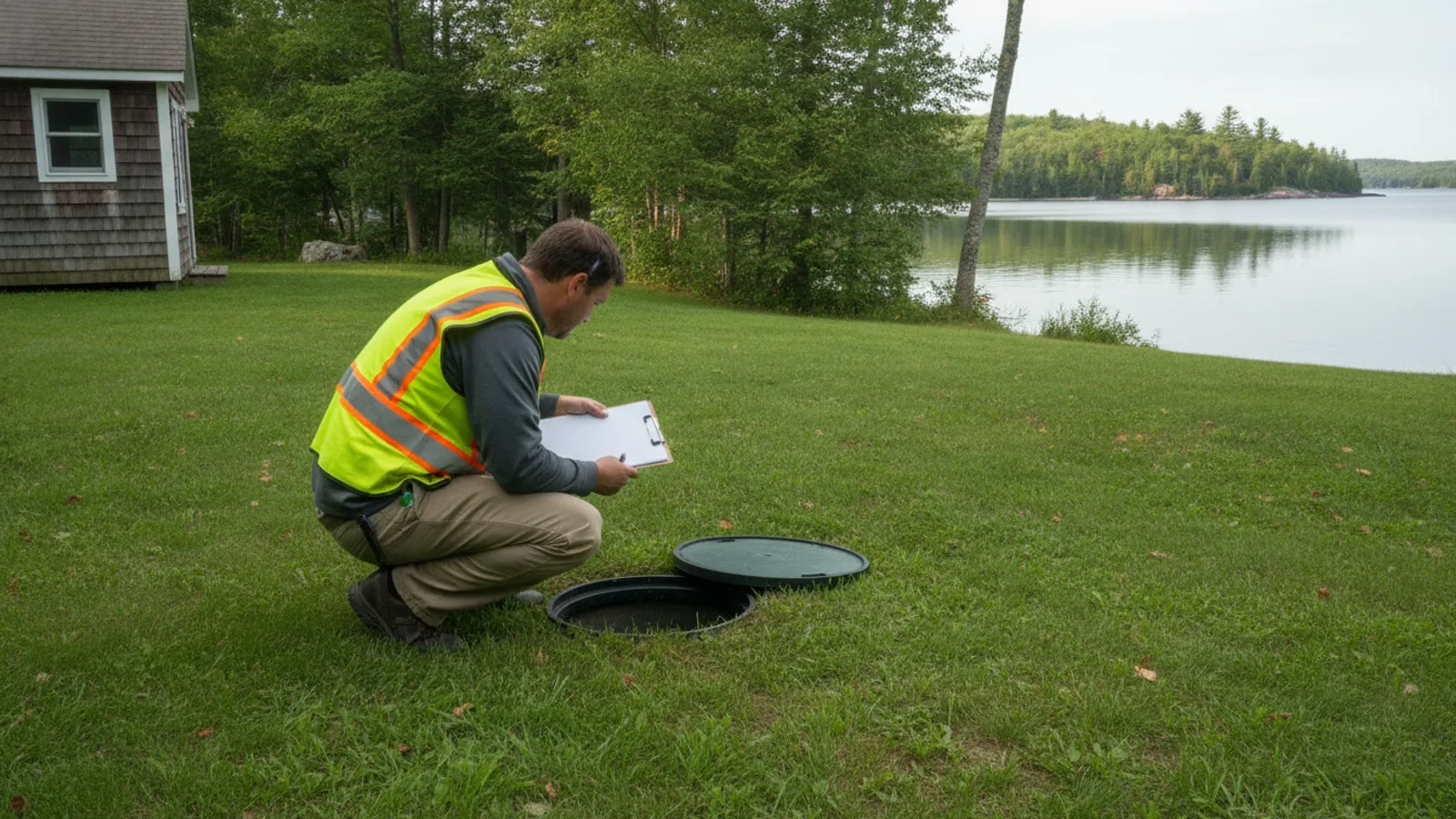
Last August, a camp on Pushaw Lake almost didn’t sell. The sellers had a solid offer, a motivated buyer, and a closing date four weeks out. Then the buyer’s agent asked one question: has the septic system been inspected? Nobody had an answer. Nobody had paperwork. And because the camp sat within 250 feet of the lake, Maine septic inspection law actually applied to the sale. The closing slid three weeks while everyone scrambled to find a certified inspector in peak season.
That story plays out all over Penobscot County every summer, and most of the stress is avoidable. Maine’s rules on septic systems and property transfers aren’t complicated once you see them laid out. But they’re specific, they carry real deadlines, and getting them wrong can cost you a closing date or a five-figure repair negotiation.
The short answer: Maine only requires a septic inspection before a sale when the property sits in the shoreland zone, generally within 250 feet of a lake, pond, river, or certain wetlands. For every other property there’s no statutory inspection requirement, but the seller must still certify in writing whether the system has malfunctioned in the 180 days before closing, and most buyers will ask for an inspection anyway.
Here’s what the law actually says, what it doesn’t say, and how to keep a septic system from stalling your sale.
Quick note before we start: this article is general information, not legal advice. For questions about your specific sale, talk to a Maine real estate attorney, and confirm local requirements with your town’s plumbing inspector.
What Maine Septic Inspection Law Requires in the Shoreland Zone
Let’s clear up the biggest misconception first. Maine does not require a septic inspection for every home sale. There’s no blanket statewide point-of-sale inspection law.
But there is one big exception, and it covers a huge share of the camps and lakefront homes in our area. Under 30-A M.R.S. §4216, when property with a subsurface wastewater disposal system located in the shoreland zone is transferred, the buyer must have that system inspected by a state-certified inspector before the purchase.
The shoreland zone generally means land within 250 feet of lakes, ponds, rivers, and certain wetlands, and within 75 feet of certain streams. Exact boundaries come from your town’s shoreland zoning map, so when in doubt, check with your town office or code enforcement officer.
A few key details from the statute, as written:
- Timing. The inspection is supposed to happen before the purchase. If weather makes that impossible (think a frozen, snow-covered leach field in January), the inspection must be done within 9 months after the transfer.
- Exemptions. No inspection is required if the system was installed within 3 years before closing, or if the seller has a written inspection report from a certified inspector dated within 3 years of the transfer. In that second case, the seller must give the report to the buyer.
- The 180-day statement. The seller must provide a written statement about whether the system has malfunctioned during the 180 days before the transfer.
- Failed systems. If the inspection finds the system is malfunctioning, it must be repaired or replaced within one year after the transfer.
If you’re buying or selling a camp on Pushaw, Chemo Pond, the Penobscot River, or any water body in the region, assume this law applies until your town tells you otherwise. And if you need an inspection scheduled fast, our septic inspection service covers the greater Bangor area. Call (509) 351-8404 or book online and we’ll get you on the calendar before your closing does the sliding.
Who Can Perform a Septic Inspection in Maine
Not just anyone with a shovel and a flashlight. For shoreland transfers, §4216 requires the inspection to be done by a person certified by the state. Certification runs through the Maine CDC’s Subsurface Wastewater Program, which also handles licensing and certification for site evaluators and installers.
Why does this matter to you? Two reasons.
First, if your buyer’s lender or attorney asks for the inspection report, a report from a non-certified inspector may not satisfy the statute for a shoreland property. You’d be paying twice.
Second, a certified inspector knows what the state’s inspection standards actually require. That includes checking the tank, the distribution box, and the leach field, not just glancing at the toilet flushing.
When you hire an inspection company, ask directly: is the person doing my inspection certified by the State of Maine for wastewater system inspections? A legitimate outfit will answer without hesitation.
The Seller’s Disclosure Duty: 33 M.R.S. §173
Even outside the shoreland zone, Maine sellers of residential property have a legal disclosure duty that covers septic systems. Under 33 M.R.S. §173, a seller with a private wastewater disposal system must disclose, among other things:
- The type of system and the size, type, and location of the tank
- The installation dates for the tank and the leach field
- The location of the leach field
- The date the system was last serviced and the name of the contractor who services it
- Any malfunctions of the tank or the leach field
That last one is the sleeper. “Any malfunctions” means backups, sewage surfacing in the yard, slow drains traced to the system, alarm events on a pump system. If you knew about it, you disclose it. The disclosure statement reflects your actual knowledge, so you’re not expected to reveal problems you genuinely don’t know about, but hiding a known failure is a legal risk no sale price justifies.
Here’s how honest disclosure plays out in real life. Karen, who sold her house in Hampden last spring, disclosed a backup from two years earlier along with the $425 pumping and service call that fixed it. Her buyers appreciated the paper trail, ordered their own inspection, and closed on schedule. A seller who stays quiet and gets caught looks suspicious on every other line of the disclosure too.
If you’re not sure whether something counts as a malfunction, our post on signs your septic tank needs pumping walks through the difference between a full tank and a failing system.
Buyer vs. Seller: Who Handles What
Responsibilities split fairly cleanly in a Maine septic transaction. Here’s the short version:
| Task | Buyer | Seller |
|---|---|---|
| Order the shoreland-zone inspection (30-A M.R.S. §4216) | Yes, the statute puts this on the buyer | Optional, but a pre-listing inspection is smart |
| Pay for the inspection | Usually, though it’s negotiable | Pays if ordering a pre-listing inspection |
| Provide the 180-day malfunction statement | No | Yes, for shoreland transfers |
| Complete the property disclosure (33 M.R.S. §173) | No | Yes, for residential sales |
| Provide a prior inspection report (within 3 years) if one exists | No | Yes |
| Repair or replace a malfunctioning system after transfer | Yes, within 1 year under §4216, unless negotiated otherwise | Often negotiated before closing via credit or escrow |
| Pull HHE-200 records from the town office | Either party can | Smart move before listing |
One thing this table can’t capture: almost everything here is negotiable except the disclosure duties, so talk to your agent and attorney early.
What a Septic Inspector Actually Checks
A real inspection is more than a look at the tank lid. Here’s what a certified inspector typically evaluates:
- Locating the system. Finding the tank, distribution box, and leach field, ideally using the HHE-200 design on file.
- Tank condition. Checking baffles, liquid levels, signs of leaks, and structural condition. The tank usually needs to be pumped for a proper look, which is why inspections and septic tank pumping are often scheduled together.
- Evidence of malfunction. Surfacing effluent, sewage odors, lush green stripes over the leach field, backflow from the field into the tank.
- Leach field performance. Signs of ponding, saturation, or breakout on the slope below the field.
- Setbacks and site conditions. How the system sits relative to the well, the water body, and property lines.
A word on safety, because it matters: never open or enter a septic tank yourself. The gases inside can knock a person unconscious in seconds, and people die in septic tanks in this country every year. Leave lids, risers, and tank access to professionals with the right equipment.
Here’s a story that shows why the pump-and-inspect combo pays for itself. Dale was selling his camp near Old Town and figured he’d save money by skipping the pre-listing inspection. His buyer’s inspector found a collapsed inlet baffle that had been quietly sending solids to the leach field for years. The buyers demanded a $14,000 credit toward field replacement. Dale’s agent later told him a $450 inspection and a $400 pumping a year earlier likely would’ve caught it when it was a $600 baffle repair. We service camps all over the Old Town area, and this exact pattern shows up every single season.
HHE-200 Records: How to Pull Your Septic Paperwork
Every septic system permitted in Maine since the state permitting system began in the 1970s should have an HHE-200 on file. The HHE-200 is the Subsurface Wastewater Disposal System Application, prepared by a licensed site evaluator, showing the system’s design, soil test results, tank size, and leach field layout. The form and program details live with the Maine CDC Subsurface Wastewater Program.
Getting a copy is usually simple:
- Call or visit your town office. Ask for the local plumbing inspector (LPI) or code enforcement office. Give them your property address and map/lot number.
- Ask for the HHE-200 and any permits for subsurface wastewater disposal on the property. Ask about replacement systems too, since a property may have more than one filing over the decades.
- If the town has nothing, the system may predate permitting (common with older camps) or records may have been lost. In that case, a certified inspector can locate and evaluate the system on site, and that report becomes your new paper record.
Sellers, do this before you list. Walking into a showing with the HHE-200, recent pumping receipts, and an inspection report is the cheapest credibility you’ll ever buy. Buyers, ask for these documents in your first request, and if the seller shrugs, budget for a full septic inspection during your due diligence period.
What Happens When a System Fails Inspection
First, don’t panic. A failed inspection kills fewer deals than people fear. Under §4216, a malfunctioning shoreland system has to be repaired or replaced within one year after the transfer, which gives everyone room to negotiate rather than walk.
In practice, one of four things usually happens:
- Seller repairs before closing. Clean, simple, keeps the sale price intact.
- Price credit. The buyer takes on the repair and the price drops to match.
- Escrow holdback. Funds sit in escrow at closing and get released when the work is done. Common when winter makes immediate work impossible.
- Renegotiated timeline. The closing moves so a site evaluator can design a replacement system.
Costs vary widely. A baffle or D-box repair might run a few hundred dollars. A full leach field replacement in our region commonly lands between $10,000 and $25,000 depending on soils, setbacks, and whether the shoreland zone forces an engineered design. For context on the cheaper end of septic spending, see our breakdown of septic pumping costs in Maine.
One more real example. Linda and her brother inherited their parents’ camp outside Orono and listed it last fall. The inspection found the leach field saturated and failing. Rather than lose their buyer, they agreed to an $18,000 escrow holdback, the buyer closed on time, and a new system went in the following June. Not fun, but the sale survived because everyone knew the rules and worked inside them.
Timing Advice: Don’t Let the Septic System Set Your Closing Date
Around Bangor, inspection calendars jam up from May through October, exactly when camps sell. A little planning keeps the septic system off the critical path:
- Sellers: order your inspection before you list, or at latest when you accept an offer. Remember, a certified inspection report less than 3 years old can exempt your buyer from ordering their own under §4216.
- Buyers: put the inspection in motion the week your offer is accepted. Don’t wait for the financing contingency to clear.
- Winter closings: if snow and frost make inspection impossible, the statute allows it within 9 months after transfer. Get that agreement in writing in your purchase contract.
- Camp properties: if the place is winterized, the system needs to be operating to be inspected properly. Our camp opening and closing service can get the water on so the inspection actually means something.
The EPA also publishes solid general guidance on caring for a septic system at epa.gov/septic, and the Maine DEP’s shorefront property owner resources are worth a read for anyone on the water.
If you’re anywhere in Penobscot County and a sale is on the horizon, don’t gamble the closing on a system nobody has looked at in a decade. Book a septic inspection or call (509) 351-8404. We’ll pump it, inspect it, and hand you the paperwork your closing table wants to see.
One last reminder: laws change, towns adopt their own ordinances, and every sale has its own wrinkles. Treat this guide as a starting point, verify the current statutes, and lean on your attorney and your local plumbing inspector for the final word.
Frequently Asked Questions
Does Maine require a septic inspection when selling a house?
Not for every sale. Maine law requires an inspection by a state-certified inspector when property with a septic system in the shoreland zone changes hands, under 30-A M.R.S. §4216. Outside the shoreland zone there’s no statewide mandate, but buyers and lenders very often require an inspection anyway, and towns can have their own rules, so check with your local plumbing inspector.
Who pays for the septic inspection in Maine, the buyer or the seller?
The statute puts the shoreland inspection duty on the buyer, but who actually pays is negotiable like any other closing cost. Many sellers order a pre-listing inspection, which typically runs a few hundred dollars, because it prevents surprises and can exempt the buyer from ordering a duplicate. Either way, somebody certified needs to look at the system before the deal is done.
What happens if a septic system fails the inspection?
Under §4216, a malfunctioning shoreland-zone system must be repaired or replaced within one year after the transfer. In practice, most deals resolve it sooner through a seller repair, a price credit, or an escrow holdback at closing. A failed inspection changes the negotiation, but it rarely has to kill the sale.
How do I find my septic system records in Maine?
Start at your town office and ask the local plumbing inspector for the HHE-200 subsurface wastewater disposal application on file for your property. Most systems permitted since 1974 have one, showing the design, tank size, and leach field location. If the town has no record, a certified inspector can locate the components on site and give you a written report that serves as your new baseline.