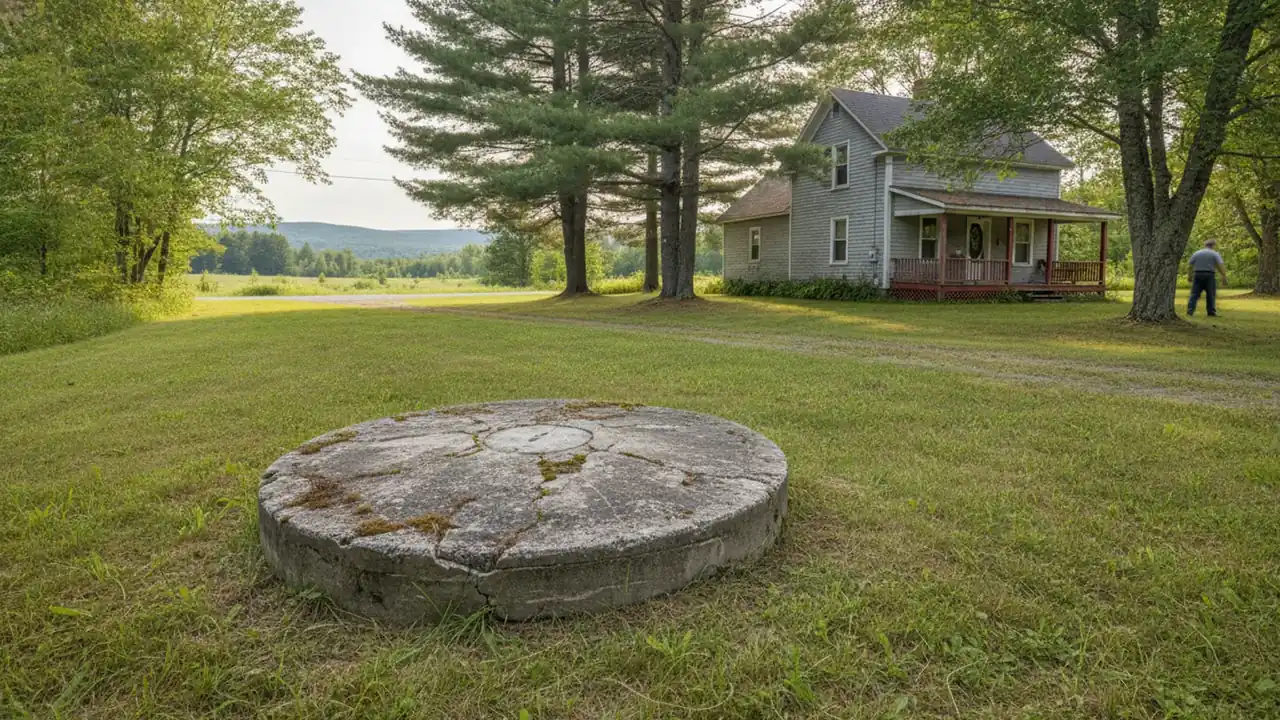
Dave in Hampden bought his place in 1998. The septic tank came with the house, and near as anyone can tell, so did the drain field — both original to a build from the early 1980s. Twenty-six years later, the tank’s still fine. The field failed two summers ago. Same system, two very different lifespans, and that split is the whole story of septic longevity: one part of your system will probably outlast you, and the other part is on a clock that started ticking the day it was installed.
A concrete septic tank can last 40 years or more. A drain field, even a well-built one, usually runs 20 to 30 years. Everything else — pumps, distribution boxes, effluent filters, risers — falls somewhere in between, and how you treat the system day to day can stretch or shrink every one of those numbers by a decade in either direction.
Lifespan by Component
Not every part of a septic system ages the same way, and homeowners are often surprised to learn the tank isn’t usually the thing that fails first.
| Component | Typical Lifespan | What Kills It Early |
|---|---|---|
| Concrete tank | 40+ years | Structural cracking, severe neglect, heavy equipment driving over it |
| Steel tank | 15–25 years | Rust-through from the inside, especially near the waterline |
| Fiberglass/plastic tank | 30–40 years | Cracking under soil pressure if installed poorly |
| Drain field (conventional) | 20–30 years | Solids overload from skipped pumping, tree roots, heavy water use |
| Distribution box | 20–30 years | Root intrusion, settling, cracked joints |
| Effluent pump | 7–10 years | Continuous running, power surges, grit buildup |
| Baffles/effluent filter | Varies, filter needs cleaning | Corrosion (steel baffles), clogging if never checked |
Concrete is the material you want to see when a lid comes off. It’s what most Penobscot County systems installed since the 1970s are built from, and it just doesn’t wear out the way steel does. If you’re the kind of homeowner who likes to know what you’re dealing with before a contractor tells you, our piece on how to find your septic tank walks through locating and identifying yours.
Why the Tank Outlives the Field
This trips people up because it seems backwards — the tank holds the waste, so shouldn’t it wear out first? Not really. A concrete tank is just a buried box. Barring a structural crack or a lid that finally gives way under a snowplow, there’s not much in there that ages. The field is different. It’s not a container, it’s a living piece of infrastructure — a network of pipe laid in trenches of stone and soil that has to keep absorbing wastewater, day after day, for decades.
Every gallon that leaves the tank carries a little bit of the fine particles the tank couldn’t settle out. Over 20 or 30 years, that residue builds a biological layer, called a biomat, along the trench walls. Some biomat is normal and even helps treat the effluent. Too much, and the soil stops absorbing water fast enough. That’s the mechanism behind almost every drain field replacement in this area — not one dramatic failure, but a slow accumulation that finally tips the field into standing water and backups.
What Shortens a Septic System’s Life
Some of this is out of your hands. Most of it isn’t.
Skipping pump-outs. This is the number one field-killer, by a wide margin. Every tank has a layer of solids on the bottom and scum on top, held back from the outlet by a baffle. Go too long between pumpings and that layer creeps up past the baffle and washes straight into the field — where it can’t be removed. You can pump the tank forever after that; the field stays damaged. If you want the specific interval that keeps you ahead of this, we cover it in our guide on how often to pump a septic tank.
Tree and shrub roots. Maine yards have a lot of mature trees, and roots go looking for moisture wherever they can find it — including pipe joints and distribution boxes. Willows, maples, and even ornamental shrubs planted too close to a field can infiltrate pipe over a decade or two and choke off flow.
Hydraulic overload. Running too much water through the system too fast doesn’t give the field time to absorb it between doses. A running toilet, a water softener that recharges constantly, or doing six loads of laundry back-to-back on a Saturday all count. Linda in Orono spent two years fighting a soggy yard before a plumber found a toilet flapper that had been quietly running for months — cheap fix, but it had been overloading her field the whole time.
Garbage disposals used heavily. Ground food waste adds solids volume the tank has to handle every single day, which means more frequent pump-outs are required to keep pace — and a lot of households don’t adjust their schedule accordingly.
Frost and ledge. This one’s mostly Maine-specific. Shallow soil over ledge, common around Old Town and parts of Penobscot County, limits how deep a field can be built, which limits its long-term capacity. Frost heave in shallow systems can also crack pipe joints over repeated winters if a field wasn’t installed with enough cover.
Heavy equipment or vehicles on the field. Parking a truck, plowing snow into a pile on top of it, or driving a mower over saturated ground compacts the soil and crushes pipe. The field needs to breathe — literally, it needs air exchange in the soil to work — and compaction shuts that down.
How to Get the Most Years Out of What You Have
None of this requires exotic maintenance. It’s mostly discipline.
Pump on schedule, not by feel. Waiting for a slow drain or a bad smell means you’ve already let solids build up longer than they should. Regular pumping is the cheapest insurance a septic system has.
Get a real inspection, not just a pump-out. A pumper can only tell you what’s happening inside the tank. A full inspection checks baffle condition, tank structure, and how the field is handling flow — which is where early field problems show up first. We break down what that actually involves in our septic inspection cost guide.
Keep records. Maine’s HHE-200 form and local permit files document your system’s original design, size, and install date, which matters enormously once you’re trying to figure out whether a 25-year-old field is due or overdue.
Spread out water use. Stagger laundry loads, fix leaks fast, and don’t let a fixture run.
Keep roots and traffic off the field. Know where it is, mark it if you have to, and treat it as off-limits for parking, plowing, and planting anything with an aggressive root system.
Watch what goes down the drain. Grease, wipes, and excess chemicals all shorten system life, tank and field both.
If your system is getting up there in years and you’re not sure whether you’re looking at routine maintenance or the start of a bigger problem, the honest answer usually takes a trained eye, not a guess. Give us a call at (207) 300-9238, or grab a ballpark number first with our septic pumping cost calculator before you book a visit through our online scheduler.
When Age Means It’s Time to Plan Ahead
A system in its 20s isn’t necessarily failing, but it’s worth budgeting for eventually. If yours is nearing the upper end of typical drain field life, or you’re buying a home in Bangor, Brewer, Hampden, or Old Town with an older system, it’s smart to get ahead of it rather than wait for a wet yard to force the issue. Our guide on new septic system cost in Maine lays out what replacement actually runs so there are no surprises. For general standards on how systems are supposed to be built and maintained statewide, the Maine Subsurface Wastewater Program (https://www.maine.gov/dhhs/mecdc/environmental-health/plumb/) and the EPA’s septic systems resources (https://www.epa.gov/septic) are both solid references.
Frequently Asked Questions
How long does a septic system last in Maine?
A well built concrete septic tank can last 40 years or more, sometimes outliving the house. The drain field is the shorter lived part of the system and typically lasts 20 to 30 years with normal care, less if it is neglected or overloaded.
What shortens the life of a septic system the most?
Skipping pump outs is the single biggest factor, since solids that build up past the outlet baffle wash into the drain field and clog the soil permanently. Tree roots, water overload from leaks or heavy laundry days, and grinding excess food waste through a garbage disposal all shorten field life as well.
Do steel septic tanks last as long as concrete ones?
No. Steel septic tanks rust from the inside out and typically fail in 15 to 25 years, while concrete tanks routinely reach 40 years or more. Most steel tanks still in service in the Bangor area are well past a reasonable inspection interval.
Can you extend the life of an old drain field?
Yes, to a point. Regular pumping before solids reach the outlet baffle, keeping roots and heavy vehicles off the field, spacing out laundry and other water use, and fixing running toilets promptly all add years. But a field that has already clogged with solids cannot be restored, only replaced.