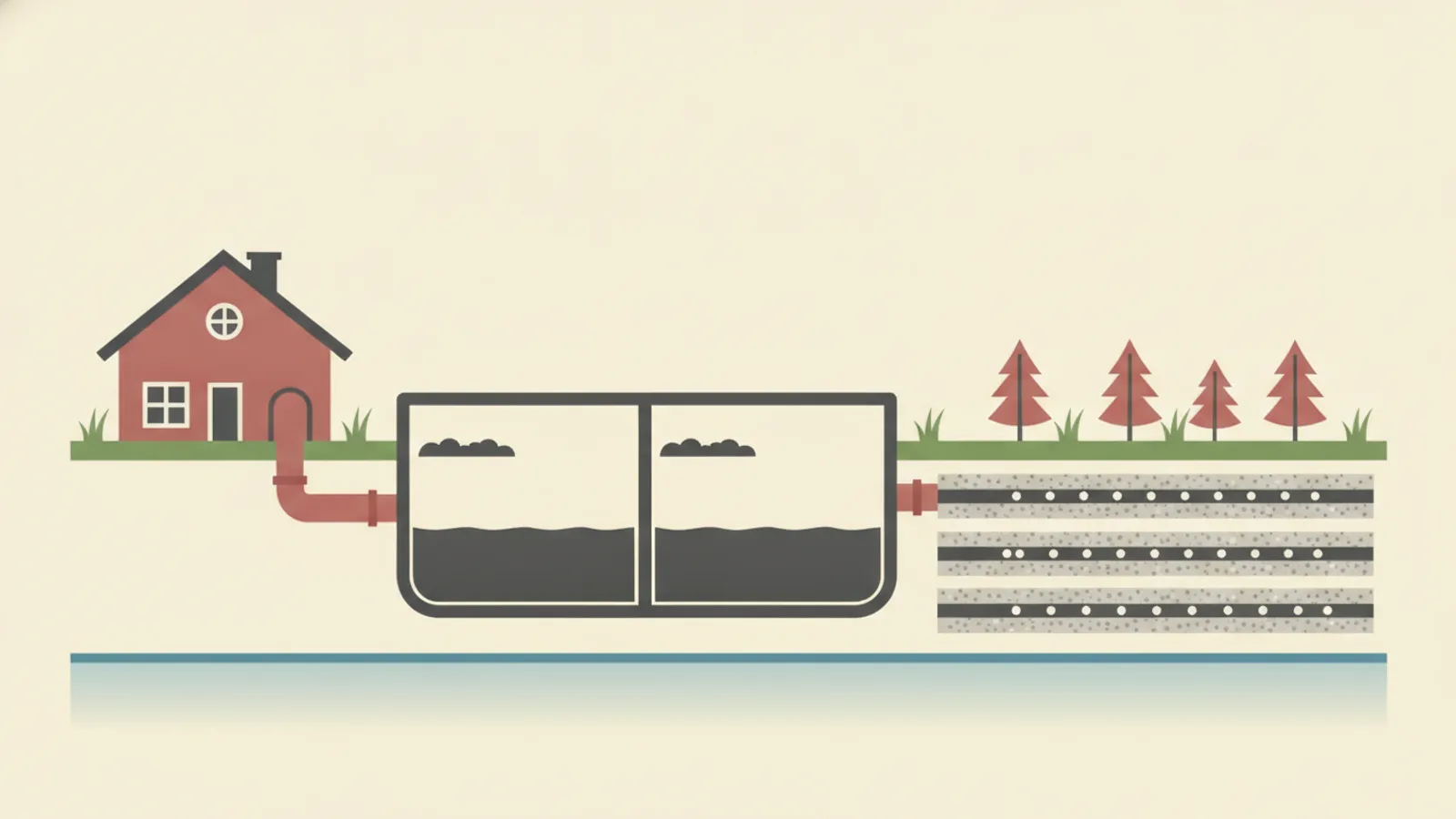
Say you just bought a place off outer Broadway, north of Bangor. Nice lot, drilled well, and somewhere under the back lawn, a septic system you’ve never laid eyes on. The seller handed over a folder with a faded sketch, and that was it. If you’re now typing “how does a septic system work” into your phone, you’re in good company. Most Maine homeowners never think about the system until a drain gurgles.
Here’s the whole trip, flush to groundwater, including the parts that are specific to Maine. A Penobscot County system lives a harder life than one in Georgia, and the design shows it.
What happens after you flush
Every drain in the house, toilets, showers, sinks, the washing machine, runs into one main pipe that leaves the foundation and slopes toward the tank. In most systems gravity does all the work, no motor, no electronics, just a four inch pipe with a steady downhill pitch ending at the tank.
Inside the tank: three layers doing the work
The tank is a buried, watertight box, usually concrete, usually 1,000 gallons around here. Its whole job is to hold everything still long enough to separate.
The cutaway above shows what that looks like inside. Grease, soap, and anything that floats rises to form the scum layer. Solids sink to the bottom and become sludge. Between them sits a deep middle layer of murky liquid called effluent, and that middle layer is the only thing that’s supposed to leave the tank.
Two fittings make sure of it. The inlet baffle turns incoming waste downward so it can’t shoot straight across the surface. The outlet baffle draws from the middle of the tank, below the scum and above the sludge. Newer tanks add an effluent filter on the outlet to catch stray solids before they reach the field.
Bacteria inside the tank digest some of the solids, but never all of them. Sludge builds year after year, and that slow buildup is the entire reason septic tank pumping exists.
One rule worth saying plainly: never open a septic tank or lean into one. The gases inside can drop a person in seconds. Leave the lids to us.
The leach field: where the real cleaning happens
Effluent leaving the tank flows to a distribution box, a small concrete junction that splits the flow evenly among perforated pipes laid in stone-filled trenches. That network is your leach field, also called a drain field, and from the surface it’s just a rectangle of lawn.
The pipes let effluent trickle into the stone and down into the soil, and the soil is the actual treatment plant. As water moves through several feet of it, soil microbes eat the bacteria, viruses, and nutrients that the tank couldn’t touch. The EPA has a good plain-language overview of this process if you want the federal version.
Follow a gallon of water through the system
The whole journey in one place:
- You flush. About 1.6 gallons head down the line toward the tank.
- It enters through the inlet baffle and pushes an equal gallon of settled effluent out the far end. A full tank is normal.
- Inside, solids sink toward the sludge and grease floats into the scum.
- The displaced gallon exits through the outlet baffle or effluent filter.
- It reaches the distribution box and gets split among the leach field lines.
- It seeps through the stone and into the soil, where microbes finish cleaning it.
- Days later, it rejoins the groundwater, often the same aquifer your well draws from.
The main parts, and how each one fails
| Component | What it does | What goes wrong |
|---|---|---|
| Main line from house | Carries all wastewater to the tank | Clogs, root intrusion, sags that freeze in winter |
| Septic tank | Separates scum, effluent, and sludge | Sludge overfills when pumping gets skipped |
| Baffles and effluent filter | Keep solids from escaping the tank | Baffles rot off old tanks; filters clog and slow the drains |
| Distribution box | Splits flow evenly to the field lines | Settles or tips, overloading one trench |
| Leach field | Passes effluent into the soil | Clogs with solids, gets crushed by vehicles, floods in spring |
| Soil beneath the field | Removes pathogens and nutrients | Compaction, saturation, or ledge too close beneath |
The tank protects the field, and the field is the expensive part. Carl in Hermon learned that the hard way. Twelve years without a pump-out, sludge crept past the outlet baffle, and solids started plugging his field lines. The $340 pumping he’d been putting off turned into a $2,800 jetting job, and the excavator’s quote to replace the field was $14,000. The warning signs a tank needs pumping are worth five minutes of your time. If you can’t remember your last pump-out, that’s the answer. Call (509) 351-8404 or book a pumping online and start the clock fresh.
How a septic system works in a Maine winter
Frost in Penobscot County can drive four feet down in a hard winter, deeper under a plowed driveway or a bare lawn. That’s why tanks and lines are buried deep, and why installers lay foam board over shallow runs. A foot of undisturbed snow insulates like a blanket too, so don’t plow or drive over the field.
Cold also slows the bacteria. The tank itself rarely freezes, since every hot shower sends warmth down the line and the biology generates a little heat of its own. But digestion drops off in January, so solids stack up faster over winter than in July. The freeze problems show up in the shallow spots, and we wrote a full guide on how Maine septic systems freeze and how to prevent it.
How does a septic system work on ledge and clay?
Dig almost anywhere around Bangor and you hit one of two problems: granite ledge a few feet down, or clay that barely drains. Maine’s subsurface wastewater rules require a cushion of workable soil between the field and whatever limits it. When the lot can’t provide that depth, you build it, which is why mound systems are everywhere in this county.
A mound is a leach field constructed above grade inside a big bed of engineered sand fill. Since effluent can’t flow uphill, a pump chamber after the tank doses it up to the mound in timed batches. More parts, more cost, less forgiveness. Mounds are one of several designs in use around here — the full rundown is in types of septic systems in Maine. Denise in Glenburn paid $21,000 to have hers built on a ledge lot, so she pumps her tank every three years without fail to protect it. If you’re buying a home with a mound, or any system you can’t see, a septic inspection before closing is cheap insurance. The fine print lives with the Maine Subsurface Wastewater Program.
Camps, holding tanks, and mud season
Many older lakefront camps run on holding tanks, simple sealed vaults with no field at all. Nothing gets treated on site, so a busy summer can mean several pump-outs before Labor Day.
Then there’s spring. When the snowpack melts, the water table rises, and a leach field sitting in saturated ground has nowhere to send water. Systems that behave all year get sluggish during mud season. Go easy on laundry marathons in April and spread big water use across the week.
That’s the whole machine: a settling tank, a buried filter bed, and a few billion microbes doing the real work. Treat it decently and it’ll run for decades. For what upkeep actually costs, our Maine pumping cost guide has real numbers, or get an instant estimate from the cost calculator.
Frequently Asked Questions
What are the main components of a septic system?
A standard system has four main parts: the pipe from the house, the septic tank, the distribution box, and the leach field. The tank separates waste into scum, effluent, and sludge, and only the effluent moves on. The soil under the leach field does the final cleaning.
Where does the water eventually go?
Effluent trickles out of the leach field pipes and filters down through several feet of soil. Microbes in that soil strip out bacteria and nutrients as the water passes. The cleaned water then rejoins the groundwater below your property, often the same water your well taps.
How often does a septic tank need pumping?
Most Maine households need the tank pumped every 3 to 5 years. Large families, garbage disposals, and undersized tanks push that closer to every 2 to 3 years, while seasonal camps can often stretch longer. When in doubt, have the sludge level checked and set your schedule off the measurement.
Can you use a garbage disposal with a septic system?
You can, but it’s rough on the system. Ground food adds a heavy load of solids that tank bacteria digest slowly, so sludge builds much faster. If you run one daily, plan on pumping about twice as often. Scraping plates into the trash is the cheaper habit.