Your pumper shows up, asks how deep the lid is, and you realize you have no idea what is under the lawn. Most Maine homeowners are in the same spot, because the tank was set decades ago and nobody wrote down more than a gallon number, if that.
This guide covers septic tank dimensions in plain terms: how big a typical tank is, how deep it usually sits, what it weighs, and how to estimate yours. Every size here is a typical figure, not a guarantee. Makers differ, and your own tank may not match. If you want it measured and located properly, book a pump-out or inspection through (207) 300-9238 or the booking form and we will tell you what we find.
If you are really asking which size you should have, that is a different question, covered in our septic tank size guide for Maine. This article is about the physical box in the ground.
How big is a septic tank? Typical footprints
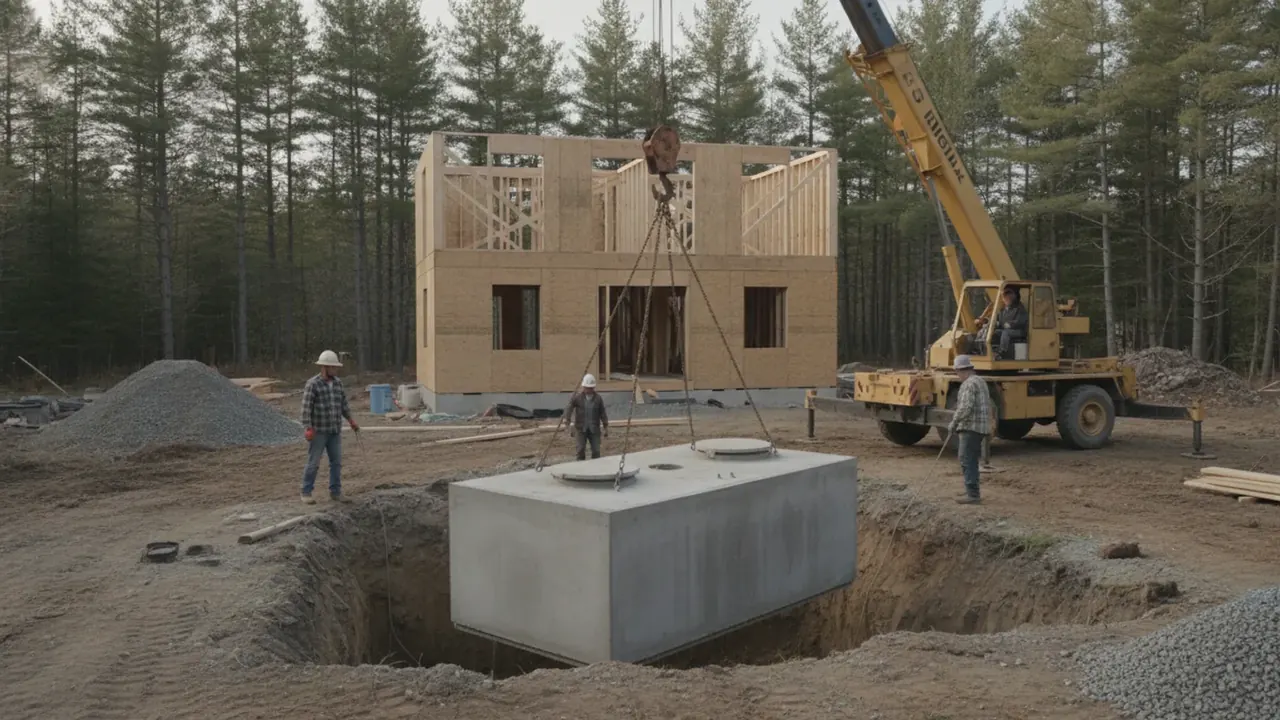
A residential septic tank is a rectangular box, usually concrete in older Maine systems. Think of a very small shipping container, buried. In many tanks, newer ones especially, an inside wall divides it into two compartments. Baffles sit at either end: these are the pipe fittings or short walls at the inlet and outlet that slow the incoming flow and keep floating scum and settled sludge from leaving with the water.
Here are the sizes you will most often run into. All are approximate outside dimensions for a standard precast concrete tank, and they vary by manufacturer.
| Tank size | Typical length | Typical width | Typical height | Notes |
|---|---|---|---|---|
| 1,000 gallon | about 8 feet | about 5 feet | about 5 feet | Common in 2 and 3 bedroom homes and many camps |
| 1,250 gallon | about 8 to 9 feet | about 5 to 6 feet | about 5 feet | Less common, sometimes used for 3 bedroom homes |
| 1,500 gallon | about 9 to 11 feet | about 5 to 6 feet | about 5 to 6 feet | Common in larger homes and newer builds |
The footprint of a 1,000 gallon tank is a bit bigger than a queen-size bed. The 1,500 gallon is longer, not much wider, and a little taller. Square or round tanks exist, but they are the exception.
Plastic and fibreglass tanks come in different shapes, often with a ribbed or rounded body. Their gallon rating is the same, but the outside dimensions will not match the concrete figures above. If you want the pros and cons of each material, see our post on plastic versus concrete septic tanks in Maine.
One more caution: a tank’s gallon rating usually means the liquid it holds up to the bottom of the outlet pipe, not the full inside volume of the box. There is air space above the liquid, and the walls and lid add more, which is why the outside of a tank is bigger than its gallon number suggests.
How deep is a septic tank buried in Maine?
The short answer: the top of the tank is commonly a foot or two below the surface, but it can be deeper. Add the tank’s own height of about 5 feet and the bottom of the box is often six or seven feet down, sometimes more.
Why the range? A few things decide it:
- The grade of the lot. If the house sits above the field, the tank may be set deeper so the pipe from the house can run downhill to it.
- Frost. Maine frost goes deep, and some tanks were set deeper to give the inlet and outlet pipes more cover.
- Ledge and groundwater. A shallow bedrock layer or a high water table can force a shallower set, or a raised system. See our posts on septic on ledge and high water table septic problems.
- Age. Older systems were installed by whoever was local, often without a record of the depth. Newer systems have a design on file.
Say you own a 1980s ranch in Hermon on flat ground. There, the lid might sit 12 to 18 inches down. Now say a camp on a slope near a Penobscot County lake had the tank set lower so the pipe from the camp could drop. That lid could be three feet or more under the dirt, and nobody would find it without a probe.
None of this is a rule. Your system might be shallower or deeper than any number here. Your town records or a visit are the real answers.
Why depth matters for pumping cost
A pumper’s hose reaches the tank through the cover, so a lid at grade is simple. A lid buried a foot or two down means someone has to find it and dig it out first.
The routine pump-out price for a 1,000 to 1,500 gallon tank with an accessible cover is $350 to $550. Digging for a buried cover is an added fee, and a deeper lid usually means more digging. The fix is a riser, a pipe collar that brings the access point up to the surface so the lid never gets buried again. We break down the economics in septic riser cost and whether it is worth it, so we will not repeat them here.
| What you have | What it means at pump-out |
|---|---|
| Lid visible at grade | Standard visit, no digging |
| Lid under a few inches of soil | Short dig, usually quick |
| Lid a foot or more down | More digging, added fee likely |
| Lid location unknown | Locating time first, then digging |
| Riser to the surface | No digging, every time |
Depth also matters in winter. Our winter pricing adds $100 to $300 on top of the routine rate, and frozen ground makes a deeply buried lid harder to reach. If your cover is deep, plan the pump-out for the warm months. A call to (207) 300-9238 before the ground freezes is easier than a scramble in January, and our post on winter septic pumping in Maine explains the trade-offs.
Depth, frost and freezing
A buried tank holds heat from the earth and from the warm water that flows through it, so a tank itself rarely freezes in a home that is lived in. The weak points are the shallow pipes, the lid area, and a tank with little soil cover.
Snow acts as insulation. A lawn that is plowed or packed down in winter loses that blanket, and frost can drive deeper. If you plow or drive over the area, read plowing and driving over a septic system in winter first. Our guide on whether a septic system can freeze in Maine goes through the risk and the fixes.
A lid that sits right at the surface can also be a cold spot. Some people think a deeper tank is always safer from freezing, and a deeper tank does have more cover, but the answer depends on the soil, the snow and how much water the house is using. A vacant camp with no flow is different from a family house with daily laundry.
How much does a septic tank weigh?
Heavy. An empty precast concrete tank in the 1,000 to 1,500 gallon range typically weighs several tons, and the figure varies by maker and wall thickness. A full tank weighs more again, because the water inside adds around 8 pounds per gallon.
This is why:
- Tanks are set with a truck-mounted crane or an excavator, not by hand.
- You should keep trucks, trailers and equipment off the tank area. Lids and walls are built to carry soil, not a loaded vehicle.
- A cracked lid or a collapsing old tank is a real hazard. Treat any soft spot or sunken patch over a tank as a safety issue and keep kids and pets away until it is checked.
Plastic and fibreglass tanks are much lighter, which is part of their appeal on sites where a machine cannot reach. They also need careful backfill, because an empty tank in wet ground can float.
If you see a sunken patch, a cracked lid or standing water over the tank, do not wait for the next pump-out. Call (207) 300-9238 and we can take a look.
How to estimate your own tank size
You do not need to dig to get a good estimate. Work through these in order:
- Look at the HHE-200. The Maine design form usually lists the tank size and often the layout. Check your town office or the records you got at closing. Our post on Maine septic records and the HHE-200 form explains where to ask.
- Check the pump-out receipt. The pumper usually records the gallons removed. If the number is about 1,000, that is a clue, though it is not exact because tanks are rarely pumped bone dry or filled to the brim.
- Look at the lids. A two-compartment tank often has two lids, one over the inlet and one over the outlet. The distance between them hints at the tank’s length, and a longer spread usually means a bigger tank. Treat this as a rough clue only, because lid spacing varies by maker.
- Count the bedrooms. The original design was based on the number of bedrooms. That tells you what size was required, not necessarily what was built, especially in older homes.
- Ask for a site visit. A pumper or inspector who opens the tank can see the actual compartments and baffles, and can tell you what they saw.
If you do not know where the tank is at all, start with how to find your septic tank. The location comes first, the size second.
Say you just bought an older house in Orrington and the seller says the tank is “a thousand, maybe”. Your inspector opens the lids, measures the length, and checks the receipt from the last pump-out. Together those give you a far better answer than the seller’s memory. That is what a septic inspection is for.
When the size on paper and the size in the ground disagree
It happens. A system gets upgraded, a tank gets swapped, and the paperwork never catches up. An old tank may be smaller than the code would require today, or it may be bigger than the form says.
If your records and your pumper disagree, we would take the pumper’s measurement first, since it comes from the actual tank. If the difference matters, for instance if you plan an addition, more bedrooms or a change from camp to year-round use, the next step is a licensed site evaluator, who designs systems and files the HHE-200, and your local plumbing inspector, who issues permits. We pump, inspect and locate tanks. We do not design or install them.
For a deeper look at how sizes are chosen and when a bigger tank makes sense, see the septic tank size guide. For how a system as a whole is meant to work, the EPA has a plain overview at How Septic Systems Work.
To keep the tank in good shape whatever its size, a regular pump-out every three to five years is the standard for most households. Your actual interval depends on household size and how much water you use.
Frequently Asked Questions
How big is a 1,000 gallon septic tank?
A typical 1,000 gallon concrete tank is roughly 8 feet long, 5 feet wide and 5 feet tall on the outside. Exact sizes vary by manufacturer, and fibreglass and plastic tanks have different shapes, so treat these as approximate.
How deep is a septic tank buried in Maine?
The lid is commonly a foot or two below the surface, though some sit deeper where the grade or frost depth called for it. The tank itself then extends several feet further down. Probing or checking your system records is the only way to know for your property.
How much does a concrete septic tank weigh?
An empty concrete tank in the 1,000 to 1,500 gallon range typically weighs several tons, and weight varies by maker and wall thickness. That is why tanks are set with a machine and why you should keep vehicles off the area.
Can I find my tank size without digging?
Often yes. Check the HHE-200 design form from your town or the state, look at the lid shape and spacing from the house, or ask your pumper how many gallons came out at the last pump-out. A site visit can confirm it.