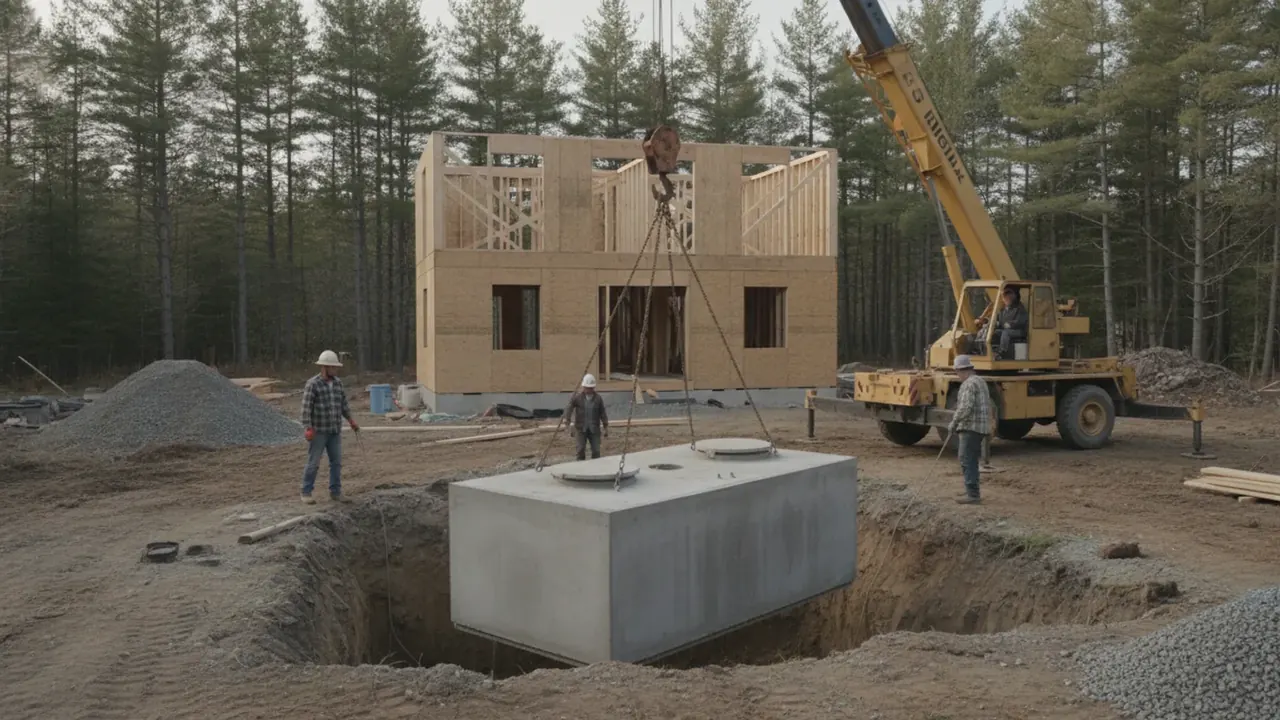
Picture a plastic septic tank popping halfway out of its hole after a wet spring pump-out, tilted like a canoe caught on a sandbar. That is buoyancy, and it is the single biggest reason the plastic vs concrete septic tank question plays out differently here than it does in a drier state. Maine’s frost, ledge and seasonal high water tables put real stress on a tank that a warm, dry climate never would.
If your tank needs replacing, or you are just trying to understand what is sitting under your yard, start with an inspection rather than guessing at material. Book a septic inspection or call (207) 300-9238 and we will tell you what is actually down there before anyone talks about swapping it out.
What Is Actually Under Your Yard: Concrete, Plastic, Fiberglass and Old Steel
Most tanks around Penobscot County are precast concrete, often split into two compartments so solids settle out before effluent moves on to the drain field. Newer builds and repairs increasingly use a polyethylene tank, a one-piece molded plastic tank that ships light and seals well. Fiberglass tanks show up less often but work on the same principle: a rigid shell instead of poured concrete.
Then there is the tank nobody wants to find: steel. Houses built roughly between the 1960s and 1980s sometimes still have a steel septic tank buried in the yard. Steel rusts through from the inside out, and a corroded lid or wall can collapse under a mower, a vehicle, or a person’s weight with no warning. If your camp or house falls in that build window and you have never had the tank located, that is worth checking before it checks itself.
Plastic vs Concrete Septic Tank Weight: Why Buoyancy Matters in Maine
An empty concrete tank weighs thousands of pounds. An empty plastic tank might weigh a couple hundred. That difference sounds like a plastic tank’s biggest advantage, easier to truck in and easier to set with smaller equipment, and on a tight access lot it often is.
But weight cuts the other way underground. Maine’s water table rises every spring with snowmelt and again after a heavy fall rain, sometimes to within a foot or two of the surface in low-lying or lakeside soil. Groundwater around an empty or mostly empty tank pushes up on it. A concrete tank’s mass holds it down. A lightweight tank with nothing inside it to counter that upward pressure can shift, tilt or in the worst cases work its way partway out of the ground, cracking pipe connections as it goes.
This is exactly why a pump-out on a plastic tank during a high water table period needs more care than routine. Some pumpers will leave a modest amount of liquid in a plastic tank rather than draining it bone dry, specifically to add ballast and prevent shifting while the ground around it stays saturated. Whether that is necessary depends on the tank, the season and the site, not a fixed rule.
Strength Under Load: Deflection and Collapse Risk
Concrete resists point loads well. A lawnmower, a plow truck backing across the yard, even a parked car, generally will not deform a properly installed concrete tank’s walls or lid.
A plastic or fiberglass tank relies on its shape and burial depth for strength rather than mass, and it can deflect, meaning the wall flexes inward, under a load that a concrete tank would shrug off. Manufacturers rate these tanks for burial and normal traffic when installed correctly, and that depends on proper backfill, correct depth, and keeping heavy vehicles off the area unless the tank and cover are rated for it. A cracked or crushed lid on any tank is a fall hazard, so plowing, driving or parking directly over a septic tank is worth thinking through regardless of material. If winter access to your tank worries you, our guide on plowing and driving over a septic system in winter walks through what is and is not safe.
Camp Lots, Ledge and Access: When a Lighter Tank Makes Sense
Plenty of camps around the lakes in Penobscot County sit at the end of a narrow, winding driveway that a concrete delivery truck and boom cannot reach, or on a lot where ledge sits close to the surface and blasting or extensive rock breaking would blow the budget. Picture a camp road too tight for a tandem-axle truck, with granite a couple feet down. A plastic or fiberglass tank, light enough to move by hand or with a small excavator, can be the only realistic option on a site like that.
This is a site-by-site call, not a rule of thumb. Ledge depth, driveway width, wetland setbacks and shoreland zoning near a lake or stream all factor in, and shoreland rules in particular can be stricter than the general state rule. None of that is something to guess at from a blog post. It is exactly what a licensed site evaluator assesses when designing your system and filing the HHE-200 form, and what your town’s local plumbing inspector checks before issuing a permit. For background on how that filing works, see our post on the Maine septic permit process.
Cracks, Joints and Roots: Where Concrete Struggles
Concrete’s weakness shows up over time rather than on day one. Precast concrete tanks are typically built in sections, with a joint where the base meets the walls or where a riser attaches. Those joints are sealed at installation, but sealant can degrade over decades, and a joint that lets in even a small amount of groundwater is also a spot roots can find. A maple or willow root system does not need much of a gap to sense moisture and start working its way toward it.
Root intrusion at a cracked joint or around an old baffle can partially block flow between compartments or into the outlet pipe, which shows up at the surface as slow drains or a tank that needs pumping more often than expected. It is a slower failure mode than the sudden float risk on a lightweight tank, but a real one, and one more reason routine pumping matters: it is also when a pumper gets eyes on the tank’s condition. If your tank has never been pumped or inspected, our post on how often to pump a septic tank in Maine covers the typical schedule.
What Your Pumper Sees, and Who Actually Picks the Material
When we open a lid, tank material changes how we approach the job more than most homeowners expect. A concrete tank generally pumps the same way regardless of season. A plastic tank during a high water table stretch gets handled differently, sometimes with liquid left as ballast as covered above, and always with more attention to how the tank sits once we are done, since a tank that shifts even slightly can strain the inlet and outlet pipe connections.
What we will not do is tell you which material to install. That decision sits with your site evaluator, who weighs soil type, water table depth, ledge and access, and with your local plumbing inspector, who has to approve the final design before anyone digs. We pump, inspect and service tanks of any material. We do not design, permit, sell or install them.
If a tank needs replacing, the box itself, meaning the concrete tank material only, typically runs $1,500 to $3,000. That is the tank alone, not installed. There is no published flat installed price for a tank-only replacement because it depends on excavation depth, how hard the access is, whether the inlet and outlet baffles need redoing, permit requirements, and what it costs to dispose of or abandon the old tank in place. Plastic and fiberglass tank prices vary too much by size and model to quote a range here; your evaluator or installer can price the specific unit your design calls for.
| Material | Weight and handling | Strength under load | High water table behavior | Typical issues |
|---|---|---|---|---|
| Concrete | Heavy, needs a delivery truck and boom or crane | Strong, resists vehicle and foot traffic | Resists floating due to mass | Joint sealant failure, root intrusion, cracking over decades |
| Polyethylene (plastic) | Light, movable by hand or small equipment | Can deflect under heavy or repeated load if underrated for the site | Can float or shift if pumped dry during high groundwater | Wall deflection, fittings pulling loose if the tank shifts |
| Fiberglass | Light to moderate, easier access than concrete | Rigid shell, generally holds shape well | Similar buoyancy risk to plastic, lighter than concrete | Gelcoat or shell cracking from impact, fitting wear over time |
| Steel (older tanks, 1960s-80s) | Light compared with concrete | Weakens as it corrodes, unpredictable | Can shift if empty in saturated ground, but corrosion is the bigger concern | Rust-through of walls and lid, collapse risk, generally due for replacement |
Deciding What Is Right for Your Property
If your system is old enough that you are not sure what material is down there, or if you are planning ahead for a replacement, the first step is the same either way: get eyes on it. Book a septic tank pumping or ask about a full inspection, and if the conversation turns toward replacement, the next real step is a site evaluation, not a material catalog. Our drain field repair page covers what happens when the rest of the system, not just the tank, is the problem, and our septic pumping cost calculator can give you a ballpark on routine service while you sort out the bigger question.
For a broader look at buoyancy and groundwater beyond just tank material, our post on Maine’s high water table and septic systems goes deeper. If cost for a full system rather than just the tank box is what you are trying to plan around, see new septic system cost in Maine. And if you are still working out what size tank your household actually needs, that is covered in our septic tank size guide for Maine.
For general background on how these systems work from a federal source, the EPA’s overview of types of septic systems and its guide on caring for your septic system cover the basics.
If a tank is visibly heaving out of the ground, a lid has failed, or sewage is backing up into the house, call (207) 300-9238 and we will get someone out same-day or next-morning, Sundays included. Otherwise, a routine inspection is the calmer way to find out what you are working with before winter sets in.
Frequently Asked Questions
Is a plastic septic tank better than concrete in Maine?
Neither wins outright. Concrete resists floating in high groundwater and holds up under vehicle traffic, while a plastic tank is lighter to move onto a hard-access camp lot. The right choice depends on the site, not a blanket rule.
Can a septic tank float out of the ground in Maine?
Yes, a lightweight empty tank can shift or float during spring snowmelt or a wet season when groundwater rises around it. Concrete tanks resist this because of their mass. It’s one reason a pumper may leave some liquid in a plastic tank in wet conditions.
How much does a concrete septic tank cost in Maine?
The concrete tank itself, the box only, typically runs $1,500 to $3,000. That figure doesn’t include excavation, pipe work, permitting or disposal of an old tank, since those costs depend heavily on site conditions.
Do I get to choose plastic or concrete for my septic tank?
The final call belongs to your licensed site evaluator and the local plumbing inspector who approves the design on the HHE-200 form. Site conditions such as water table depth, soil type and access usually narrow the choice before you ever see it.