You bought a camp on a quiet pond north of Bangor, and out back there’s a leaning outhouse with a moon cut in the door. Is it legal, is it safe, and what happens if you want to keep it? The short answer is that Maine still has a place for the pit privy, but the decision belongs to your town’s local plumbing inspector, not to you or to us.
This guide covers what an outhouse really is under Maine’s rules, why water near a camp changes everything, how to close one properly, and what to do when one is failing. If you’ve got sewage showing up anywhere it shouldn’t, skip ahead and call (207) 300-9238 today.
What Counts as an Outhouse or Privy in Maine?
A privy is a small building over a pit or vault that takes toilet waste only. There’s no flush and no water line. Waste drops into the ground or into a sealed container, and the soil does the treatment work on whatever liquid seeps out.
People use several words for it: outhouse, privy, pit privy, “the necessary.” Those are mostly the same thing, with one important split. A pit privy is open at the bottom, so liquid soaks into the soil. A vault privy has a sealed box (concrete or plastic) under the seat, so nothing leaks out and the box has to be emptied.
That split matters for everything below. An open pit is a small disposal system. A sealed vault is closer to a holding tank, and we cover the camp tradeoffs there.
Are Outhouses Still Allowed in Maine?
Yes. Maine’s plumbing and wastewater rules, the Subsurface Wastewater Disposal Rules (10-144 CMR 241), list the pit privy and the vault privy as “alternative toilets,” and they’re most common at camps with no flush toilet. It isn’t a free pass, though. The rules require a permit to install one, and a pit privy is treated like a small disposal field: it needs a site evaluation, it has to keep the same setbacks as a disposal field, and the bottom of the pit has to stay far enough above the water table and bedrock. A sealed vault privy has to meet septic tank setbacks instead. Whether your lot can have one comes down to the site and what your town’s inspector says.
Here’s who does what, so you know whom to call:
- Local plumbing inspector (LPI): your town’s official who issues permits and inspects. For a privy, this is your first call.
- Licensed site evaluator: the person who studies the soil and prepares the permit application (the HHE-200 form). A new pit privy needs one because the pit drains into the soil. We don’t do this work.
- Maine DEP: the state agency that licenses septage haulers and regulates septage disposal. Its main site is at maine.gov/dep.
We pump, inspect and maintain systems. We aren’t the permit authority for a privy, and we won’t tell you your outhouse is approved. What we can do is tell you what we see when we’re out there.
One more warning. A privy that was fine in 1965 may not be fine today. If it was built before the current rules and is still working, it may be treated as an older, existing setup, much like the situation in our piece on grandfathered septic systems. Rebuilding or moving it is where the inspector gets involved.
Why Water Changes the Rules at a Camp
Maine is lake and river country, and the closer a privy sits to water, the more attention it gets. A pit puts untreated waste into the ground. Near a pond, a stream or a high water table, that waste can travel to the water instead of being filtered by soil.
Shoreland zoning adds its own limits near lakes, rivers and wetlands. We won’t quote a setback here, because the number depends on the water body and the town, and it’s easy to get wrong. Your LPI will know the real figure for your lot. Our post on shoreland zoning and septic in Maine explains how those rules work in plain words.
Say you have a camp on a Penobscot County lake, and the old privy sits on a low, wet shelf about as far from the water as you can stand. A dry summer might hide the problem, but a wet May is when a shallow pit floods. That’s the kind of site where an inspector may steer you toward a sealed vault or a holding tank rather than an open pit.
Wells are the other concern. If a camp has a drilled or dug well, the privy and the well must be kept well apart. Our post on well and septic distances in Maine covers the idea, and your LPI gives the real number.
A Privy Is Not a Place for Grey Water
This is a common mistake at camps. Maine’s rules say a pit privy takes human waste and toilet paper only. Dishwater, shower water and laundry water, called grey water, don’t belong in it.
Grey water carries soap, grease, food scraps and bacteria. Poured into a pit it can overload the soil, and poured onto the ground near a lake it can wash straight in. The rules handle it separately: a camp with a privy and hand-carried or hand-pumped water can have a small permitted grey water field, and a camp with a pressure pump can keep the privy only if the grey water goes to its own permitted system with a septic tank or filter. Either way, that’s a site evaluator design and an LPI permit.
| What you’re doing | Privy okay? | What the camp likely needs |
|---|---|---|
| Toilet use only, no running water | Possibly, with a permit | A permitted pit or vault privy |
| Hand pump or carried water to a sink or shower | Toilet waste only | Privy plus a small permitted grey water field |
| Pressurized water to a sink or shower | Toilet waste only | Privy plus a permitted grey water system, or a full septic system |
| Flush toilet added | No | Holding tank or a full septic system |
| Privy replaced by a full system | Not needed | A design that meets the rules for a first-time system |
If you’re stepping up from seasonal to full-time use, read converting a camp to year-round septic before you spend money on anything. A grey water option may exist for some camps, and we cover it in a separate post, but it still needs permitted disposal.
Pumping a Privy: What Can and Can’t Be Done
People often ask whether the pit can just be pumped out like a septic tank. It depends on which kind you have.
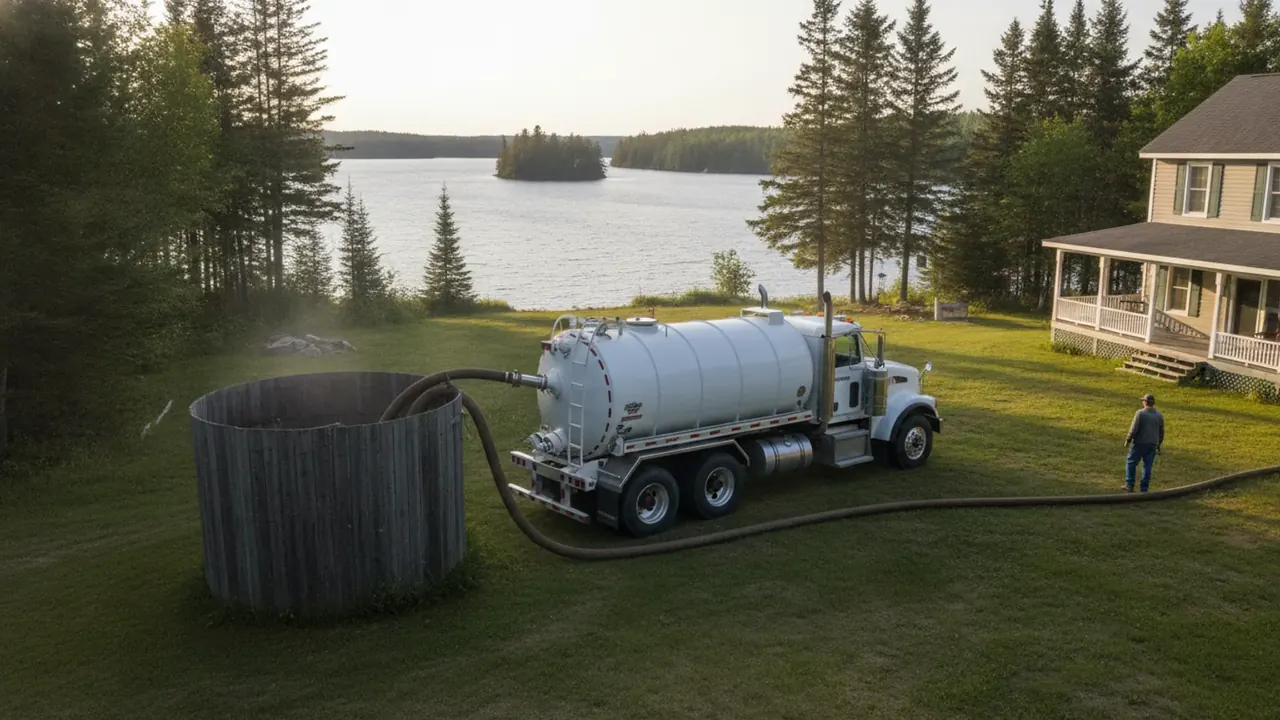
A sealed vault is a container, so it can often be pumped. Whether we can reach it, and whether the hose can reach from where the truck parks, depends on the road and the path. A camp road in April mud season may not take a truck, and some camps need pumping after the ground firms up.
An open pit is different. The contents are mostly solids that have settled and composted in place, and there are no tank walls to pump from. Pumping rarely works well. If your pit is full, the usual answer is to close it and build a new one in a new spot, or to move to a sealed vault, and either one needs a permit from your inspector.
When you call to ask about a privy, tell us:
- Whether it’s a sealed vault or an open pit.
- How far a truck can get from the building.
- Whether the ground floods in spring.
- When it was last emptied or rebuilt.
Pricing for a vault depends on volume and access, so we quote it after we hear the details. For reference, a routine pump-out of a standard 1,000 to 1,500 gallon tank with an accessible cover runs $350 to $550, and a vault is a different job. Our general guide to septic pumping cost in Maine shows how those numbers build up.
Closing an Old Privy the Right Way
Maybe you’ve added a bathroom, or you’ve bought a camp and the privy is leaning. Don’t push the building over the hole and call it done. An abandoned pit is a safety hazard (a child or a dog can fall into a soft, rotten cover) and a pollution source.
The exact steps depend on the site and your town, so ask your inspector what they require. In general, closing a pit involves taking the building off, treating or removing the contents as directed, filling the hole with clean soil, and marking where it was. Write the location down for your records and for whoever buys the camp next. Buyers and inspectors both ask, and an unmarked old pit is a real problem. If you’re selling, the guide on buying a house with septic in Maine shows how these things come up.
If you aren’t sure whether you have a privy pit or something older, like a cesspool (a buried pit that takes household wastewater, with no real treatment), read our post on cesspools in Maine. Cesspools are a bigger issue than privies, and they’re often hiding under old camps.
What to Do When a Privy Is Failing
Say you own a camp near Old Town or up toward Lincoln, and the privy has started to smell strong in wet weather. Or the seat has sunk. Or you’ve noticed green, wet ground downhill from it. Those are signs it’s overloaded, flooded or leaking.
Here’s a sensible order:
- Stop using it if the pit is overflowing or the ground around it is wet and foul.
- Keep people and pets away from the area, and keep it away from your water source.
- Call your LPI about whether it can be repaired, moved or replaced.
- Call us if it’s a vault that needs emptying, or if you want someone to look over the camp’s setup. Our septic inspection can include a look at the tank and field if the camp has them.
If sewage is surfacing or backing into a building, that’s an emergency. Call (207) 300-9238, and we’ll tell you how soon we can get there. Emergency response is same-day or next-morning, Sundays included, and our emergency septic service page explains what to expect. Emergency or after-hours pricing runs $650 to $850.
A permanent fix for a camp with water usually means a holding tank or a new system. A new or replacement system runs $12,000 to $40,000 or more, with most conventional replacements at $12,000 to $25,000. The site evaluator and licensed installer do that work, not us. Our new septic system cost guide breaks the price down.
Your Next Step
If you own an outhouse, make three calls in this order. First, your town’s LPI, to ask what’s allowed on your lot. Second, a site evaluator, if the LPI says your lot needs a design. Third, us, if you’ve got a vault or a tank that needs emptying or a look.
For general background on how septic systems work and how to look after one, the EPA’s guide on how to care for your septic system is a good plain-language read. If you’d like us to look over a camp’s setup, book a visit and tell us what’s out back. For the full picture on camp setups, see holding tank versus septic at a Maine camp and our camp opening and closing service.
Frequently Asked Questions
Is an outhouse legal in Maine?
Yes. Maine rules list pit privies and vault privies as alternative toilets, but a permit is required to install one. A pit privy needs a site evaluation and has to meet disposal field setbacks, so ask your local plumbing inspector before you build or rebuild one.
Can I put sink or shower water into an outhouse?
No. A privy is for toilet waste only. Water from sinks, showers and laundry is grey water and needs its own permitted grey water field or system, designed by a site evaluator. A camp that adds a flush toilet needs a holding tank or a full septic system.
Can an outhouse be pumped?
A sealed vault privy can often be pumped, much like a small holding tank. An open pit generally can’t be pumped well, because the contents aren’t liquid and the pit has no tank walls. Ask before booking so the right equipment shows up.
What do I do with an old outhouse I no longer use?
Don’t just push the building over the hole. An abandoned pit should be closed properly, and the steps depend on the site and the town. Ask your local plumbing inspector what they require before you fill it in.