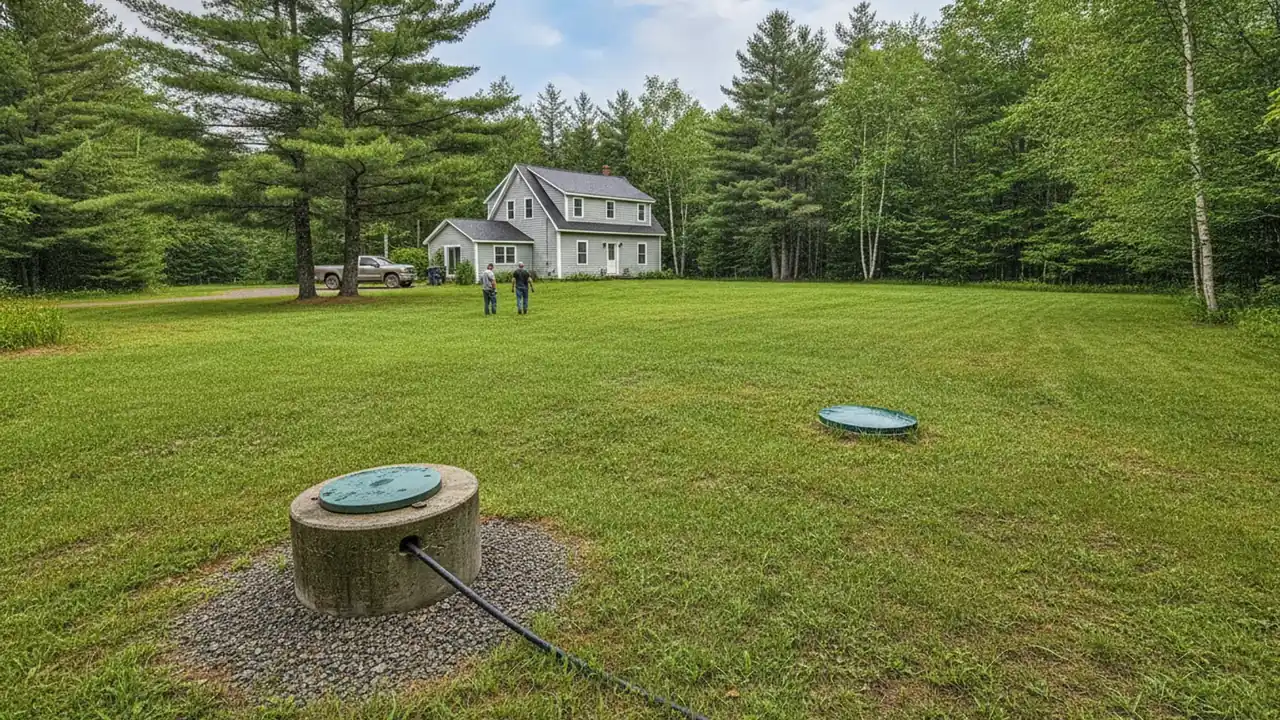
Dave in Hampden bought a camp on a half-acre lot with the well on the north corner and the septic field tucked along the tree line to the south. He never measured the distance between them until he tried to sell the place ten years later, and the site evaluator came back with a number that made his stomach drop: 61 feet. Not even close to legal. He had been drinking that water the whole time, and it had never once been tested.
That is the risk hiding in plain sight on a lot of older Maine properties. The state requires at least 100 feet between a well and a septic system, full stop, and that number exists for one reason: to keep what comes out of your toilet from ending up in what comes out of your tap. If your well and your field are closer than that, or you simply do not know the distance, it is worth figuring out today, not when a bank appraiser or a home inspector forces the question.
Why 100 Feet Is the Number
Effluent leaving a septic tank is not sterile. It carries bacteria, viruses, and nitrates, and the whole design of a drain field depends on soil doing the work of filtering that material out before it reaches groundwater. Soil is good at this job, but it is not infinite. Give it enough distance and enough unsaturated depth, and by the time water reaches a well 100 feet away, the dangerous stuff has mostly been broken down or filtered out.
Give it 60 feet, or 40, or run it through cracked ledge instead of packed soil, and that filtering never finishes. Bacteria and nitrates can travel through fractured bedrock far faster than they move through sand or loam, which is part of why so much of Penobscot County’s terrain makes this setback more than a bureaucratic formality. A well pulling water from a fractured rock aquifer under a tight lot is drinking from the same plumbing system as the septic field, just with extra steps.
The Maine Setback Table
The Maine Subsurface Wastewater Program sets minimum horizontal separation distances for septic components. Here is the practical version of the table homeowners actually need:
| Component | Minimum distance from a drilled well | Minimum distance from a dug well |
|---|---|---|
| Septic tank | 50 feet | 75 feet |
| Drain field / leach field | 100 feet | 100 feet |
| Holding tank | 50 feet | 75 feet |
| Property line | 10-25 feet (varies by component) | 10-25 feet |
| Surface water (lake, stream) | 75-100 feet, shoreland zones often more | 75-100 feet |
Dug wells get extra distance because they draw from shallower groundwater and have a wider intake area, both of which make them easier to contaminate. If your property has a dug well, treat every one of these numbers as a floor, not a target. For the full regulatory language, the Maine Subsurface Wastewater Program publishes the current rules, and the EPA’s septic system guidance covers the drinking water side of the same issue.
What Counts as “Too Close” in the Real World
The 100-foot rule is a legal minimum, not a guarantee of safety. A few conditions push the actual risk higher even when the measured distance technically passes:
Slope working against you. If the septic field sits uphill from the well, even at 100 feet, gravity is doing the well no favors. Groundwater and surface runoff both tend to move downhill, so a well downslope from a field is catching more of whatever escapes than a well on flat ground or uphill.
Shallow bedrock or ledge. A lot of lots around Old Town, Glenburn, and Hermon sit on thin soil over ledge. When effluent hits rock instead of soil, it moves through cracks and fissures far faster than the 100-foot rule assumes, sometimes reaching a well that is technically outside the setback.
A dug well instead of a drilled well. Dug wells are shallow, wide, and drink from the water table directly. They are far more vulnerable to a nearby septic system than a drilled well tapping a deeper aquifer.
An old or failing system. A drain field that is clogged, oversaturated, or pushing effluent to the surface is sending more contamination further than a healthy field would, regardless of the measured distance. If your field is already showing trouble, the setback distance matters less than fixing what is going on underground.
Tight Lots: What Are Your Real Options
Plenty of older camps and in-town lots around Bangor, Brewer, and Veazie were built long before modern setback rules existed, and moving either the well or the field is not always possible on a small parcel. If you are stuck with tight numbers, here is what typically happens next.
Get a licensed site evaluator to measure and document the actual distance. Guessing does nobody any good. A site evaluator can tell you exactly what you are working with and whether a variance is realistic given your soil and slope.
Ask about a variance. In some cases the Maine Subsurface Wastewater Program will approve a reduced setback if the system design compensates, often with a raised bed, an engineered system, or additional treatment components. Approval is not automatic, and it usually costs more upfront than a standard system.
Consider relocating the smaller piece. Moving a drain field is a major project, but moving a well is sometimes more affordable, especially if a drilled well can be sunk deeper and farther from the field rather than digging a new shallow one in the same spot.
Add water treatment as a backstop, not a fix. A UV filter or chlorination system can knock down bacteria in water that is already close to a marginal septic setback. It does not solve the underlying distance problem, but it buys margin while you plan a longer-term fix.
Know your soil before you assume anything. How septic systems work covers how a field actually filters effluent, which helps explain why sandy soil forgives tighter setbacks better than clay or ledge ever will.
Testing Your Well: What to Actually Do
You cannot see, smell, or taste bacterial contamination in most cases. The only way to know your well is safe is to test it.
Test for total coliform and E. coli at least once a year. This is the baseline test that catches bacterial contamination from a septic system or any other source. Most county health departments and private labs in the Bangor area offer this test for a modest fee.
Add a nitrate test if your well sits within 200 feet of any septic field. Nitrates are a slower-moving but longer-lasting indicator of septic influence on groundwater, and they matter especially for infants and pregnant women in the household.
Test again after any heavy rain event or spring thaw if you already have tight setbacks. Saturated ground moves contamination faster and further than dry ground does. If your well and field are close, a wet spring is exactly when you want a fresh sample.
Test immediately if you notice a change in taste, smell, or color. A sudden change is not proof of septic contamination, but it is reason enough to stop drinking the water until you know.
Linda in Orono found out her well had elevated coliform levels the same week she noticed her drain field was staying wet longer than usual after rain. The two were connected — a field that was starting to fail was sending more untreated effluent toward a well that sat right at the edge of the legal setback. Fixing the field solved both problems at once.
When the Setback Question Comes Up
This distance matters most at a few specific moments, and it is worth being proactive rather than finding out the hard way like Dave did.
Buying or selling a property. Maine’s inspection laws around selling a house do not always require a well-to-septic distance check by default, but a smart buyer or seller asks for one anyway, especially on older rural lots. If you are the one buying, our guide on buying a house with a septic system in Maine covers the other red flags worth checking at the same time.
Installing or replacing a system. Any new septic install requires a soil test and site evaluation that accounts for well placement from the start. Our septic soil test and site evaluation guide walks through what that process looks like.
Adding a well to a property that already has septic, or vice versa. New construction, a second well for irrigation, or a new camp building on the same lot all need the same setback math run again before anything goes in the ground.
After any system failure or repair. If your drain field just failed or needed major work, it is a good time to double check that your well is still a safe distance away and get a fresh water test while you are at it.
Bottom Line
A hundred feet is not an arbitrary number pulled out of a state handbook — it is the distance Maine’s own soil science says it takes for a septic system to stop being a threat to a well. If you do not know your actual distance, or you suspect your lot is tighter than that, get it measured before you assume your water is fine. And if your setback is legal but your field has been acting up, do not wait for a water test to tell you what a site visit could catch first.
Not sure where your well and septic actually stand, or want a straight read on your system before you worry about the water? Call us at (207) 300-9238 or book a septic inspection online and we will tell you exactly what is going on underground.
Frequently Asked Questions
How far does a septic system need to be from a well in Maine?
Maine state rules require a minimum of 100 feet between a drilled well and a septic tank or drain field, and at least 100 feet from a dug well as well, though local shoreland zoning or difficult soils can push that distance higher.
What happens if a septic system is too close to a well?
Effluent can migrate through soil or bedrock fractures and reach the water table that feeds the well, introducing bacteria such as coliform and E coli along with nitrates, which makes the water unsafe to drink without treatment or a new well.
Can you get a variance for a septic system closer than 100 feet to a well?
In some tight-lot cases a licensed site evaluator can apply for a variance through the Maine Subsurface Wastewater Program, often paired with design changes such as a raised or engineered system, but approval is not guaranteed and depends on soil and slope conditions.
How often should I test my well water if I have a septic system nearby?
Most Maine health officials recommend testing well water for bacteria at least once a year, and adding a nitrate test if the well sits within 200 feet of a septic field or the property has a history of tight setbacks.