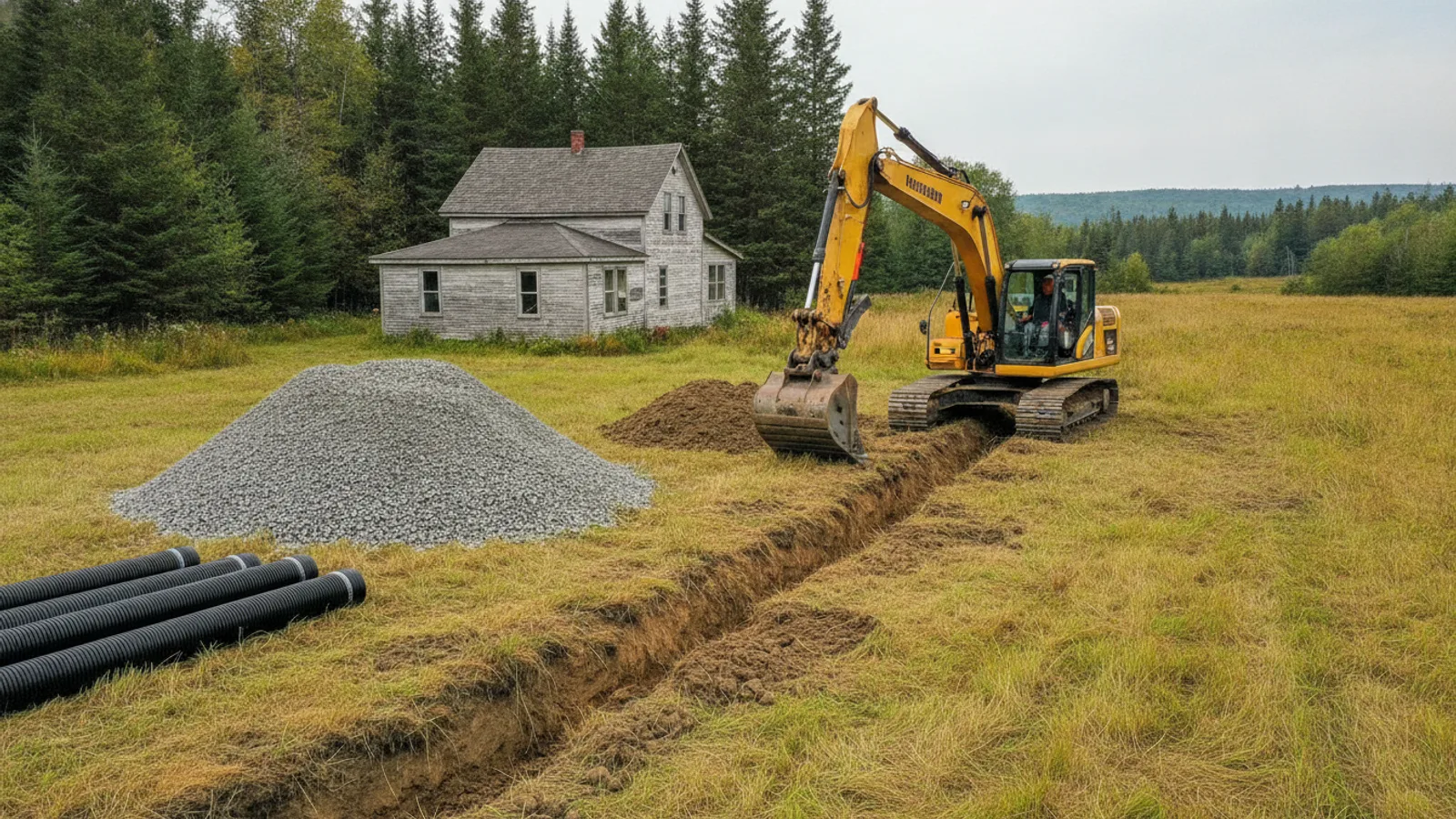
Dave in Hampden got a number he did not expect. His 1987 system failed the inspection when he went to sell, and the first quote back was $38,000. He nearly called off the sale. Then he got two more quotes: $16,500 and $19,200. Same lot, same house, wildly different numbers — because the first contractor was speccing an engineered mound system before anyone had even dug a test pit, and the other two waited for soil results first.
That is the honest answer to “what does a new septic system cost in Maine”: somewhere between $12,000 and $40,000+, and the only way to know which end you are on is to test the soil. A straightforward conventional gravity system on decent sandy loam might land at $14,000 to $18,000 installed. Put that same house on ledge, clay, or a high water table, and you are building an engineered system that can run $30,000 to $45,000. The tank barely moves the number. The dirt does.
Why the Price Range Is So Wide
A septic system has two jobs: hold the solids (the tank) and let the liquid soak safely back into the ground (the leach field). The tank is a commodity — a 1,000 or 1,250-gallon concrete tank costs roughly the same whether you are in Bangor or Bar Harbor. The field is where the real money lives, because it has to be custom-built to whatever soil you actually have.
Penobscot County soil is a grab bag. Some lots along the Penobscot River have decent sand and gravel that percs well. Plenty of others — especially up toward Old Town, out past Glenburn, or anywhere near ledge outcrops — have tight clay, shallow bedrock, or seasonal high water tables that a standard trench system cannot handle. When that happens, the state requires an engineered alternative, and that is where costs jump.
What Drives the Bill
| Factor | Low-cost scenario | High-cost scenario |
|---|---|---|
| Soil type | Sandy loam, good percolation | Clay, hardpan, or high water table |
| Ledge/bedrock | None encountered | Requires blasting or fill |
| System type | Conventional gravity | Engineered mound or pressure-dosed |
| Lot size/setbacks | Plenty of room | Tight lot, well or water setbacks |
| Site access | Flat, easy excavator access | Steep, wooded, or ledge-heavy access |
| Permitting | Standard local plumbing inspector review | Requires licensed site evaluator + engineer stamp |
A soil test and site evaluation, done before anyone digs a shovel of dirt, is the single best money you will spend on this project. It tells you which column of that table you are in before you commit to a number.
Cost by System Type
Here is roughly what Bangor-area homeowners are paying in 2026, all-in with permitting, excavation, materials, and labor.
| System type | Typical installed cost | When it is required |
|---|---|---|
| Conventional gravity | $12,000 – $20,000 | Good soil, adequate depth to water table/ledge |
| Pressure-dosed conventional | $18,000 – $26,000 | Marginal soil, needs a pump to distribute flow evenly |
| Mound system | $25,000 – $38,000 | Shallow soil over ledge or water table, needs built-up sand |
| Engineered/proprietary system (e.g., advanced treatment unit) | $28,000 – $45,000+ | Very poor soil, small lot, or shoreland zoning near a lake |
| Holding tank (no leach field) | $6,000 – $12,000 to install, but ongoing pumping cost | Camps or lots where no field is feasible at all |
A few things that move a number within any of those bands: how far the truck and excavator have to travel down a rural road, whether the driveway needs to be torn up to reach the tank, and whether you are replacing an undersized old system with a properly sized one for your actual bedroom count. Our guide on choosing the right tank size for a Maine home walks through how bedroom count and water usage set the minimum size the state will approve.
Why the Leach Field Costs More Than the Tank
People assume the tank is the expensive part because it is the part you can picture — a big concrete box in the yard. In reality the tank is often 10-15% of the total bill. The field is the rest, because:
- It has to be engineered to your specific soil, not a generic size. A licensed site evaluator digs test pits, checks how fast water moves through the soil, and measures depth to the water table or ledge. That report drives the design.
- Poor soil means more material. A mound system, for example, requires trucking in specific sand to build an artificial soil layer above your natural ground — that is a lot of truck trips before a single pipe goes in.
- Bad access means more labor hours. A wooded lot with a narrow driveway takes an excavator crew twice as long as an open field.
Linda in Orono replaced her field two years ago and was surprised the tank swap itself took an afternoon, while the field work took four days. That ratio is normal. If a contractor quotes you a number that sounds suspiciously low, ask specifically what soil testing they did — a lowball bid that skips the site evaluation is the tell that they are guessing, and you will pay the difference later in change orders.
What Drives Timing and Permitting
Maine requires a permit through the local plumbing inspector before any new system goes in, and for anything beyond a basic conventional system, a licensed site evaluator’s design gets submitted along with it. That process typically adds two to six weeks before a shovel touches dirt, and our guide to the Maine septic permit process walks through the steps and fees, longer if the lot needs a variance for setbacks from a well, a property line, or a lake.
Mud season (late March through May) and frozen ground (December through March) both slow installs in Penobscot County — contractors either cannot get equipment onto soft ground or cannot dig through frost. If your system is failing and you can see the writing on the wall, starting the permitting process in fall gives you a shot at spring installation instead of waiting behind everyone else who waited until their field actually failed. The Maine Subsurface Wastewater Program oversees this permitting statewide, and the record of your system once it is built gets filed as your HHE-200 form — worth keeping a copy of for the next owner.
Financing and Timing the Replacement
A $20,000-plus bill is not something most households have sitting in a checking account. Common ways homeowners cover it:
- Home equity line of credit, usually the lowest interest option if you have equity.
- Contractor payment plans, which some Maine septic installers offer directly.
- USDA Rural Development loans, aimed at rural homeowners replacing failed systems, sometimes with reduced rates for lower-income applicants.
- Personal loans, faster to close but higher interest than a HELOC.
If your system is not failed yet but is showing its age, the smartest financial move is to get ahead of it rather than wait for an emergency. A system that is nearing the end of its life gives you time to shop three quotes and choose your season. A system that fails on a Saturday during a house sale gives you none of that leverage — see our breakdown on how long a septic system typically lasts in Maine for a sense of where your system’s age puts you.
The Cheapest Insurance You Have: Routine Pumping
None of this replaces the cheapest thing you can do to protect the system you already have. A $300 to $500 pump-out every two to four years keeps solids from ever reaching the leach field. Once solids get into the field itself, that damage is almost always permanent — there is no fixing a clogged field, only replacing it. Compare a few hundred dollars every few years against a $20,000-plus replacement and the math is not close.
If you are not sure when your tank was last pumped, that is the first call to make, not the last. We can check your tank, tell you honestly whether pumping now buys you more years or whether you are already looking at field failure, and walk you through next steps either way. Get a ballpark on the front end with our septic pumping cost calculator, or call (509) 351-8404 to get on the schedule.
Frequently Asked Questions
How much does a new septic system cost in Maine in 2026?
Most full septic system replacements in the greater Bangor area cost between $12,000 and $25,000 for a conventional gravity system. Engineered systems such as a mound or pressure-dosed design typically run $25,000 to $40,000 or more, mainly because of poor soil, ledge, or a tight lot.
Why is the leach field the most expensive part of a septic system?
The tank itself is a commodity, usually $1,500 to $3,000 for the concrete box. The leach field is custom engineered to your soil, your lot size, and your setbacks, which means excavation, stone, pipe, and often an engineer-stamped design. That labor and material adds up fast, especially if the soil cannot handle a simple gravity trench.
Can I finance a new septic system in Maine?
Yes. Many homeowners use a home equity line of credit, a personal loan, or a contractor payment plan. Some Maine towns and USDA rural development programs also offer low-interest loans for failed system replacement, particularly for older or lower-income homeowners.
Does regular pumping delay the need for a full replacement?
Yes, significantly. Solids that are never pumped out eventually wash into the leach field and clog the soil permanently. A tank can be pumped for a couple hundred dollars for decades, but a clogged field usually cannot be repaired and forces a full replacement.