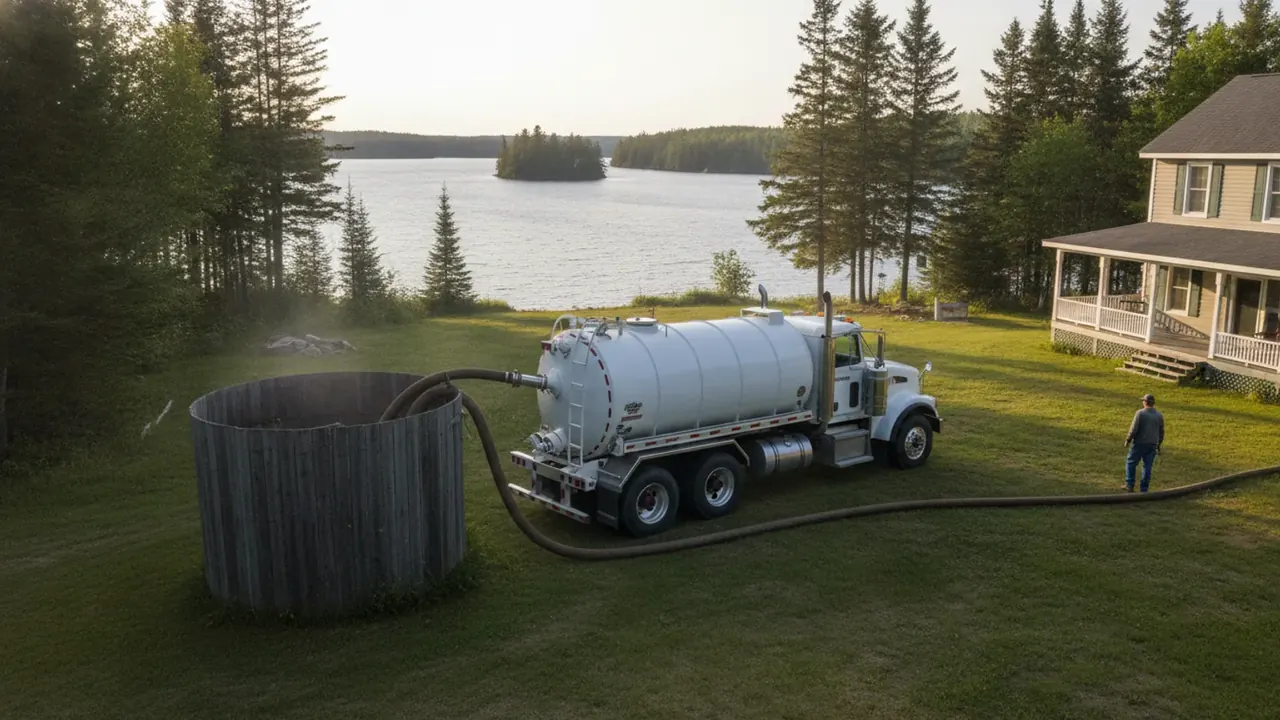
Dave in Hampden bought his grandfather’s camp on the water and figured it had a septic system like every other house he’d owned. It didn’t. It had a 1,000-gallon plastic box buried by the shed with a float alarm wired to a light on the porch, and nothing else. No drain field, no leach lines, nothing treating the water at all. The first time that alarm went off two days into a long weekend with his in-laws visiting, he learned the hard way what a holding tank actually is. It’s not a septic system. It’s a bucket with a truck on speed dial.
If you own or are buying a camp near a Maine lake or river, you need to know which one you have, because they are not interchangeable and they don’t cost the same to live with.
The Core Difference, In Plain Terms
A septic system is a small treatment plant. Wastewater flows into the tank, solids settle, bacteria break down what they can, and the clarified liquid disperses out into a drain field where the soil finishes the job. Once it’s sized right and pumped on schedule, you barely think about it. Our guide on how septic systems work in Maine covers that process if you want the full picture.
A holding tank treats nothing. It’s a sealed, watertight vessel that stores everything — solids, liquids, all of it — until a truck comes and pumps it out completely. There’s no leach field, no soil absorption, no biological breakdown happening inside. It’s pure storage, and storage has a ceiling.
That difference sounds academic until you’re the one watching the water level. Here’s the honest comparison:
| Septic System | Holding Tank | |
|---|---|---|
| Treats wastewater on site | Yes | No |
| Needs a drain field | Yes | No |
| Pump-out frequency | Every 3–5 years, typical use | Every 1–3 weeks in season, heavy use |
| Typical install cost | Higher upfront | Lower upfront |
| Ongoing cost | Low, predictable | Higher, usage-driven |
| Where it’s allowed | Where soil and setbacks permit | Where a leach field is not possible |
| Overflow risk | Backup into house | Overflow onto ground or toward water |
When Maine Law Forces the Choice For You
Nobody picks a holding tank because they like paying for frequent pump-outs. It gets chosen, or more accurately assigned, when a standard septic system physically cannot be permitted on the lot.
Shoreland zoning setbacks eat up the buildable area. Maine’s shoreland zoning rules require a drain field to sit a minimum distance back from the high water mark of a lake, pond, river, or stream — often 100 feet or more depending on the water body and local ordinance. A lot of older camps around places like Old Town or Orono were built decades before those rules existed, sitting close to the water on a narrow lot with no room left for a compliant field once you measure back from the shoreline.
The soil won’t perc. Ledge close to the surface, heavy clay, or a water table that sits high for most of the year can all disqualify a site. A site evaluation and soil test — which any licensed site evaluator has to run before a system gets designed — either confirms a drain field will work or rules it out. If that test comes back bad and there’s no alternative location on the lot, a holding tank becomes the only legal path to running water in the camp.
The lot is just too small. Some camp lots, especially older ones platted before modern minimum lot sizes, don’t have the square footage for a code-compliant field no matter how good the soil is.
When any of those conditions apply, the Maine Subsurface Wastewater Program (the state agency that governs septic design, found at maine.gov/dhhs/mecdc/environmental-health/plumb) permits a holding tank as the fallback option specifically for situations where nothing else will work. It’s not a workaround — it’s the designed solution for camps and shoreland lots that can’t support a drain field.
The Real Cost Isn’t the Tank. It’s the Truck.
Installing a holding tank is often cheaper upfront than a full septic system, since there’s no field to excavate, no distribution box, no leach lines to lay. But that upfront savings gets eaten by the ongoing reality: every gallon that goes down the drain has to leave the property in a truck, and someone has to pay for that truck.
A modest camp used by a couple on weekends might only need pumping a handful of times a season. A busy family camp on a lake, with kids, showers, and a full house every weekend from Memorial Day through Labor Day, can fill a 1,000-gallon holding tank in one to three weeks. That’s not a one-time cost, it’s a recurring line item all summer long. Compare that to a properly sized septic system on the same camp, which might only need a pump-out once every three to five years, and the math over a decade tips heavily toward the septic system — if the lot can even support one.
Linda in Orono runs the numbers every June before her family arrives for the season. She keeps a simple log of pump-out dates on the fridge, because guessing wrong on a holding tank doesn’t mean a slow drain — it means an alarm going off at 11pm on a Saturday with a house full of guests.
Pump Scheduling Discipline Is Not Optional
With a septic system, missing a pump-out by a year is usually forgivable. The tank has margin, and the drain field keeps working even if the tank is a little fuller than ideal. With a holding tank, there is no margin. The tank has a fixed capacity, a float switch, and a wire running to an alarm — and once it’s full, it’s full. There’s nowhere else for the waste to go.
Know your tank size and your household’s daily usage. A 1,000-gallon tank serving four people showering, washing dishes, and running a toilet regularly fills faster than most people expect. Do rough math before the season starts, not after the alarm trips.
Treat the alarm as a hard deadline, not a suggestion. If the high-water alarm goes off, that means the tank is at or near capacity right now, not sometime this week. Waiting risks an overflow — untreated sewage pooling on the ground or moving toward the water, which near a lake or stream is both a serious health hazard and a shoreland code violation that can bring real consequences.
Book pump-outs ahead of holiday weekends, not during them. The camps that call us in a panic on a Friday of a holiday weekend are almost always the ones that didn’t schedule around known heavy-use stretches. If you know fifteen people are showing up for the Fourth of July, get the tank pumped a day or two before, not after the alarm is already blinking.
Never try to check the tank level yourself by opening it. The gases inside any sealed sewage tank, holding tank included, can be lethal in seconds. Leave the lid alone and call a licensed crew to check and pump it — every time, no exceptions.
If your camp’s holding tank schedule has become a source of summer stress, it’s worth having someone take a real look at whether a septic system is possible on your lot after all — soil conditions, setback measurements, and lot layouts sometimes change what’s allowed compared to when the camp was first built decades ago.
Closing Up for the Season
Whichever system your camp has, both need proper attention before you shut the water off for winter. A holding tank left partially full can freeze and crack over a Maine winter just like a septic tank can. Our camp opening and closing checklist walks through what to do on both ends of the season so you’re not troubleshooting a frozen or overflowing tank the first warm weekend of next May.
Get a Straight Answer for Your Camp
If you’re not sure whether your camp has a septic system or a holding tank, or you inherited one and nobody left instructions, don’t guess. Give us a call at (207) 300-9238 and we’ll help you figure out what’s out there and what it needs. If you already know it’s a holding tank and you’re trying to get ahead of a busy season, book a pump-out at our online scheduler before the long weekends fill up the calendar, and if you’re weighing whether a full septic system might be worth the investment down the road, our septic pumping cost calculator is a good place to start comparing.
Frequently Asked Questions
What is the difference between a holding tank and a septic system?
A septic system treats wastewater on site and disperses the treated liquid into a drain field in the soil. A holding tank does not treat anything. It just stores everything that goes down the drain until a truck comes and pumps it out, which for a busy camp can mean every one to three weeks in season.
Why would a Maine camp be required to use a holding tank instead of a septic system?
Shoreland zoning setbacks, thin or ledgy soil, a high water table, or a lot too small to fit a code compliant leach field can all make a standard septic system impossible near a lake or river. When the soil and the setbacks will not allow a drain field, Maine subsurface wastewater rules allow a holding tank as the only remaining option.
How much does it cost to pump a holding tank at a Maine camp?
A single pump-out typically runs similar to a standard septic pump-out, but the real cost is frequency. A camp that hosts a family of four every summer weekend can need pumping every one to three weeks, which adds up to several hundred to over a thousand dollars across a season depending on tank size and usage.
What happens if a holding tank overflows?
An overflow sends untreated sewage onto the ground or toward the water, which is both a health hazard and a code violation near shoreland property. Most holding tanks have a high water alarm for exactly this reason, and it should never be ignored or reset without calling for a pump-out.