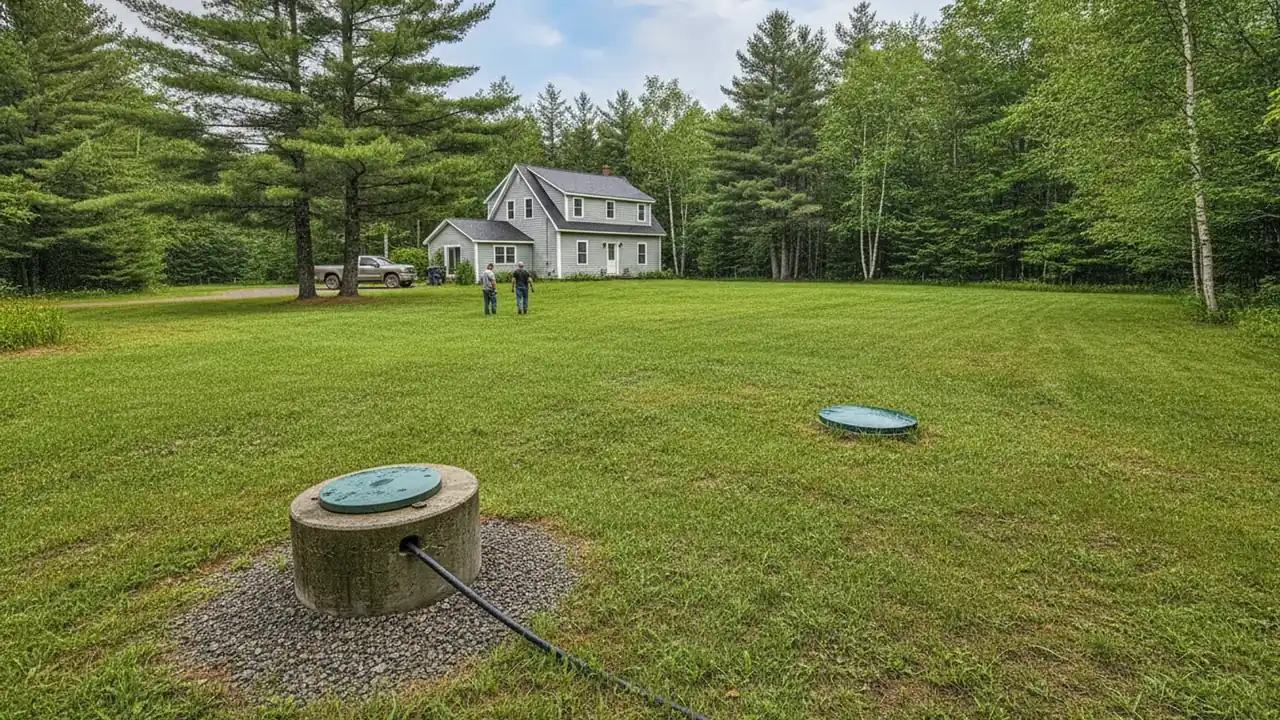
If your house sits outside the sewer lines in Penobscot County, you almost certainly have two buried systems on one lot: a septic system sending water into the ground and a well pulling water out of it. The question that keeps people up at night is whether the first one is quietly fouling the second. Regular well water testing is the only way to know, because clear, good-tasting water can still carry bacteria or nitrate.
This guide covers what to test for, how often, and what to do when a result comes back positive. We pump and inspect septic systems, so we’ll stick to what we know and point you to the right people for the rest. If you want the septic side of your property looked at, you can book a pump-out or inspection online or call (207) 300-9238.
What does well water testing cover, and who does it?
Testing is done by a state-accredited laboratory, not by a septic company. You collect a sample in a bottle the lab gives you, follow its instructions, and return it fast. Bacteria samples in particular have a short window before they’re no good, so the lab will tell you how fast it needs them back, often within a day of collection.
We don’t test water, and we don’t sell test kits. Maine CDC is the state office to ask about which labs are accredited and how to read a result. Its Testing Your Wellwater page lists what to test for and when. The EPA also keeps a private drinking water wells page that explains a key fact: federal law and most state laws don’t regulate private well water, so the quality of your water is your responsibility, not your town’s.
A basic test panel and a broader one cost different amounts at different labs. Ask the lab for its current price list rather than going by a number you read online.
Which tests matter most when a septic system is nearby?
Three results speak most directly to septic influence. The rest of the panel is about Maine geology and has little to do with your tank.
Coliform bacteria and E. coli. Coliform is a broad family of bacteria found in soil, plants and animal waste. It’s an early warning that something is getting into the well. E. coli is a narrower group that points to waste from people or animals, so an E. coli result is taken more seriously.
Nitrate and nitrite. Nitrate is what’s left when the nitrogen in human waste is broken down. A septic system always releases some into the ground, which is normal and expected. A high nitrate reading in a well suggests the water is picking up something from the surface or the soil nearby. Farm fertilizer, animal waste and septic effluent are all possible sources, and a test alone can’t tell you which.
Chloride, sodium and conductivity. Some labs offer these as add-ons. Road salt and water softener brine can show up here, and so can wastewater. They’re clues, not proof.
Two other results are worth knowing about even though they have nothing to do with septic. Arsenic, radon and uranium occur naturally in Maine bedrock, and plenty of drilled wells here carry one or more of them. Maine CDC suggests testing for these and other minerals every 3 to 5 years, and a full panel the first time you ever test. A clean septic system won’t fix either one.
How often should you test?
Maine CDC recommends testing a private well every year for coliform bacteria, E. coli, and nitrate and nitrite, with a wider panel every 3 to 5 years and a full panel the first time you test. A good habit is to do it in the same season each year, so you can compare results fairly. Many people pick late summer or fall.
Some events should trigger a test no matter when you last had one:
- After flooding or a washed-out yard. Surface water can run straight down a poorly sealed casing. Our post on septic problems after heavy rain in Maine covers what the same storms do to the tank and field.
- After a septic backup or a field repair. If sewage came up in the house or the yard, test the well once things have settled.
- After any well work. Pump replacements and casing repairs can let bacteria in. Ask your well contractor about disinfecting afterward.
- When the water changes. A new smell, taste, cloudiness or stain is worth a test even if your last result was fine.
- Before you buy or sell. More on that below. If the well and the septic system share a small lot, our post on well and septic distances in Maine explains why the two have to sit apart.
What does a positive bacteria result actually mean?
A positive result tells you something is getting into the water. It doesn’t tell you what. Septic systems are one possible source, but they are rarely the first one to rule in.
Here’s how the common results line up with likely causes and next steps.
| Result | Common causes | What to do first |
|---|---|---|
| Coliform only, no E. coli | Loose or cracked well cap, damaged casing, new pump work, shallow dug well, runoff after rain | Check the cap and casing, disinfect the well as your well contractor directs, retest |
| E. coli present | Surface water or waste entering the well, failing septic field, animal waste near the wellhead | Don’t drink untreated water, use bottled water, call a well contractor, then have the septic system looked at |
| High nitrate | Fertilizer, animal waste, septic effluent, a shallow well | Retest, ask the lab or Maine CDC what the number means for your household, especially if an infant is in the home |
| Arsenic or radon | Natural bedrock in your area | Talk to a water treatment contractor; unrelated to septic |
| Clean on all tests | None of the above | Keep your yearly schedule |
Don’t just wait and hope it clears up. If E. coli is confirmed, treat the water as unsafe until your well contractor and Maine CDC tell you otherwise.
In what order should you rule out the causes?
Work from the cheapest, most common cause to the least common one. This saves you from digging up a perfectly good septic field over a loose cap.
- Look at the well itself. Is the cap tight and intact? Is the casing cracked? Does water pool around it after rain? A sanitary well cap and ground that slopes away from the casing cost far less to fix than anything else on this list.
- Think about recent weather. Did the sample come after days of heavy rain or snowmelt? Spring thaw in March and April can push surface water into shallow wells.
- Disinfect and retest. Your well contractor can shock-chlorinate the system. If the retest is clean and stays clean, a one-time entry was the likely cause.
- If bacteria keep coming back, look at the septic system. This is where we come in. A septic inspection checks the tank, the baffles and filter, the inlet and outlet, and how the water is moving out to the field. We’ll tell you what we saw.
- Look at the distance and the age. An older system close to a well is more likely to be the problem. The distance post linked above covers the rules, so we won’t repeat the numbers here.
Pumping a tank doesn’t clean a well. Pumping only helps if overfull solids are what’s pushing the system to fail, and it’s an honest first step in some cases. But if a field has failed or a line is broken, the water will keep going where it’s going. For a look at what failure looks like, see drain field failure signs and costs in Maine.
Three hypothetical cases around Bangor
These are made-up examples, built on the kinds of lots common around the county.
The spring sample. Say you have a shallow dug well in Glenburn and your April test shows coliform. It’s mud season, snow just melted, and the well pit has water around it. A tight cap, regraded ground and a disinfection usually clear this up. The septic system may be fine.
The older house in Hermon. Say you have a 1980s system in Hermon and a drilled well that’s been tested twice with rising nitrate. The tank hasn’t been pumped in eight years. A pump-out and inspection would show the tank’s condition and any obvious signs of trouble at the field. It still wouldn’t prove the septic is the nitrate source, but it would tell you if something is wrong on your side of the lot.
The sale in Orono. Say you’re selling a home near Orono and the buyer’s lender asks for water results. Test early, because a retest after a disinfection takes days, not hours. If the septic system is also being checked, our post on buying a house with septic in Maine shows what a buyer typically asks to see.
If you’d rather get the septic side settled before any sale or test, you can schedule a septic inspection and we’ll tell you what we find at the tank, the baffles and the outlet.
Can a septic backup or an overfull tank affect the well?
Sometimes, but not always. A backup into the house is a plumbing and tank problem. It doesn’t automatically mean your well is contaminated. A field that is surfacing sewage on the lawn is a different story, especially if it’s uphill from the wellhead or in the path of drainage toward it.
If sewage is backing up right now, don’t wait for a test result to act. Call (207) 300-9238 for emergency service, and read what to do when your septic is backing up while you wait. Same-day or next-morning response applies, Sundays included, though we can’t promise an arrival time.
Once the system is working and cleaned up, test the well. Keep the lab report with your other septic papers so the next owner has a record.
How does regular pumping fit in?
A tank that is pumped on schedule is less likely to push solids into the field, and a healthy field treats wastewater before it reaches groundwater. Most households do well with a pump-out every three to five years. A septic tank pumping visit is also the easiest time to have the inlet, outlet and baffles looked at.
If you want a cost estimate, the septic pumping cost calculator is a quick place to start. A routine pump-out for a 1,000 to 1,500 gallon tank with an accessible cover runs $350 to $550.
For questions about your particular results, the Maine CDC page linked above lists the state’s contacts, and an accredited lab can explain what each number means.
Frequently Asked Questions
How often should I test my well water if I have a septic system?
Maine CDC recommends testing a private well for bacteria and nitrate every year. Test again after flooding, after a septic backup, after any well repair, and before you buy or sell the property.
Does a positive coliform result mean my septic system is failing?
Not necessarily. Coliform bacteria also get in through a loose well cap, a cracked casing or surface water after heavy rain. Rule those out first, then look at the septic system if the problem continues.
Can you test my well water when you pump my septic tank?
No. We pump and inspect septic systems but we don’t test water. Use a state-accredited lab for the test and ask Maine CDC if you need help reading the results.
Does pumping my septic tank fix bad well water?
Pumping removes the solids from the tank but it doesn’t clean a well. If septic water is reaching the well, the cause is usually a failing field, a damaged line or a well problem, and pumping alone won’t solve it.