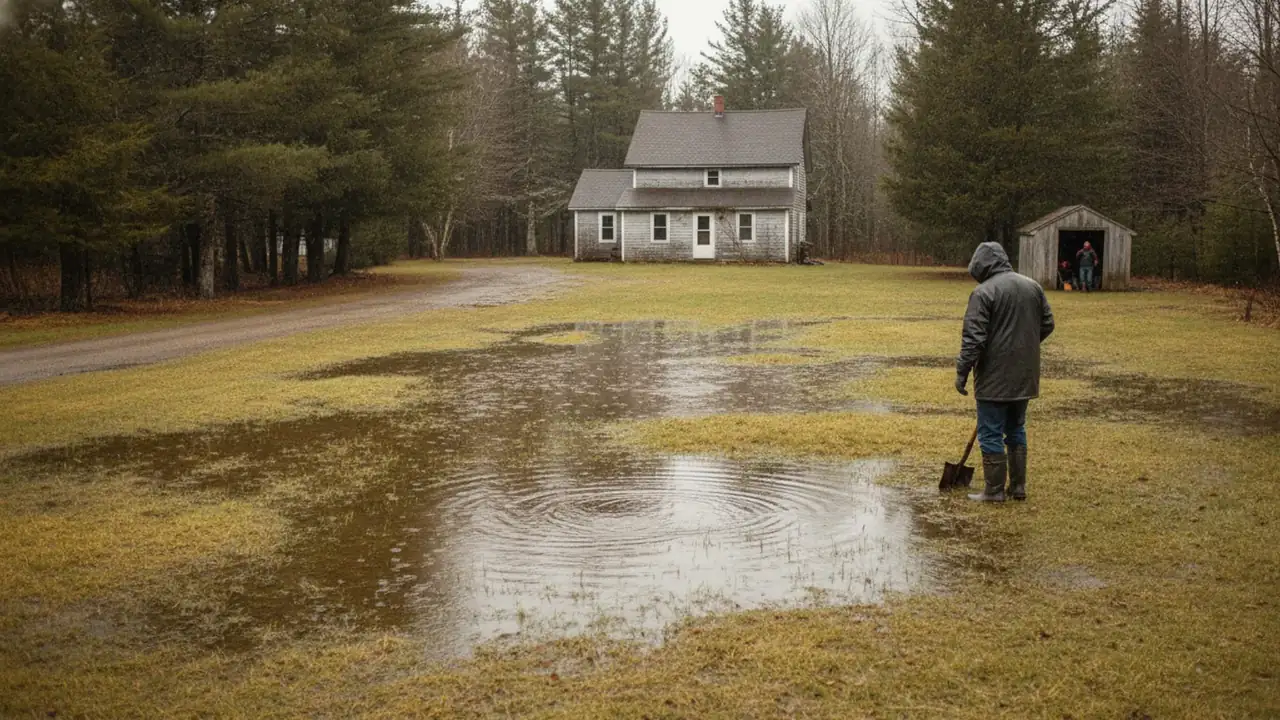
Dave in Hampden called us in a panic last April. Three days of rain on top of a fast snowmelt, and his basement toilet was gurgling every time his wife ran the washer. He was sure he needed a new field. What he actually needed was two dry days and a little less laundry. By Thursday, everything was running fine again.
That is the scenario we hear on repeat every spring and every time Bangor gets a real gully-washer: drains go slow, maybe a wet patch shows up in the yard, and the homeowner assumes the worst. Sometimes it is the worst. Most of the time, it is just water in the ground doing exactly what water in the ground does. Knowing which one you are looking at saves you a panicked call and, more often than not, a bill you did not need to pay.
Why Rain and Snowmelt Overwhelm a Healthy Field
Your drain field works by letting wastewater trickle down through unsaturated soil, which filters it before it reaches groundwater. That process depends on the soil around and below the pipes having room to absorb liquid. A hard rain, or a fast spring thaw stacked on frozen ground that cannot absorb anything yet, fills that soil up from the outside. Now your field is trying to push wastewater into ground that is already saturated. There is nowhere for it to go, so it backs up the pipe instead, right toward your house.
This is not a defect. It is physics. A field sized correctly for a three-bedroom house in Glenburn will still choke temporarily under two inches of rain in six hours, the same way a good highway backs up in a snowstorm. The road is not broken. It is just carrying more than it can move at that moment.
Maine’s mud season makes this worse than almost anywhere else. Frost depth can run several feet down through a long winter, and when that frost layer starts to let go in March and April, snowmelt has to travel across it before it can soak in anywhere. Add a warm rain on top of melting snow, which happens most years, and you get the wettest soil conditions of the entire year landing right on top of your field.
Temporary Trouble vs. an Actual Failing Field
This is the part homeowners genuinely cannot always tell on their own, so here is the honest breakdown.
| Sign | Usually Temporary (Saturation) | Usually a Real Problem |
|---|---|---|
| Timing | Starts during or right after heavy rain/thaw | Present even during dry stretches |
| Drain speed | Slow, but clears within 1-3 dry days | Stays slow or worsens over weeks |
| Yard | Damp, spongy, maybe standing water that recedes | Mushy or lush green patch that never dries out, even in July |
| Odor | Faint or none | Persistent sewage smell over the field |
| Pattern | Every fixture affected roughly equally | One drain or the lowest fixture backs up first |
| History | First time, tied to a specific storm | Has happened before, getting more frequent |
If your symptoms sit clearly in the left column, the fix is patience and cutting back water use for a couple of days. If you are seeing the right column, especially a wet spot that stays soggy through a stretch of dry July weather, that is not rain saturation anymore. That is a field that is struggling to accept water even under normal conditions, and it deserves a real look. Our guide on the signs your septic tank needs pumping covers some of the overlapping symptoms if you want a second checklist to compare against.
One safety note that matters more than any of this: if you do get a backup, do not go looking for the tank lid to check levels yourself, and never climb down into a septic tank or attempt to open it beyond the cover. Tank gases can be lethal in minutes. Call a licensed pumper.
The Gutter and Sump Pump Mistake We See Constantly
Here is the single most common self-inflicted wound we find on service calls after a storm: roof downspouts or a basement sump pump dumping water straight onto or right next to the drain field. We saw this at a place in Eddington last spring, a nice ranch with a sump pump discharge line that ran exactly twenty feet from the house, which happened to land it directly over the far corner of the field. Every time it rained hard enough to trigger the sump pump, that homeowner was manually flooding his own leach field on top of whatever the storm was already doing to it.
The fix costs almost nothing compared to a field replacement.
- Extend downspouts. Route them at least 10-15 feet away from the field and ideally toward a spot where the yard naturally slopes away from the system.
- Reroute sump discharge. Pipe it to daylight well clear of the field, not into the same low spot the field drains toward.
- Check the grading. If the ground slopes toward your field from the driveway, garage, or a neighboring property, water is funneling in from outside your own roof, too.
- Keep vehicles off it. A soaked field compacts easily under a car or truck, which crushes the pore space in the soil you need for drainage. Mud season is exactly the wrong time to park on the lawn over the tank or field.
None of this is glamorous work, but it is the difference between a field that shrugs off a heavy storm and one that backs up your basement every time the sky opens up.
Cutting Water Use During the Storm Itself
When you know a big rain event or a fast thaw is coming, or you are already in the middle of one and drains are getting sluggish, the smartest move is to simply reduce how much water you are asking the field to absorb until the ground catches up.
- Spread out laundry. Do not run three loads back to back during a storm. One load, then wait.
- Shorten showers and stagger them instead of back-to-back showers for the whole household.
- Skip the dishwasher for a day if you can, or run it half-full loads less often.
- Hold off on hosting. If you were planning a big gathering during a forecasted deluge, that is the week to reconsider, or at least rent a portable toilet if it is a large event.
This is temporary triage, not a permanent lifestyle change. Once the ground has a couple of dry days to drink down, you can go back to normal. If cutting water use does not bring relief within a few days, or the backup is severe enough that wastewater is coming up inside the house, treat it as an emergency rather than waiting it out. Our septic backup first steps guide walks through what to do in that moment.
When to Call and When to Wait It Out
A little slowness during a genuine downpour, especially in mud season, is not usually worth a service call by itself. Give it a couple of dry days first. But there are a few situations where you should not wait:
- Sewage backing up inside the house, at any time of year.
- A wet, smelly patch over the field that does not dry out even after a week of no rain.
- The same corner of the yard getting soggy every single time it rains, storm after storm, all season.
- An older field (Linda in Orono’s system was original to a 1994 build) that has been marginal for years and is now getting worse with every rain event instead of recovering.
If any of those describe your situation, it is worth having someone actually look at the tank and field rather than guessing. A pump-out clears the way for an accurate look at the tank itself, and in some cases buys the field breathing room while the ground drains, especially if the tank was already fairly full when the rain hit. You can get a ballpark on what that runs with our septic pumping cost calculator, or just call us directly at (207) 300-9238 and we will tell you straight whether this sounds like a wait-it-out situation or a get-someone-out-there situation.
For homeowners near Kenduskeag Stream or the Penobscot River floodplain, or anyone on a low lot in Old Town or Milford, seasonal saturation is close to a yearly event. Knowing your own field’s normal recovery pattern, meaning how many dry days it typically takes to bounce back, is the best diagnostic tool you have. Keep a mental note the first time it happens, and you will know immediately the next time whether you are looking at typical mud season behavior or something that needs a professional set of eyes.
Frequently Asked Questions
Why do my drains get slow every time it rains hard?
Heavy rain saturates the soil around your drain field so it cannot absorb wastewater as fast as usual. Your system is still working, it just has less room to push water into the ground until the soil drains down again, usually within a day or two.
Is it normal for the ground over my septic field to be soggy after a storm?
Some dampness and slower absorption is normal in a big storm or during mud season. It becomes a problem when the ground stays soggy for many days after it stops raining, or when you see standing water and smell odor over the field.
Should I pump my tank during mud season if it is backing up?
Pumping can buy you a few days of relief, but if the field itself is saturated, pumping the tank will not fix slow drains caused by wet ground. It helps most when the tank was already close to full before the rain hit.
How can I protect my septic system before spring thaw or a big storm?
Make sure roof gutters and any sump pump discharge are routed well away from the drain field, spread out laundry and shower use over the storm instead of running everything at once, and avoid parking or driving over the field when the ground is soft.