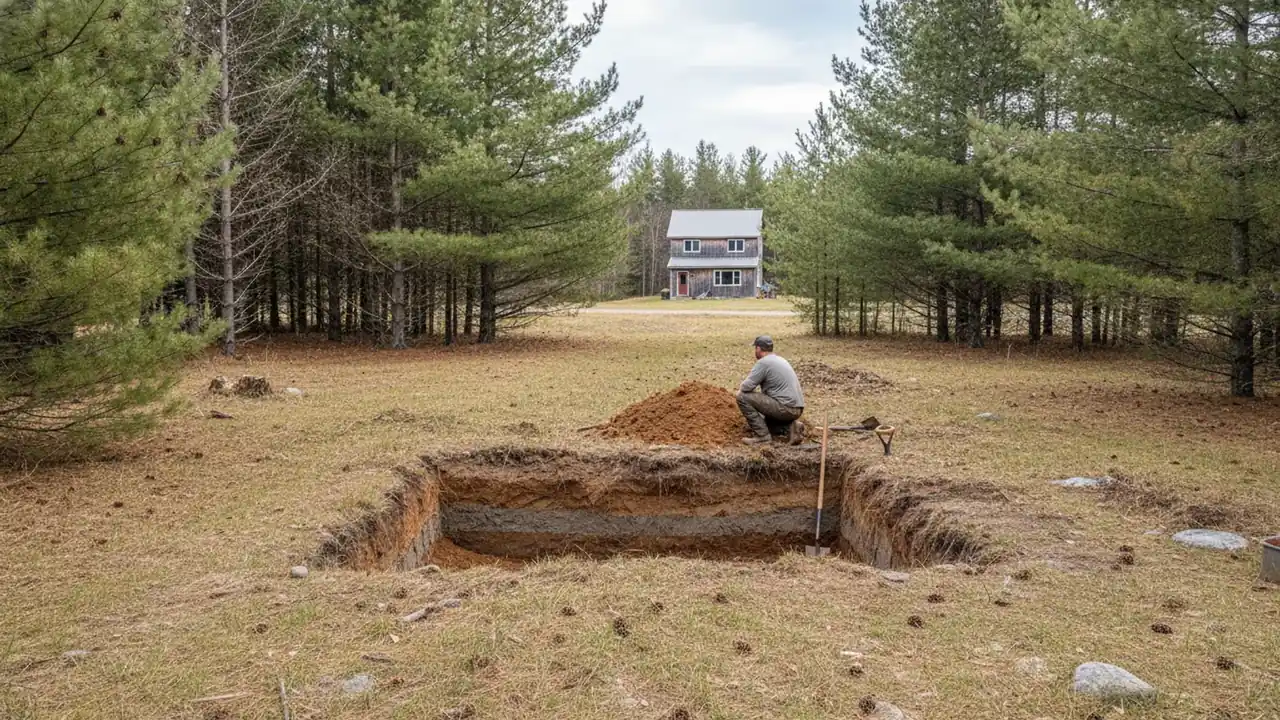
You found a wooded lot outside Hermon for a fair price, and your agent says “make sure you get a perc test.” Skip that step and you could close on a lot that needs a $25,000 to $40,000 engineered septic system, or one that can’t take a system at all.
“Perc test” is the phrase everybody uses. In Maine, though, it usually means something a little different from what the phrase suggests. This guide explains what you’re really getting, when to get it, and how to protect yourself as a buyer.
If you already own a home on septic and have questions about the tank, you can book a pump-out or inspection or call (207) 300-9238. This article is for the person standing on raw land with a purchase and sale agreement in hand.
What a Perc Test Means in Maine
A percolation test, or perc test, is the classic timed hole test. Someone digs a hole, fills it with water and measures how fast the water drains away. That number tells you roughly how quickly the soil can take in wastewater.
Maine doesn’t rely on that method for most designs. Instead, a licensed site evaluator digs test pits and reads the soil itself. The evaluator looks at soil texture, color patterns that show where the water table rises in wet seasons, and how deep it is to ledge or other layers that block drainage. Those findings drive the system design, which gets filed on a form called the HHE-200.
So when a seller, an agent or a bank says “perc test,” they almost always mean “a site evaluation by a licensed site evaluator.” Use that term when you call around. It gets you to the right person faster.
The step-by-step process is covered in our guide to the septic soil test and site evaluation in Maine. Here we’re focused on the buying decision.
Why Land Buyers Should Get the Evaluation Before Closing
A lot with no septic design is a lot with an unknown cost. That’s the whole problem.
Say you’re looking at two similar three-acre lots in Levant. One has deep, well-drained soil and can take a conventional system. The other has a seasonal water table close to the surface and a ledge outcrop at the back. They may sell for nearly the same price, but the septic bill can differ by tens of thousands of dollars.
Here’s how the money tends to fall out, using the ranges we see for Maine systems:
- A conventional replacement or new system usually runs $12,000 to $25,000.
- Engineered and mound systems run $25,000 to $40,000 or more.
- Advanced treatment (ATU) systems with engineered designs run $28,000 to $45,000 or more.
Those are the same figures we cover in what a new septic system costs in Maine. The evaluation tells you which bucket your lot falls into before you’ve paid for the land.
The way to protect yourself is a purchase contingency. Ask your attorney or agent to add a clause that lets you back out, with your deposit, if a licensed site evaluator finds the lot can’t support a system you can afford. This kind of clause is common in Maine land deals. The wording and the deadline are a legal matter, so have your attorney draft it.
Timing matters too. Evaluators are busiest in late spring and summer. Frozen ground and snow cover make test pits hard in winter, and a good evaluation wants to see the soil as it really is. If your closing date is tight, book the evaluator the day your offer is accepted.
What Test Pits Tell the Evaluator
On evaluation day, an excavator digs one or more pits in the area where the system might go. The evaluator examines the pit wall and records what the soil shows.
In short, the evaluator reads soil texture, the depth to anything that stops treatment (ledge, hardpan or the seasonal high water table, which shows up as gray and orange mottling even in a dry August pit), and the slope and nearby wells, wetlands and water that limit where a system can go. Near lakes and streams, shoreland zoning adds stricter rules. The site evaluation guide walks through each of these in detail.
You can read more about two common trouble spots in our posts on septic systems on ledge and high water table septic problems. Both are common across Penobscot County, where glacial soils change from one lot to the next.
One practical point: soil can change a lot over a short distance. A pit on one side of the lot may look great while the other side is ledge. That’s why a good evaluation looks at more than one spot when the lot allows it.
What a Bad Result Means for Your Lot
A poor result doesn’t automatically mean the lot is worthless. It means the cheap option is off the table. There are three broad outcomes.
| Result | What it usually means | What to expect |
|---|---|---|
| Good soil, enough depth | A conventional system should fit | Lowest-cost design, most replacement budgets in the $12,000 to $25,000 range |
| Marginal soil or shallow limiting layer | An engineered design, often a raised mound or other special system | Costs often $25,000 to $40,000 or more, plus more design work |
| Not enough usable soil, ledge, or water table at the surface | The lot may not be buildable for a home | Ask the evaluator and the local plumbing inspector what, if anything, is possible |
A mound system is a raised bed of sand built on top of the natural soil to give wastewater more room to be treated. If you want to see how it works, read about mound septic systems in Maine.
Whichever column your lot lands in, the number to carry back to the negotiation is the likely system cost. The gap between a conventional system and an engineered one is a fair reason to ask the seller for a lower price, even if the answer is no.
Questions to Ask the Seller Before You Pay an Evaluator
Before you spend a dime, a few questions can save you time. Sellers and their agents often know more than they volunteer.
- Is there an HHE-200 on file for this lot? Some lots already have a design from a past sale or a past owner. Ask for a copy. The town or the state may also hold records. Our guide to Maine septic records and the HHE-200 form shows what a design looks like and where records live.
- How old is that design? Rules and conditions change. An old design isn’t a guarantee, and the local plumbing inspector decides whether it still works.
- Has anyone dug test pits here? If yes, ask who did it and when.
- Are there wet spots, ledge outcrops or a brook on the lot? Sellers usually know where the mud is in April.
- Is the lot part of an approved subdivision? Some subdivisions carry their own septic conditions. Your attorney can check.
- Is the lot near a lake, pond or stream? If so, shoreland rules may apply.
Write down the answers. They belong in your file with the purchase agreement.
Who Does What, and What Septic Pumpers Can Help With
Buyers often mix up the roles, so here’s the short version.
- A licensed site evaluator does the soil evaluation and designs the system. They file the design on the HHE-200.
- The local plumbing inspector, or LPI, issues the permit and inspects the work in your town.
- A licensed installer builds the system.
- Maine DEP licenses septage haulers and regulates how septage is disposed of.
We don’t do any of the first three. We pump tanks, inspect existing systems, locate buried tanks, check baffles and filters, and handle emergencies across Bangor, Brewer, Hampden, Old Town, Orono and the rest of Penobscot County.
Where we do come in is later. If you buy a lot with an existing system, or buy a house on septic instead of raw land, a septic inspection before closing tells you what condition the tank is in. For a home purchase, our guide to buying a house with a septic system in Maine covers what to ask for.
Once your system is built and in use, septic tank pumping every three to five years keeps it working. A routine pump-out for a 1,000 to 1,500 gallon tank with an accessible cover runs $350 to $550. If you put in a riser at install, you won’t pay extra for digging later.
What a Perc Test or Evaluation Costs
We don’t set site evaluation fees, and they vary, so we won’t put a number on them. What we can do is tell you what moves the price, so you can compare quotes.
| Cost driver | Why it matters |
|---|---|
| Number of test pits | More pits means more excavator time and more reading by the evaluator |
| Excavator access | A lot with a rough or soft access road costs more to reach |
| Travel distance | Remote lots in the north of the county take longer to reach |
| Site complexity | Ledge, slope and wetlands mean more careful work |
| Report and design work | A full design filed on an HHE-200 costs more than a quick feasibility look |
| Seasonal timing | Frozen ground and snow cover can slow or stop the work |
When you ask for a quote, ask these things:
- Is the excavator included, or do I hire one separately?
- How many test pits are in the price?
- Is the written design included, or only the soil report?
- What happens if the first location fails? Will you test a second area, and is that extra?
Get the answers in writing. A quote that lists what’s covered beats a low number with surprises behind it.
Hypothetical Scenarios From Around Penobscot County
These are made-up examples.
The Glenburn lot. Say a buyer has a purchase agreement on a wooded lot in Glenburn with a 30-day closing. They book a site evaluator in week one. The test pits show a seasonal water table close to the surface. The evaluator says the lot can still be built on, but only with a raised, engineered design. The buyer takes the report back to the seller and renegotiates the price. The contingency made that possible.
The Orrington hillside. Say a family eyes a sloping lot above a river. The soil is good on the lower third and ledge on the upper two thirds. The only workable spot is near the road, which pushes the house site and the driveway cost up. The septic design was fine. The layout cost them. A feasibility look early in the process would have shown it.
Both are ordinary, and both are easy to plan for by testing first.
Next Steps for a Land Buyer
Here’s a short order of operations:
- Ask the seller for any existing HHE-200 or soil evaluation.
- Add a septic contingency to your purchase agreement, drafted by your attorney.
- Hire a licensed site evaluator for a soil evaluation as soon as the offer is accepted.
- Read the result with the evaluator. Ask what system type fits and what the design involves.
- Talk to the local plumbing inspector about permitting before you finalize your build plan. The state’s permit process is covered in how Maine septic permits work.
- Decide with real numbers, not hope.
For general background on how a septic system treats wastewater, the EPA has a plain-language page: How Septic Systems Work.
When the system is in the ground and the house is built, we’re here for the pumping, inspections and emergencies that come later. Call (207) 300-9238 to book. Emergency response is same-day or next-morning, Sundays included.
Frequently Asked Questions
Is a perc test required in Maine?
For most new systems, Maine requires a soil evaluation by a licensed site evaluator, not a classic timed perc hole. The evaluator records the soil profile and files the design on an HHE-200. Your local plumbing inspector issues the permit.
How much does a perc test cost in Maine?
There is no single price. The cost depends on the number of test pits, excavator access, travel to the lot and how complicated the site is. Ask the site evaluator for a written quote that says what is included.
Can I buy land before the soil is tested?
You can, but it’s risky. A purchase contingency that lets you walk away if the lot can’t take a system protects your deposit. Without it, you may own land that needs an expensive engineered system or can’t be built on.
What happens if the lot fails the soil evaluation?
It depends on why. Some lots need an engineered or mound system that costs far more than a conventional one. Others have too little usable soil, ledge or a high water table and can’t be built on. The site evaluator can tell you which.