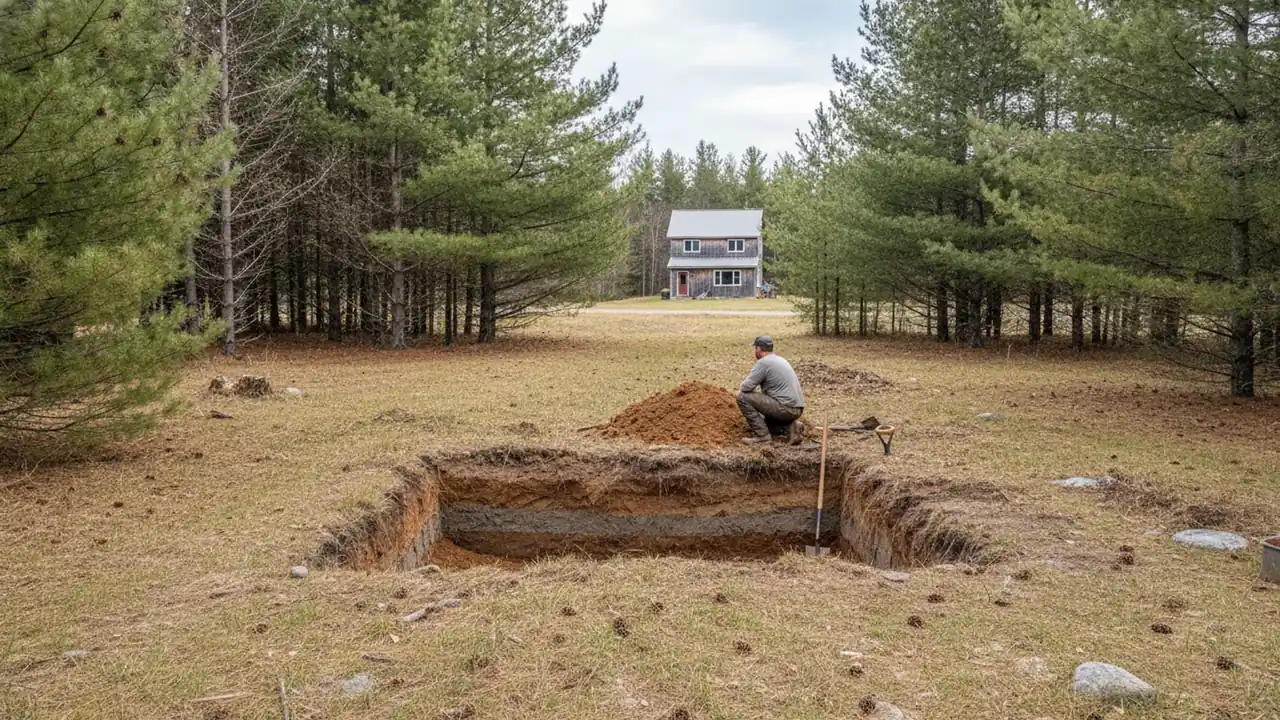
Before you pour a foundation, drill a well, or even sign a purchase and sale agreement on raw land near Bangor, there is one hole in the ground that matters more than any other: the test pit a Site Evaluator digs to look at your soil. That hole tells you whether your lot can support a standard septic system, needs an expensive engineered one, or cannot be built on at all. Skip it, and you can end up owning land you cannot legally put a house on.
That is not scare talk. We get calls every summer from people who bought a pretty wooded lot in Hermon or Eddington, hired a builder, and only then found out the soil would not perc. By then they had already paid for the land.
What a Site Evaluator Actually Does
In Maine, only a state-licensed Site Evaluator, referred to as an SE on permit paperwork, is legally allowed to evaluate soil for a subsurface wastewater system. This is not a job for your excavator, your Realtor, or a YouTube video. The SE digs one or more test pits, usually four to six feet deep, in the area you want to put your septic system and reserve area (the backup spot for a future replacement field).
Standing in that pit, the evaluator reads the soil like a book:
- Soil texture and structure. Sand drains fast. Clay barely drains at all. Loam is somewhere in between and usually the sweet spot.
- Color and mottling. Gray or rust-colored streaks in the soil are a tell. They mean water sits at that depth at some point in the year, even if the pit is bone dry on the day of the test.
- Depth to the limiting layer. That is either ledge (bedrock), a hardpan layer, or the seasonal high water table, whichever comes first going down.
- Slope of the land, which affects how the leach field is laid out and how much fill might be needed.
From those observations, the SE assigns a soil class, ranging from Class A (the best, usually well-drained sand or gravel) down through Class D (barely usable) and unsuitable. That single classification, more than square footage or budget, is what determines whether you get a simple gravity system or something far more expensive.
Why Ledge and Water Table Depth Change Everything
Here is the part people underestimate. Two lots half a mile apart in Penobscot County can require completely different systems because of what is under the topsoil, not what is on top of it.
| What the pit reveals | What it typically means for the system |
|---|---|
| 4+ feet to ledge/water table, sandy loam | Standard gravity leach field, lowest cost |
| 2 to 4 feet to limiting layer | Often needs a raised or mound system with imported fill |
| Less than 2 feet to ledge or seasonal water table | Engineered system, pump-assisted, significant added cost |
| Heavy clay throughout | Slow percolation, larger field or alternative design required |
| Ledge at or near surface across the lot | May be unbuildable without blasting or major engineering |
Maine’s short building season makes this worse if you find out late. If your evaluation reveals a high water table, the fix (bringing in fill and building a raised system) is a summer job. Discover that in October and you may be looking at a spring start, which pushes a whole construction schedule back a season. This is one of the biggest cost drivers we cover in our guide to new septic system costs in Maine, and it starts right here in the test pit.
The Timeline: What Comes Before You Can Build
People planning a new build or a full septic replacement almost always underestimate how long the front end takes. A realistic order of operations looks like this:
- Hire a licensed Site Evaluator to dig test pits and produce a soil report. Scheduling alone can take one to three weeks depending on the season, since evaluators book up fast in spring and early summer.
- Get the soil classification and system recommendation. This determines whether you need a standard system, a raised system, or an engineered design.
- Have a design engineer or the SE draw the actual system plan sized to your soil class, bedroom count, and lot layout, including the reserve area for a future replacement.
- Submit for a local plumbing permit through your town’s Local Plumbing Inspector, referencing the state’s Subsurface Wastewater Disposal Rules. The Maine septic permit process covers what the HHE-200 application needs and how long approval takes.
- Schedule installation, which for most homes runs a few days once the permit is in hand and the ground is workable.
Start to finish, from the first test pit to a permit in hand, two to six weeks is typical around Bangor, and that is assuming no complications. Add ledge, a tight lot, or an SE with a full calendar and it stretches longer. If you are buying a house that already has a system and just want to know its condition rather than plan a new one, that is a different process entirely, covered in our post on septic inspection costs in Maine.
What Makes a Lot Buildable (or Not)
Not every parcel with a nice view can support a septic system. A few realities we see over and over in this region:
Lakeside and shoreland lots face extra scrutiny. Maine’s shoreland zoning rules add setback requirements from the water, and soil near a lake often has a shallower water table because the lake is, in effect, the water table. This matters a lot for anyone eyeing a camp lot near one of the region’s lakes for a future build.
Ledge-heavy parcels are common inland, especially as you move away from river valleys. A quick test pit that hits rock at eighteen inches is a hard stop for a standard system, though a mound system built up above the ledge can sometimes rescue the lot at added cost.
Clay soils hold water and drain slowly. They are workable but usually mean a larger leach field footprint than a sandy lot would need for the same size home.
Linda in Orono learned this the expensive way. She bought a lovely two-acre lot, assumed septic would be routine since the neighbors all had systems, and only ordered the soil test after her builder asked for it. The test pit hit a seasonal high water table at three feet. The fix was a raised system with trucked-in fill, which added real money to her build budget. Her neighbor Dave in Hampden did it the other order: soil test before the purchase and sale agreement even went final, which gave him real numbers to negotiate the land price down when the results came back Class C instead of Class A.
Get the Order of Operations Right
If you are eyeing land, or planning to replace a failing system on a lot you already own, the soil test is not a formality to knock out after the fact. It is the fact that everything else depends on. Get the site evaluation done first, understand your soil class before you commit to a house design or a purchase price, and you avoid the expensive surprises that hit people who build the plan first and test the dirt second.
If you already know your system is due for replacement rather than a fresh build, our septic tank pumping and inspection team can walk your existing setup, tell you what shape it is in, and connect you with a licensed Site Evaluator if a new system is on the horizon. Call (207) 300-9238 or book a visit at /#book, and if you just want a ballpark number to plan around, run it through our septic pumping cost calculator first.
Frequently Asked Questions
Who is allowed to do a septic soil test in Maine?
Only a state-licensed Site Evaluator, sometimes called an SE, can dig test pits, classify your soil, and sign the site evaluation form your town requires for a septic permit. Homeowners and contractors cannot self-certify this step.
How much does a septic site evaluation cost in Maine?
Most Penobscot County site evaluations run 600 to 1,200 dollars depending on lot size, access, and how many test pits are needed. Difficult sites with ledge or a high water table can push higher.
Can a lot fail a septic soil test?
Yes. Shallow ledge, a water table too close to the surface, or heavy clay with almost no drainage can make a standard system impossible. Some of those lots can still work with an engineered system at a much higher cost, and some genuinely cannot be built on.
How long before building does a soil test need to happen?
Do the site evaluation before you get attached to a house plan, well location, or closing date. In Maine it commonly takes two to six weeks to schedule the evaluator, get the report, and have the design engineer draw the system, and that is before the town issues a permit.