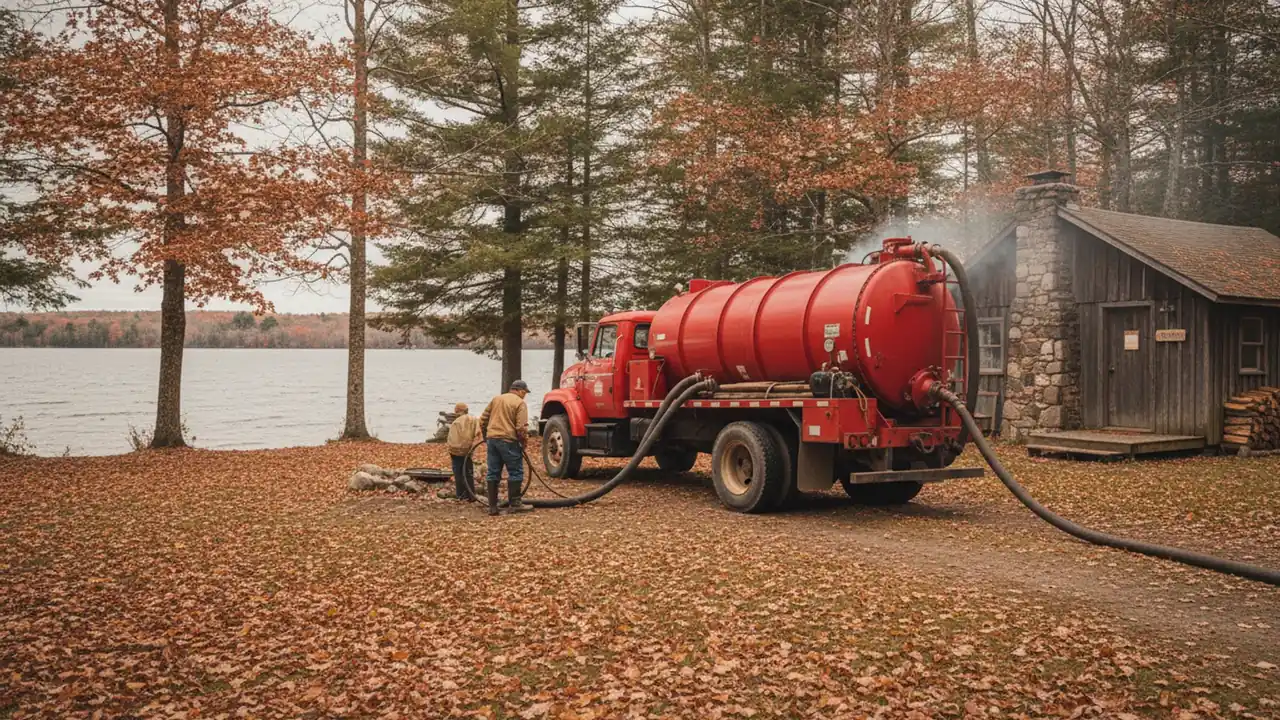
Dave closes up his camp on Pushaw Lake the same weekend every year, right after deer season starts eating into his free time. Two years ago he skipped the septic and just shut the water off. Came back in May to a heaved lid, a cracked 4-inch line between the camp and the tank, and a puddle of thawed sewage where his flower bed used to be. This year he called us the week before Thanksgiving instead. Twenty minutes of work, and he’s not thinking about it again until ice-out.
That’s the whole story of winterizing a septic system at camp. It is not complicated, but it is easy to skip, and skipping it is what turns into a spring repair bill. Here is exactly what needs to happen before you lock the door.
Pump It or Don’t — Here’s How to Tell
Not every camp needs a pump-out just because winter is coming. What matters is what kind of system you have and where you are in your normal cycle.
Standard septic tank, not due yet. If your tank was pumped within the last two to three years and isn’t due on your regular schedule, you can usually skip pumping and just handle the closing steps below. A full tank freezing solid over the winter is not a problem — more on that in a minute.
Standard septic tank, due or close to it. If you’re within a few months of your next scheduled pumping, get it done before you close rather than waiting until spring. Access can be tougher in April with mud season and a soft yard, and a tank that’s near capacity going into a long closed season with less water use isn’t doing you any favors. If you’re not sure where you stand, our septic pumping cost calculator will get you a ballpark fast.
Holding tanks are a different animal entirely. A holding tank has no drain field — everything that goes in stays in until a truck pumps it out. If you close camp with even a foot of waste sitting in a holding tank, that waste freezes into a block that can’t be pumped until it thaws in the spring, and it can put enough pressure on the tank walls and fittings to crack them. Holding tanks get pumped empty, every single year, before closing. No exceptions. If you’re not sure which kind of system your camp has, we cover the difference in holding tanks versus septic systems for Maine camps.
Linda’s camp in Orono runs a holding tank because the lot is too tight to code for a leach field. She used to guess at timing and call whoever picked up the phone. Now she has us on the calendar every October, same week, no guessing. That’s the move — get on a schedule instead of relying on memory.
Why a Full, Frozen Tank Is Fine — and a Half-Empty One Isn’t
This confuses a lot of camp owners, so it’s worth explaining plainly. Water expands about 9% when it freezes. A tank that’s mostly full of liquid and freezes solid pushes that expansion upward, against a lid that’s engineered to handle it. Concrete and heavy-duty poly tanks buried below frost depth are built for exactly this. It’s ugly, it’s frozen, but it’s not damaged.
The problem is standing water in a place that isn’t built to absorb the expansion — a pipe, a low spot in the line, a trap. Water sitting in a 4-inch PVC line between the camp and the tank has nowhere to go but sideways when it freezes, and PVC splits under that kind of pressure. A cracked line under three feet of frozen ground in January isn’t getting fixed until spring, and by then you’ve got a season’s worth of graywater backing up somewhere it shouldn’t be.
So the goal isn’t “empty everything out.” It’s “don’t leave water sitting where it can crack something.” Those are two very different instructions, and mixing them up is exactly what got Dave’s line last year.
The Actual Closing Checklist
Do these in order, and budget about half an hour if the camp’s plumbing is straightforward.
Shut off the water supply. Whether it’s a well pump, a shutoff valve from a shared line, or a seasonal fill from the lake, kill it at the source first.
Open every faucet in the camp. Sinks, tub, outdoor spigots — all of it, low points and high points both. This drains the interior lines by gravity and tells you where water is still trapped.
Drain or blow out the line to the tank. The run of pipe between your camp and the septic tank is the part people forget. If it doesn’t have a steady pitch downhill the whole way, water can pool in a belly in the line. A shop vac on the cleanout, or a quick blow-out with compressed air if you’ve got it, clears that pooled water before it has a chance to freeze and split the pipe.
Add RV antifreeze to traps, not straight water. Toilet bowls, tub traps, and any P-traps under sinks should get a dose of nontoxic RV antifreeze after draining, not just left dry. A dry trap lets sewer gas creep back into the camp; antifreeze in the trap keeps the seal without giving ice anything to grab onto.
Check and lock down the riser or lid. Before the snow covers the spot, make sure the tank access — riser or original concrete lid — is seated properly and secured. A loose lid lets snowmelt and spring rain pour into the tank all winter, which adds volume you don’t want and can flood a system that should otherwise be stable. If your access is still the old buried concrete lid and you’re tired of digging for it every fall, a septic riser at grade solves that permanently and is worth doing before you close up for the year, not after you’re shoveling snow off the yard trying to find it.
Mark the spot if you plow or park a sled over it. A frozen, buried tank cover can take some weight, but a loaded plow truck rolling directly over an old lid is asking for trouble. A cheap stake or flag now saves a much worse conversation in March.
| Task | Who needs it | Skip if |
|---|---|---|
| Pump the tank | Holding tanks, always; standard tanks due for service | Standard tank, recently pumped |
| Drain interior plumbing | Every camp | Never skip |
| Clear standing water from the line | Every camp | Never skip |
| Antifreeze in traps | Every camp | Never skip |
| Secure riser/lid | Every camp with an accessible lid | Never skip |
| Mark the tank location | Camps that plow or ride sleds over the yard | Tank is nowhere near vehicle traffic |
What Happens If You Skip It
Dave’s story is the common one — a cracked line and a heaved lid, discovered in May when the ground is finally soft enough to dig. The repair itself usually isn’t dramatic, a section of pipe and some labor, but it’s an unplanned bill on top of everything else that comes with opening camp for the season, and it means your first weekend back is spent with a shovel instead of on the dock.
The version we see less often but that’s worse is a holding tank that got closed up with waste still in it. That’s a full excavation and tank inspection in some cases, because a hard freeze on a tank under pressure can do real damage to fittings and even the tank body itself. It’s avoidable with one phone call in the fall.
One thing we’ll say plainly: never open or climb down into a septic tank or holding tank yourself to check the level or clear anything. The gases that build up inside are genuinely dangerous, closed system or not — that job is for a truck and a trained tech, every time.
Get on the Fall Schedule
If your camp is anywhere in Bangor, Brewer, Hampden, Old Town, Orono, or the rest of Penobscot County, we run a fall closing route every year and we’d rather have you on the list before the first hard freeze than answer an emergency call after one. Whether you need a straightforward pump-out or just want a tech to walk the line and confirm nothing’s holding water, call us at (207) 300-9238 or grab a slot through our online booking before the calendar fills up. If you’re weighing whether this is the year to also handle other seasonal work, our septic tank pumping page has the full rundown of what a standard service visit includes.
Frequently Asked Questions
Should I pump my septic tank before closing camp for winter?
Yes, especially for holding tanks, which must be pumped empty before closing since they have no outlet and any leftover waste will freeze solid and cannot be pumped again until spring. A standard septic tank does not need to be pumped just for winter unless it is already due on your regular schedule.
Is it bad if my septic tank freezes solid over the winter?
A full tank that freezes solid is generally not a problem because the tank was built to hold that volume and there is nowhere for the ice to push except up, against a lid designed to take it. The real danger is a partly empty tank or a pipe with standing water in it, where ice has room to expand sideways against the pipe wall or a fitting and crack it.
How do I keep water from sitting in my septic lines when I close camp?
Turn off the water supply, open faucets to drain the interior plumbing, and run a shop vac or gravity drain on any low spots in the line between the camp and the tank so no puddle of water is left sitting in a pipe that can freeze and split it.
Do I need to protect the septic riser or cover before winter?
Yes. Make sure the riser lid is seated and locked down before the snow flies, since a loose or cracked lid lets meltwater and snowmelt into the tank all winter and makes the cover a hazard once it is buried and someone drives a plow truck or snowmobile over the spot without knowing it is there.