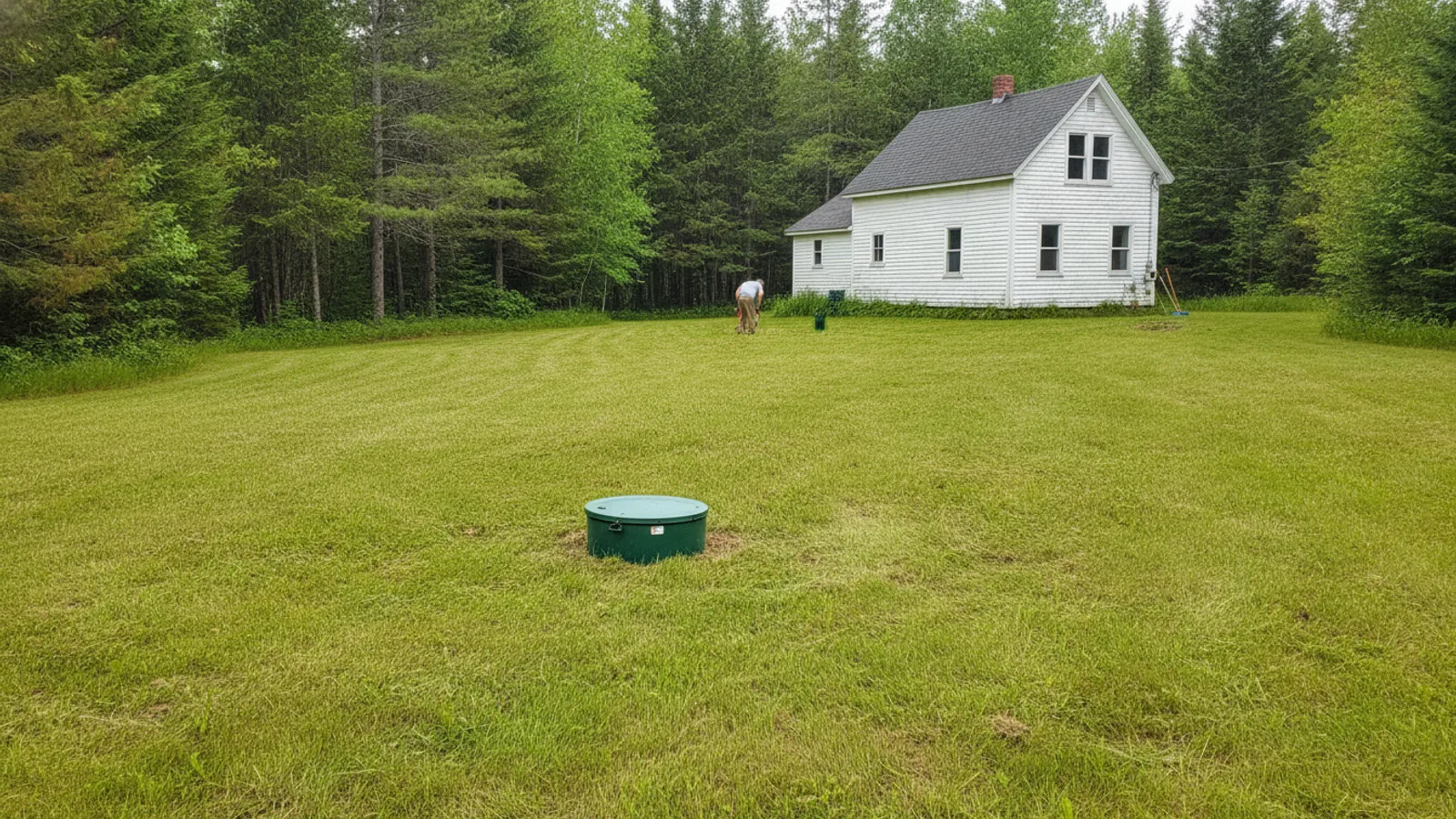
A septic tank lid is the only thing between your lawn and a hole several feet deep full of wastewater and gas. When it cracks, rots or goes missing, the risk is a fall through the opening, and the people most likely to find it are kids, pets and whoever is mowing. This guide covers septic tank lid replacement: how to spot a failing cover, what to do today to make it safe, and the permanent options. Risers get their own guide, whether a septic riser is worth it in Maine, so this one stays on the lid.
If you have an open or collapsed lid right now, keep everyone away from it and call (207) 300-9238 to get it looked at.
Why a bad septic tank lid is a safety problem first
Most septic trouble is slow and expensive. A bad lid is different: it is fast and dangerous. A cover that has weakened over decades can hold fine under its own weight and then give way under a child, a dog or the front wheel of a ride-on mower.
The air inside a tank is not breathable. It carries gases that can overcome a person in seconds, and the standard rule is that nobody goes into a tank, ever. That includes reaching in to retrieve a dropped toy or leaning in “just to look.” If someone falls in, call 911 and do not climb in after them.
Dirt tells you a lot too. A depression, a soft spot or a sunken ring in the lawn over where the tank sits can mean the lid or the tank top is failing. Treat it as a warning, not a lawn problem.
Types of septic tank lids you will find in Maine
Not every lid is the same, and the type changes your options.
Concrete lids. A concrete tank typically has one or more round or rectangular concrete covers, and on older systems they are often buried somewhere under the lawn. They are heavy and they last a long time, but the lifting handles can rust, edges can chip, and freeze and thaw can crack them.
Plastic or fiberglass riser lids. These sit on a riser, a pipe or collar that brings the opening up to the surface. They are light, usually green or black, and often bolt down. UV from the sun makes old ones brittle.
Old steel tops. Some older Maine tanks and camp systems have steel tanks or steel lids. They rust, especially at the top, and a rusted-through steel cover can fail with no warning. If you suspect steel, treat the whole area as unsafe until someone has looked at it.
If you are not sure what you have, or where the tank even is, our guide on how to find your septic tank walks through the usual places to look before anyone starts digging.
How to tell a septic lid is failing
Some signs are obvious and some only show up when you look closely. Here is how to read what you see.
| What you see | What it usually means | What to do |
|---|---|---|
| Visible crack or chipped edge on a concrete lid | Freeze and thaw, age, or a past impact | Make safe, then plan a replacement |
| Plastic lid faded, chalky or splintering | UV damage, now brittle | Replace before it breaks under weight |
| Lid sits crooked or rocks when stepped near | Seat or collar is damaged, or soil has settled | Keep off it and have it checked |
| Rust stains or flaking on a steel top | Steel is corroding from the inside out | Treat as unsafe, call for an inspection |
| Missing bolts or screws on a riser lid | Lid is no longer secured | Secure or cover it, then replace hardware |
| Sunken patch of lawn over the tank | Cover or tank top may be giving way | Fence it off and call |
| Smell at the tank location | Gas escaping around a poorly seated or cracked lid | Have the seal and lid inspected |
A cracked lid is not always an emergency, but it is never something to leave for next summer.
Make it safe today: temporary steps
You do not have to wait for a repair to remove the immediate danger. These steps are for making a bad lid safe, not for fixing it.
- Keep kids, pets and mowers away from the area. Rope it off if you have to.
- If the opening is exposed and the ground around it is firm, slide a heavy sheet of exterior plywood over it from the side, well past the edges, then weigh it down with concrete blocks so it cannot slide. Never stand at the edge of the hole to do it, and a flimsy tarp is not a cover, because someone will step on it.
- Mark the spot with bright stakes or flags so it is visible, especially if there is snow coming.
- Do not stand on a cracked lid to inspect it, and do not lean over an open hole.
- If the lawn around the lid has sunk or feels soft, do not walk up to it at all. Fence off a wide area and call.
- Skip driving over it. Cars and plow trucks are one of the common ways lids and tank tops fail. Our piece on plowing and driving over a septic system in winter covers how to keep equipment off it.
Say you have a 1980s system in Hermon, and your teenager is mowing the back lawn when the mower dips and you spot a dark crescent where the lid should be. Cover it, mark it, keep the mower away, and make the call that day. That is the right order.
Replacement options: a matching lid or a riser
Once the area is safe, there are two main ways to fix a failing cover. Which one makes sense depends on the tank and how it is set up.
A matching concrete lid. If the tank is concrete and the lid is the problem, a precast concrete company can often supply a new lid that fits the opening. The hole size and the lip matter, so measure before you order, and do not assume a lid is standard. The lid still ends up buried unless you also bring the access up to grade.
A riser with a bolted lid. A riser extends the access opening from the tank up to ground level or just above it. The lid bolts or locks down, which is safer around children, and it sits where you can reach it without digging. For the cost and the trade-offs of this route, see our post on whether a septic riser is worth it in Maine, which owns that topic.
A new or replacement lid is work for an installer or a precast supplier, not something we do. We pump, inspect, locate the tank and tell you what we saw, which is often what you need before you order anything.
Why a lid at grade beats a buried one
A lid buried a foot down feels fine until the day you need it. Then someone has to find it, dig it out, and later put the dirt back. Digging for a buried cover is an added fee on a pump-out, and in a Maine winter, with frost in the ground, it gets harder.
A lid at grade changes that. It is easier to find and check, it is easier to keep tabs on its condition, and a bolted lid is a lot harder for a child to open. You also see problems earlier, when a crack is still just a crack.
That ties directly to how often you need the tank open. Most households should pump every 3 to 5 years, and a visible lid means the tank is never forgotten. If your records are thin, our guide on how often to pump a septic tank in Maine helps you set a schedule.
What septic lid replacement costs: the drivers
There is no honest single number for a lid, so we do not print one. The price depends on what you are replacing and how you are doing it. Here is what moves it.
- Lid material and size. Concrete, plastic, fiberglass and steel all price differently, and round and rectangular openings differ.
- Whether you add a riser. A lid alone is one job. A riser plus a lid is another.
- Depth of the tank top. A deeper tank needs more riser height.
- Excavation. If the lid is buried, someone has to dig. Frozen ground adds to it.
- Condition of the opening. A cracked collar or a damaged tank top turns a lid swap into a bigger repair.
- Access to the site. Equipment has to reach the tank, and mud season and soft ground in March and April can slow that down.
- Who does the work. A precaster, an installer or a general contractor will each quote differently.
When you ask for a quote, ask what is included, whether excavation and backfill are in the price, what the lid material is, and whether the lid locks or bolts. Get at least two quotes if you can.
If you want the lid located and the tank looked at first, a pumping visit is a sensible starting point. A routine pump-out of a 1,000 to 1,500 gallon tank with an accessible cover runs $350 to $550, and a separate septic inspection runs $200 to $500. Book a pump-out or inspection and we will tell you what condition the cover and the tank access are in.
When a bad lid also points to a bigger problem
A damaged lid is sometimes just a damaged lid. Other times it is the first thing you see of something larger.
Say you have an older camp near Pushaw Lake that was opened for the season, and the cover has a long crack and a rust stain around the edge. The lid may be the least of it, because a steel tank top that rusts at the lid can be rusting elsewhere. That is worth a proper look before the first guests arrive, and our camp opening checklist lists what to check on a seasonal system.
If water pools around the lid after rain, or you smell sewage near it, the issue may not be the cover at all. In that case read our guide on septic problems after heavy rain. And if sewage is backing up in the house, call now at (207) 300-9238 rather than waiting. Our emergency septic service responds same-day or next morning, Sundays included.
One more case. Say you are shopping for a house in Glenburn and the inspection notes a lid that is buried and cracked. That is a negotiating point and a safety fix, not a reason to walk, and our guide to buying a house with a septic system in Maine explains how to handle it.
Where Maine rules come in
If all you are doing is swapping a lid or adding a riser to an existing tank, you are working on access, not redesigning the system. Even so, rules about what counts as a repair and what needs a permit are set locally. Your town’s local plumbing inspector can tell you what applies to your property, and shoreland zoning adds stricter rules near water.
For a general look at how a septic system is supposed to be kept up, the EPA has a plain-language page, how to care for your septic system, and our own septic maintenance page covers the routine work between pump-outs.
Frequently Asked Questions
Can I replace a septic tank lid myself?
A light plastic riser lid can often be swapped by a handy homeowner if it is the right size. A concrete lid can weigh well over a hundred pounds and a bad one can break under you, so it is a job for a crew with the right equipment. Never reach into the tank or lean over an open hole.
What should I do right now if my septic lid is cracked or missing?
Keep people, pets and mowers away from it. If the ground around it is firm, slide a heavy sheet of exterior plywood over the opening from the side and weight it with concrete blocks, then mark it. If the ground has sunk, stay back and fence off the area. Then book a visit so the lid can be replaced properly.
Should my septic lid be at ground level?
Yes, a lid at or just above grade is easier to find, easier to check and safer than one buried under soil. Many Maine owners get there by adding a riser, which brings the access up to the surface for good. Ask what the cost drivers are when you get a quote.
Does the pump-out price include digging up a buried lid?
No. A routine pump-out of a 1,000 to 1,500 gallon tank with an accessible cover runs $350 to $550. Digging for a buried cover is an added fee, which a riser removes permanently.