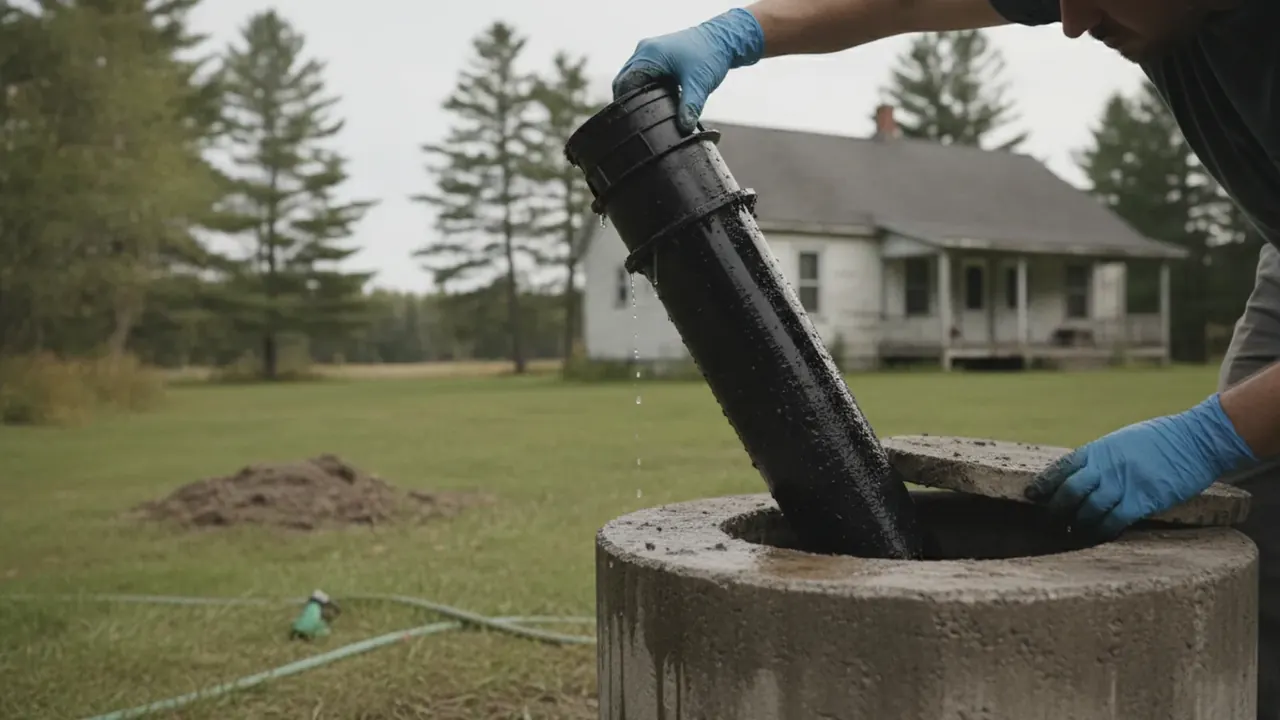
Dave in Hampden called us in a bit of a panic. His alarm had started chirping two days after a pumping he’d paid another company for, and he figured he’d been ripped off, or worse, that the tank was already full again. It wasn’t full. The crew that pumped it had never touched the effluent filter, a plastic cartridge sitting right in the outlet, and it had quietly clogged solid in the days after service, backing up flow just enough to trip the float switch. Fifteen minutes with a hose and it was over. No new part, no truck roll for anything major, just a filter nobody had bothered to rinse.
That little cartridge is one of the cheapest, most overlooked parts of your whole septic system, and it does more to protect your drainfield than almost anything else down there.
What Baffles Actually Do
Every septic tank has two baffles, or the modern equivalent: a tee fitting at the inlet and one at the outlet. Wastewater comes in through the inlet baffle, which points the incoming flow downward so it doesn’t churn up the scum layer floating on top or stir up settled sludge on the bottom. The outlet baffle does the same job in reverse. It pulls liquid from the clear middle zone of the tank, below the floating scum and above the settled solids, and sends that relatively clean water out to the drainfield.
Baffles are the whole reason a septic tank works at all. Without them, wastewater would flow straight through, and every bit of toilet paper, grease, and solid waste you flush would end up in the soil that’s supposed to treat your water. If a baffle deteriorates, particularly the old fiberglass or steel style used in older Bangor-area tanks, it can crack or rust through, and the tank stops sorting solids from liquid the way it should. That’s one reason a septic inspection checks baffle condition specifically, not just tank level.
The Effluent Filter: A Second Line of Defense
The outlet baffle does a good job, but it’s not perfect. Some fine solids and floating bits still ride along with the outgoing liquid. That’s where the effluent filter comes in. It’s a slotted plastic cartridge that fits inside or right next to the outlet baffle, and it physically screens the water one more time before it leaves the tank.
Think of it like a lint trap for your septic system. Anything too big to pass through those slots stays in the tank, where it belongs, instead of traveling out into the drainfield.
Modern tanks, and any system installed or upgraded in the last couple of decades in Penobscot County, almost always have one. Older tanks sometimes don’t, especially systems that predate current Maine Subsurface Wastewater rules. If you’re not sure whether yours has one, it’s a two-minute question for whoever pumps your tank next.
Why a Clogged Filter Is Good News, Not Bad
Here’s the part that trips people up. When a filter gets clogged enough to slow drainage or trigger an alarm, the instinct is to think something’s broken. It isn’t. The filter is doing exactly what it’s built to do.
Picture two identical tanks side by side, same size, same household, same age. One has an effluent filter that’s caked with hair and grease after two years. The other has no filter at all. The clogged filter is a five-minute cleaning job. The tank with no filter has been sending that same hair and grease straight into the drainfield for two years, silently coating the soil that’s supposed to absorb your wastewater. One of those tanks needs a hose. The other one needs a new field, eventually, and that’s not a cheap fix. Our guide on new septic system costs in Maine has real numbers on what a full replacement runs when a field finally gives out.
That’s the tell with effluent filters: a dirty one is proof the system is protecting itself. A missing one just means the protection isn’t there.
Cleaning It During a Pumping (Not an Extra Trip)
This is the part that should already be baked into every pumping visit. When we pump your tank, pulling and rinsing the effluent filter takes a few extra minutes with a hose, done right there at the truck. There’s no reason it should require a separate appointment or a separate charge for anything beyond the routine.
A few things worth knowing:
- It should be rinsed every pumping, at minimum. For most homes on a normal pumping schedule, that lines up naturally with our post on how often to pump a septic tank in Maine.
- Households with a garbage disposal, more people, or heavy laundry days clog filters faster. If yours seems to need attention more than once every few years, it’s not a defective part, it’s a sign of heavier-than-average solids load.
- A filter cartridge itself typically runs $30 to $90 to replace if it’s cracked, warped, or missing an alarm float that some models include.
Never open the tank yourself to check the filter. Septic tanks trap methane and hydrogen sulfide gas that can be lethal in minutes, even with the lid off and even if you don’t smell anything unusual. Pulling a filter is routine work for a technician with the right setup. It is not a DIY job.
The $30-90 Part vs. the $15,000 Field
This is the whole argument for effluent filters in one comparison. Here’s how the numbers actually stack up for a typical Bangor-area home.
| Item | Typical Cost | Frequency |
|---|---|---|
| Effluent filter cartridge | $30 – $90 | Replace occasionally, if damaged |
| Filter rinse during pumping | Usually included | Every pumping visit |
| Standard drainfield repair | $3,000 – $8,000 | As needed, if field is compromised |
| Full drainfield replacement | $10,000 – $20,000+ | Once, if field fails completely |
A field doesn’t fail because of one clogged filter. It fails from years of solids and grease reaching the soil that a filter would have stopped, one pumping at a time. Linda over in Orono has had the same effluent filter in her tank for six years now, rinsed at every pumping, never replaced. Her neighbor’s tank, same age, same house style, never had one installed. Guess whose drainfield needed a repair last summer.
If you want to see where a compromised field can push your total costs, our septic pumping cost guide breaks down how access, condition, and prior neglect all move the number.
What This Means for Your Next Pumping
If you’ve never asked whether your tank has an effluent filter, ask at your next visit. If it doesn’t, and your outlet baffle can accept one, adding it is a small cost that buys years of protection for a much bigger investment sitting under your yard. If it does have one, make sure it’s actually getting rinsed every time, not just quoted on the invoice.
Ready to get your tank checked, filter included? Call (509) 351-8404 or use our septic pumping cost calculator to see what a visit runs, then book online and we’ll take care of the rest, filter and all.
Frequently Asked Questions
What does a septic effluent filter do?
An effluent filter sits in the outlet baffle of the septic tank and screens the liquid before it leaves for the drainfield. It catches small solids, hair, and floating scum that would otherwise wash out and clog the soil in the field, which is a repair that costs far more than the filter itself.
Why did my septic alarm go off after the tank was pumped?
If the effluent filter was skipped during a pump-out or was never installed, solids can build up in the outlet fast, especially with a full tank in the days after service. That backs up flow and can trip a high water alarm. It is one of the more common reasons for a repeat visit soon after a supposedly routine pumping.
Is a clogged effluent filter a bad sign?
A dirty filter is not damage, it is the filter doing exactly what it was designed to do. The alternative, a system with no filter at all, lets that same material travel straight into the drainfield instead. A clogged filter just means it is time to rinse it off, which takes a few minutes during a normal pumping visit.
How much does it cost to add an effluent filter to an older septic tank?
Most effluent filter cartridges run 30 to 90 dollars for the part itself. If your outlet baffle already has a housing that accepts one, a technician can often install it during a routine pumping for a modest labor fee. Tanks without a compatible outlet baffle may need a small fitting added first.