Your shower drained fine last month. Now you’re standing in two inches of gray water every morning, and there’s a smell near the basement floor drain that wasn’t there in June. Nothing has backed up yet, but something’s off, and you know it.
Good news: you’re catching it at the right time. Almost every septic failure we see in the greater Bangor area announced itself weeks or months ahead of time. The signs your septic tank needs pumping are usually right there in plain sight. Most homeowners just don’t know what they’re looking at, especially in winter, when snow hides half the evidence.
This guide walks through nine warning signs, what each one actually means, and which ones say “book a pumping this month” versus “shut the water off and call somebody today.”
The 9 signs your septic tank needs pumping, at a glance:
- Every drain in the house slows down at once
- Pipes gurgle after you flush or drain
- Sewage smells indoors, outdoors, or from a frozen roof vent
- Soggy ground or pooling snowmelt over the tank
- Unusually green grass over the drainfield
- Sewage backing up into tubs or floor drains
- Weak toilet flushes throughout the house
- Nitrates or bacteria showing up in your well water
- Three or more years since your last pump-out
How Do I Know If My Septic Tank Is Full?
Quick refresher so the signs below make sense. Your tank collects everything that leaves the house. Solids sink to the bottom as sludge, grease floats to the top as scum, and the liquid in the middle flows out to the drainfield. According to the EPA, the average household system needs pumping every three to five years, and here in Maine, with our high water tables and long freezes, many homes need it closer to every two or three.
When sludge builds up too high, the tank runs out of working space. Wastewater has nowhere to go, so it either backs up toward the house or gets forced out to a drainfield that can’t keep up. Every symptom on this list traces back to that one problem: no room left in the tank.
If you’d rather skip the detective work, we can check your sludge level and tell you straight whether you need septic tank pumping or whether you’ve got another year. Call (509) 351-8404 or book online and we’ll get you on the schedule.
1. Drains Slow Down Everywhere at Once
One slow sink is a clog. Every drain in the house running slow at the same time is a septic problem, and it’s the single most common early warning we hear about.
Here’s the difference. A hair clog in the bathroom doesn’t affect the kitchen sink. But when the tank is full, the whole house shares one bottleneck, so the tub, the toilet, the washer, and the kitchen sink all struggle together. If you’ve already snaked a drain or two and nothing improved, stop buying drain cleaner. It won’t fix a full tank, and the harsh stuff can kill the bacteria your system depends on.
2. Gurgling Pipes After You Flush or Drain
That “blub-blub-blub” sound from the toilet after the washing machine drains? That’s air fighting its way through a waterlogged system. When the tank is full, wastewater moves slowly and traps air in the lines, and that air has to bubble back up somewhere.
Gurgling usually shows up a few weeks before slow drains get bad. If you’re hearing it regularly, you’ve got a window to act before things get messy. Take it.
3. Sewage Smells Inside, Outside, or From a Frozen Vent
A healthy system shouldn’t smell like anything from inside your house or standing in your yard. When the tank fills up, gases get pushed back through the plumbing and out through every weak point: floor drains, seldom-used sinks, and the vent stack on your roof.
Maine winters add a twist here. When it’s well below zero for a stretch, the moisture in septic gases can freeze inside the roof vent and slowly cap it with frost. A blocked vent forces gas back down into the house, so a sewage smell that only shows up during a January cold snap might be a frozen vent, not a full tank. But if the smell hangs around after a thaw, or you smell it outdoors near the tank lids, the tank itself is the likely culprit. Our post on whether septic systems freeze in Maine covers the vent problem in more detail.
4. Soggy Ground or Pooling Snowmelt Over the Tank
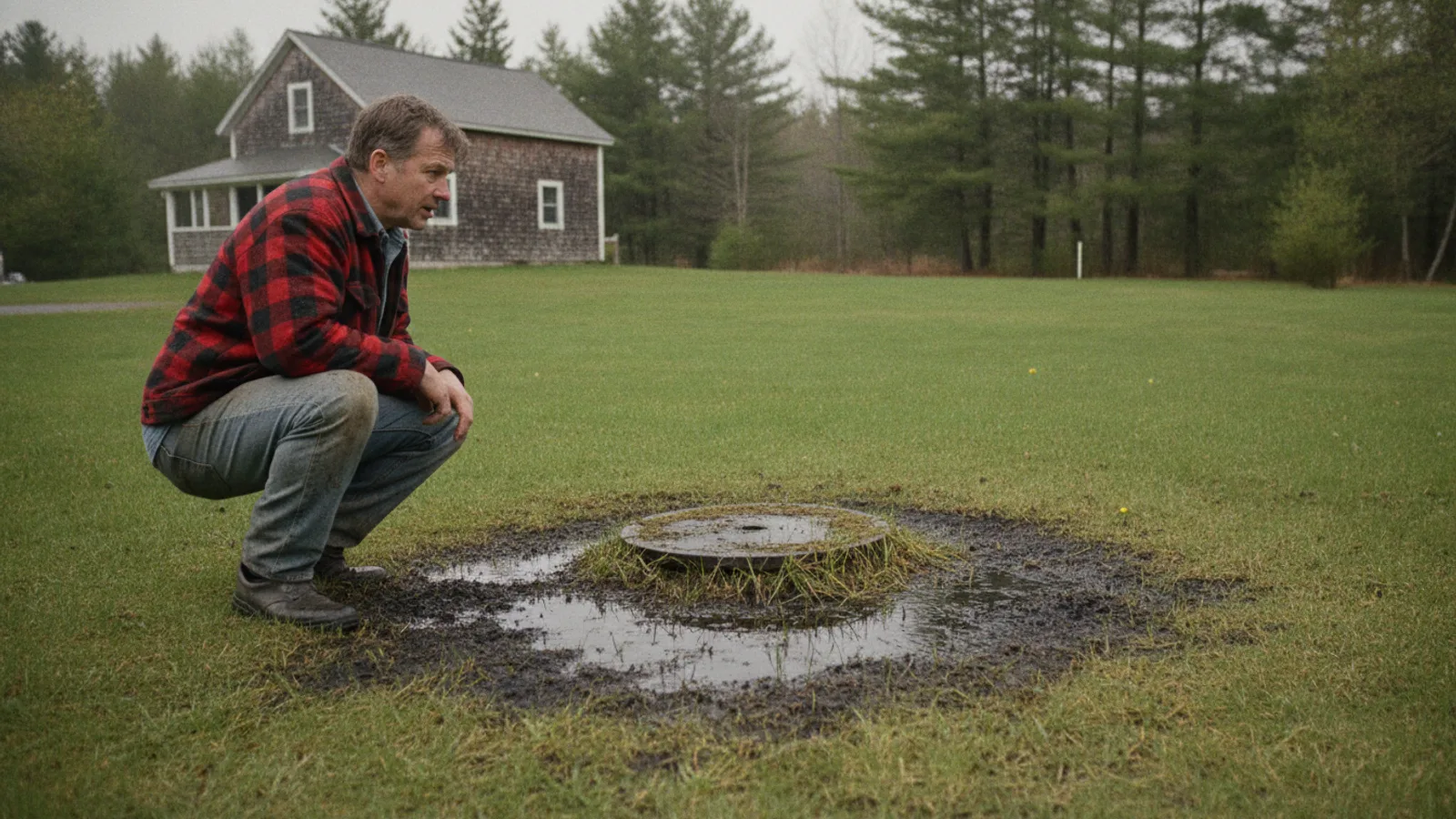
This is the big Maine-specific tell, and spring thaw is when it shows itself. When March and April melt three feet of snowpack, that water should soak away evenly across your yard. If it pools and lingers in one rectangle over your tank or drainfield while the rest of the lawn drains fine, your system is likely saturated and pushing effluent up instead of down.
In winter, watch for the opposite clue: a patch of yard where snow melts faster than everywhere else. Wastewater sitting near the surface is warmer than frozen ground, so a bare stripe in an otherwise snowy yard can outline exactly where your problem is.
Denny in Hampden called us last April about “a spring popping up” in his side yard during the thaw. It wasn’t a spring. His tank hadn’t been pumped in seven years, and effluent was surfacing over the outlet. A $325 pumping and a follow-up check caught it before the drainfield was damaged. His neighbor two roads over waited on the same symptom the year before and ended up with a $9,400 drainfield replacement.
5. Grass That’s Too Green Over the Drainfield
Bright green, fast-growing stripes of grass over the drainfield in summer mean the same thing as that melted snow patch in winter: your lawn is being fertilized from below. Effluent that should be filtering down through the soil is rising up near the roots instead.
Plenty of Bangor and Brewer homeowners take this one as a compliment to their lawn care. It isn’t. It’s one of the classic signs your septic tank is full, and it usually shows up alongside odors outdoors. A septic inspection can tell you whether pumping will solve it or whether the drainfield itself needs attention.
6. Sewage Backing Up Into Tubs and Floor Drains
Now we’re past “warning sign” and into “act today.” When wastewater has truly nowhere to go, it comes back up through the lowest fixtures in the house first, usually a basement floor drain, a first-floor tub, or a shower.
If you see dark water or waste rising in a low drain, stop running water immediately. Every flush and every load of laundry from that point on ends up on your floor. We’ve written a full step-by-step guide on what to do when your septic is backing up, but the short version is: shut off the water, keep everyone away from the mess, and call for emergency septic service at (509) 351-8404. Sewage carries real disease risk, and cleanup gets expensive fast.
Marc in Brewer learned this one the hard way last November. He’d noticed gurgling for a month and figured it could wait until spring. It backed up into his finished basement on a Sunday night: $340 for the emergency pump-out, and about $2,100 in flooring and cleanup. The pumping alone, booked a month earlier, would’ve been the whole bill.
7. Toilets Flush Weak or Need a Second Try
A toilet that flushes lazily, needs two tries, or lets the water rise a little too high before it slowly drops is telling you there’s back-pressure in the line. If it’s one toilet, suspect the toilet. If it’s every toilet in the house, suspect the tank.
This one’s easy to live with for months, which is exactly why it’s dangerous. The system doesn’t heal itself, and “it still mostly works” almost always ends in a backup at the least convenient time. In Maine, that usually means February, when the ground is frozen solid and access is hardest.
8. Nitrates or Bacteria Show Up in Your Well Water
Most homes outside the Bangor and Old Town water districts are on private wells, and your well is the canary for your septic system. A failing or chronically overfull tank can leak nitrates and coliform bacteria into the groundwater your family drinks.
The EPA recommends testing private well water at least once a year. If a test comes back with rising nitrates or any coliform hit, and your tank is overdue, get the system checked right away. This is the one sign on this list that’s a health issue before it’s a plumbing issue.
9. It’s Been Three-Plus Years: The Quietest of the Septic Tank Warning Signs
No smell, no gurgle, no soggy yard, but you honestly can’t remember the last pump-out? The calendar is a warning sign all by itself, and it’s the one that saves people the most money when they listen to it.
Sludge builds silently. By the time a full tank produces symptoms, some of the damage to the drainfield may already be underway. For a typical Penobscot County family of four with a 1,000-gallon tank, every two to three years is the safe rhythm. Smaller households and seasonal camps around Orono, Glenburn, and Hermon can often stretch longer. Our guide on how often to pump a septic tank in Maine breaks down the schedule by household size.
Karen bought a camp outside Old Town in 2023 with “recently serviced” in the listing. No paperwork, though. She had us check it during a camp opening that spring: the tank was within an inch of the outlet baffle. A $300 pumping that day, versus the drainfield failure that was one busy summer of guests away.
Quick Reference: What Each Sign Means and How Fast to Act
| Sign | What It Usually Means | Urgency |
|---|---|---|
| All drains slow at once | Tank at or near capacity | Book pumping within 1-2 weeks |
| Gurgling pipes | Air trapped in a waterlogged system | Book pumping within 1-2 weeks |
| Sewage odors (persistent) | Gases backing up from a full tank | Book pumping soon; check vent first in deep cold |
| Snowmelt pooling or bare snow patch over tank | Effluent surfacing, system saturated | Call within days |
| Extra-green grass over drainfield | Effluent rising toward the surface | Inspection within days |
| Sewage in tubs or floor drains | Full backup in progress | Emergency, call today |
| Weak, slow toilet flushes (all toilets) | Back-pressure from a full tank | Book pumping within 1-2 weeks |
| Nitrates or bacteria in well water | Possible septic leaching into groundwater | Test and inspect immediately |
| 3+ years since last pumping | Sludge near capacity even without symptoms | Schedule at your convenience, soon |
What to Do Next (And What Not to Do)
If you counted one early sign, get a pumping on the calendar. If you counted two or more, or anything from the “call today” rows above, don’t wait for spring or a better paycheck. A standard pump-out in the greater Bangor area costs a few hundred dollars. A drainfield replacement runs well into five figures. You can ballpark your own job in about a minute with our septic pumping cost calculator, or read up on what septic pumping costs in Maine before you call anyone.
A word on safety, because it matters more than anything else on this page. Never open a septic tank lid yourself, and never, ever lean over or enter a tank. The gases inside can knock a healthy adult unconscious in seconds, and people die this way every year. DIY ends at watching your drains and your yard. Checking sludge levels, opening lids, and diagnosing the system is professional work with proper equipment, full stop.
If you’re anywhere in Penobscot County, from Veazie up through Orono and out to Hermon, we’re happy to take a look and give you an honest answer, even if that answer is “you’re fine for another year.” Call (509) 351-8404 or book your pumping online. We’d much rather pump your tank on a sunny Tuesday than dig it out of a snowbank at midnight.
Frequently Asked Questions
How do I know if my septic tank is full without opening it?
Watch for slow drains throughout the house, gurgling pipes, sewage odors, and soggy or unusually green ground over the tank and drainfield. If two or more of these show up together, the tank is likely at or near capacity. A pumping visit or septic inspection can confirm it without you ever touching a lid, which you shouldn’t do anyway.
How often should a septic tank be pumped in Maine?
Most Maine households need pumping every 2 to 4 years, depending on tank size and how many people live in the home. Seasonal camps can often go longer, while larger families or homes with garbage disposals may need service more often. When in doubt, have the sludge level checked and work from real numbers instead of guesses.
Can cold weather make a full septic tank worse?
Yes. Frozen ground traps effluent near the surface, vent pipes can ice over and push odors back into the house, and a saturated drainfield has nowhere to send water during spring thaw. A tank that’s already full going into winter is far more likely to back up before April, which is why we push fall pumpings so hard.
How much does septic pumping cost in the Bangor area?
Most standard pumpings in the greater Bangor area run a few hundred dollars, with the exact price depending on tank size, access, and how long it’s been since the last service. Emergency calls and deeply buried lids add to the bill. Our cost calculator will get you a local estimate in about a minute, or just call (509) 351-8404 and ask.
What happens if you never pump your septic tank?
Sludge keeps building until solids wash out of the tank and into the drainfield, where they clog the soil that treats your wastewater. That leads to backups in the house and, eventually, drainfield failure, a repair that runs well into five figures. The tank keeps working silently right up until it doesn’t, which is why the schedule matters even when nothing seems wrong.