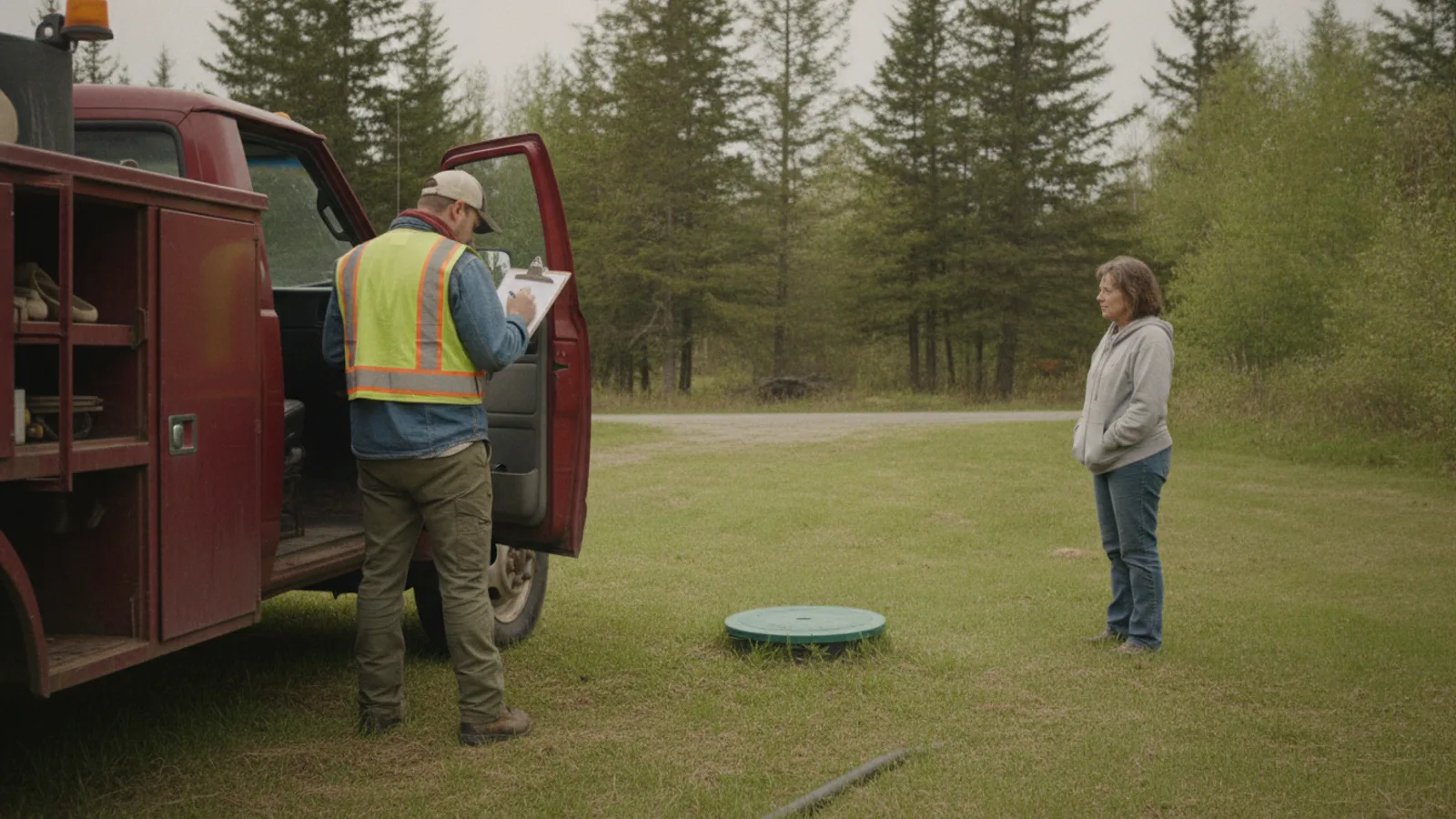
The inspection question usually shows up at the worst possible time. You’re three weeks from closing on a house sale, or you just noticed the lawn over the leach field looking a little too green, and suddenly you need a number. So here it is straight: a septic inspection in the Bangor area costs $200 to $500 in 2026. A basic visual check runs at the low end, and a full real estate inspection with a flow test sits at the top. That range is the honest answer to the septic inspection cost Maine homeowners keep searching for, and the rest of this guide breaks down exactly where your job lands in it.
We’ll cover what each type of inspection includes, the add-ons that push a bill higher, why bundling an inspection with a pump-out is the single best value in septic service, and what Maine law actually requires when you sell.
Septic Inspection Cost in Maine: The 2026 Numbers
There isn’t one price because there isn’t one inspection. What you pay depends on how deep the look goes and how much paperwork comes out the other end.
| Inspection type | Typical 2026 price (Bangor area) | Best for |
|---|---|---|
| Visual check during a pump-out | $0 to $75 added to the pumping bill | Homeowners already due for pumping |
| Routine standalone inspection | $200 to $350 | Peace of mind, new-to-you homes, pre-listing prep |
| Full real estate inspection with flow test | $350 to $500 | Home sales, refinancing, shoreland-zone transfers |
For context, the national range runs roughly $150 to $450 for a routine inspection and $300 to $650 for a real estate inspection. Our local $200 to $500 window sits right in the middle of that, which is about where it should be. Maine’s short digging season and rural drive times push us above the cheapest markets, but we don’t have the big-metro overhead that drives the top of the national range.
A quick word on that first row, because most people miss it. During a pump-out, the technician is already standing over an open, empty tank. Checking the baffles, filter, and walls at that moment costs almost nothing, which is why a visual check bundled with septic tank pumping is free or a small add-on. The same look as a standalone visit means a truck roll, a dig, and an hour of labor. Same eyes, very different invoice.
If you want a real number for your property instead of a range, call us at (509) 351-8404 and describe your tank, your access, and why you need the inspection. You’ll have a quote in a couple of minutes. Or book online and we’ll confirm the price before the truck rolls.
Routine vs Real Estate: Two Different Jobs
These two get lumped together, but they’re built for different customers and priced accordingly.
A routine inspection is a health check for the person who already owns the system. The tech exposes the tank, measures the scum and sludge layers, checks that the inlet and outlet baffles are intact, pulls and rinses the outlet filter if you have one, and walks the leach field looking for soggy spots, odors, or that suspiciously lush grass. You get a verbal rundown and usually a short written summary. Thirty to sixty minutes, $200 to $350, done.
A full real estate inspection is a documented evaluation for a transaction, and everything about it is heavier. The tank gets pumped so the inspector can see the walls, the baffles, and the condition of the concrete or plastic with nothing hiding it. A flow test or load test pushes water through the system to prove the field can actually accept it. The inspector pulls whatever records exist, ideally the original HHE-200 design form from the town office, and compares what’s in the ground to what was permitted. Then it all goes into a formal written report that the buyer, the lender, and sometimes the code enforcement officer will read. That’s 1.5 to 3 hours of work and $350 to $500, more if access is bad.
Here’s the difference in real life. Dave in Hampden listed his place last spring and ordered a full real estate inspection through our septic inspection service before the buyer’s agent could order their own. It ran him $465 with the pump-out included. The report flagged a deteriorating outlet baffle, a $250 fix he handled before the buyer ever saw the tank. His sale closed without a single septic question. The seller two roads over skipped the pre-listing inspection, the buyer’s inspector found the same baffle problem a week before closing, and that seller credited the buyer $2,000 because there was no time to fix and re-verify. Same problem, ten times the price.
The EPA’s SepticSmart program recommends inspecting most systems at least every three years, and around here the easiest way to hit that mark is the bundle we’ll get to in a minute.
What Moves the Septic Inspection Cost Up or Down
The base prices above assume the inspector can find your tank and reach the cover without a shovel. When that’s not true, the add-ons start stacking.
| Cost factor | Typical added cost | Why it costs more |
|---|---|---|
| Buried cover, hand digging required | $50 to $150 | Shovel time before the inspection even starts |
| Tank locating (location unknown) | $100 to $250 | Probing, records research, sometimes electronic locating |
| Camera inspection of lines | $150 to $350 | Specialized equipment and a tech trained to read it |
| Pumping bundled with the inspection | $300 to $500 for both together | The pump-out is the cost; the inspection piggybacks cheap |
| Winter or frozen-ground access | $75 to $250 | Snow removal and frozen soil over the cover |
| Extra written documentation for a lender | $50 to $100 | Report formatting, photos, records copies |
Two of those rows deserve a closer look.
The digging and locating fees are the most avoidable money in this guide. If your cover sits under a foot of soil, you’ll pay for a dig every time the tank is opened. A riser that brings the cover to grade runs $200 to $400 installed and deletes that fee forever. And once your tank is found the first time, keep a simple sketch with measurements from the house so you never pay a locating fee again.
And notice what the bundling row says. When pumping and inspection happen in one visit, the combined bill is often barely more than the pump-out alone. Which brings us to the best deal in septic.
The Best Value: Inspect While the Tank Is Already Open
A standalone inspection and a standalone pump-out are two truck rolls, two setups, and two invoices. Combine them and you pay for one visit.
The logic is simple. The most useful part of any inspection is seeing the tank empty. Baffle damage, cracks, root intrusion, and a sagging inlet all hide below the waterline in a full tank. A pump-out removes the waterline. So the moment your tank is empty for pumping is the cheapest and most thorough inspection opportunity you’ll ever get.
Sue in Brewer figured this out after years of paying separately. Her last visit was a pump-out with a full inspection added on: $525 total, where the same two services booked months apart would have run closer to $700. The tech caught early sludge carryover, swapped her filter, and tightened her pumping schedule from five years to four. That adjustment matters more to her leach field’s lifespan than anything else on the invoice.
If you’re already seeing warning signs, slow drains, gurgling, or odd smells near the tank, check our guide to the signs your septic tank needs pumping, because you may be able to solve two problems with one appointment. And for the pumping side of the math, our septic pumping cost guide breaks down the 2026 numbers, or you can run your own estimate with the cost calculator.
One thing we have to say plainly: never open a septic tank cover yourself, and never lean over or enter an open tank. The gases inside can drop a healthy adult in seconds. Leave open tanks to techs with the training and equipment for it.
Selling a House? Maine’s Shoreland Rule Changes the Math
Maine doesn’t have a blanket law forcing a septic inspection on every home sale. But if the property sits in a shoreland zone, generally within 250 feet of a lake, pond, river, or certain wetlands, state rules require an inspection by a state-certified site evaluator or inspector at the time of transfer. Around here that catches a lot of properties: camps on the lakes near Old Town, riverfront homes along the Penobscot, and plenty of places that don’t feel like waterfront until you measure.
Certified shoreland inspections follow a specific state format, and the paperwork ends up with the town. That’s part of why real estate inspections cost more than routine ones. The full details, including who qualifies as certified and what happens if the system fails, are in our guide to Maine septic inspection laws when selling a house. The state’s Subsurface Wastewater Program is the office behind the rules and the keeper of the design records.
Outside the shoreland zone, no statute forces the inspection. Your buyer’s lender almost certainly will, though, and any buyer with a decent agent will ask. Practically, if you’re selling a Maine home on septic, plan on an inspection and budget $350 to $500 for the full version. Ordering it yourself before listing, like Dave did, keeps you in control of the timeline and the repair bids.
When a Camera Inspection Is Worth the Extra $150 to $350
A camera inspection sends a small video head through the pipe between the house and the tank, or out toward the distribution box, and shows exactly what’s happening inside the line. It’s a genuinely useful tool. It’s also not something every inspection needs, and an honest company will tell you which situation you’re in.
Skip the camera when a standard inspection comes back clean and the system is behaving. There’s nothing for the camera to find that the open-tank check didn’t already cover.
Bring in the camera when there’s a specific question a visual inspection can’t answer. Repeated backups with a tank that isn’t full. A soggy stripe over one section of pipe. A line that runs under a driveway, a big maple, or an addition, where roots and crushing are real risks and digging blind would cost thousands.
Mark in Old Town is the textbook case. Two backups in six months, but his tank was barely half full each time we arrived. A $275 camera run found the answer in twenty minutes: a section of inlet pipe crushed by frost heave under his walkway. The fix was a targeted dig and a $700 repair. Without the camera, the guesswork started with excavating the whole line at $3,000 and up. That’s what a camera buys: a cheap, specific answer to an expensive mystery.
If you’re not sure whether your situation needs the camera, describe it to us and we’ll tell you straight. Our septic inspection page covers what’s included at each level, or just book a visit and we’ll bring the right equipment the first time.
Frequently Asked Questions
What is included in a septic inspection?
A routine inspection covers the tank, baffles, outlet filter, scum and sludge measurements, and a surface check of the leach field, finished with a verbal or short written summary. A full real estate inspection adds a pump-out, a flow test, a records review against the original design, and a formal written report. Camera work on the lines is an optional add-on used when a blockage or break is suspected.
How long does a septic inspection take?
A routine inspection usually takes 30 to 60 minutes once the cover is exposed. A full real estate inspection with pumping and a flow test runs about 1.5 to 3 hours. If the cover is buried deep or nobody knows where the tank is, add an hour or more for digging and locating.
Is a septic inspection required to sell a house in Maine?
There’s no blanket statewide mandate, but properties in a shoreland zone generally require an inspection by a state-certified inspector at the time of sale. Outside the shoreland zone, most lenders and buyers require one anyway, so in practice nearly every Maine home sale on septic includes an inspection. Our shoreland-zone law guide covers the details.
What is the difference between a routine and a real estate inspection?
A routine inspection is a health check for the current owner, typically $200 to $350, with a quick summary of what the tech found. A real estate inspection is a documented evaluation for a transaction, typically $350 to $500, and includes pumping the tank, testing flow to the field, and producing a written report that buyers, lenders, and code officers can rely on. The price gap buys the pump-out, the testing, and the paperwork.