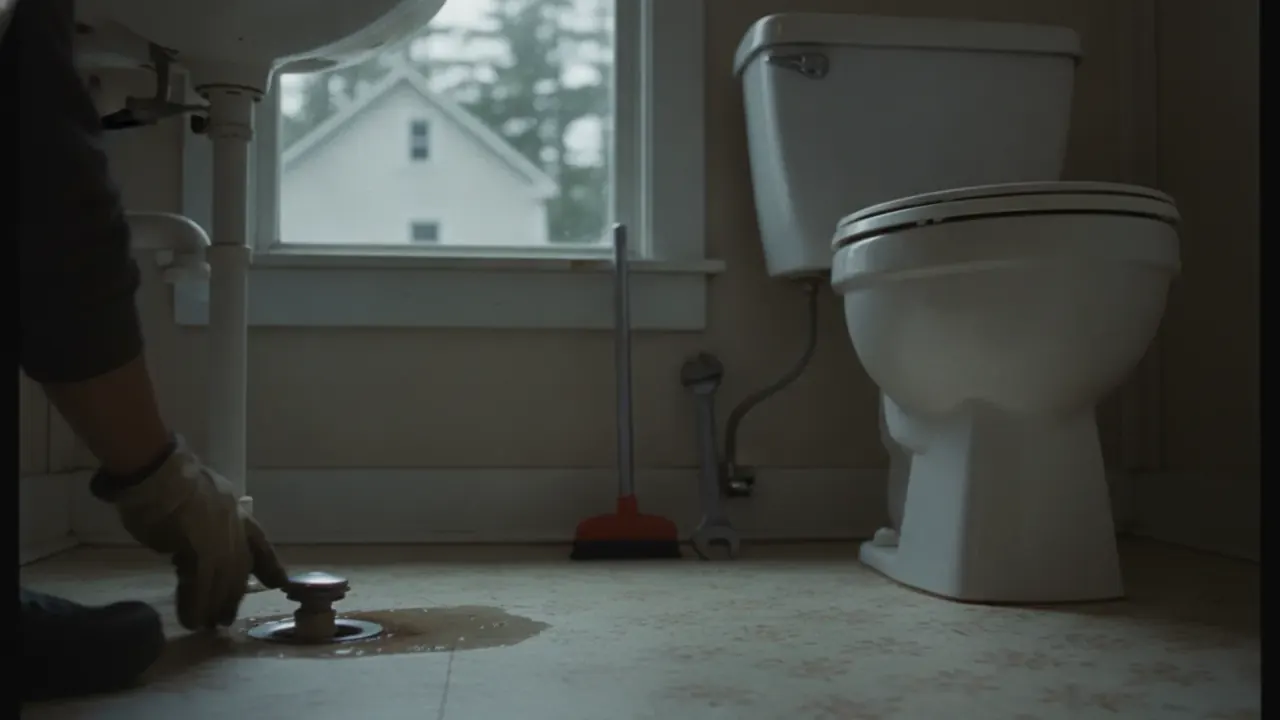
Dave in Hampden noticed it on a Tuesday night. He flushed the upstairs toilet and the downstairs one burped back at him — a low, wet gulp, like the house had indigestion. No backup, no smell, nothing on the floor. Just a noise. He almost ignored it. Two weeks later he was calling us at 8 p.m. with two inches of water on his basement floor.
That gurgle was the whole warning. Here is what it means and what to do with it before it turns into Dave’s Tuesday night.
What Gurgling Actually Is
Your plumbing system runs on a balance of water going down and air coming in behind it. Every drain has a vent pipe that runs up through the roof, and its whole job is to let air into the system so water can flow smoothly, the way a second hole in a gas can lets fuel pour out instead of glugging. When that air can’t get in through the vent, it finds another way in — backward, through the water in your traps, which is what makes the bubbling and gurgling sound you hear at the fixture.
There are two basic reasons air gets forced backward like that:
A blocked or undersized vent. Sometimes it is as dumb as a bird’s nest or a dead squirrel in the roof vent, or ice sealing it shut in a hard Maine winter. Air genuinely cannot get in from outside, so it steals it from your drains instead.
Nowhere for the water to go on the septic side. This is the more common one, and the one you need to take seriously. If your septic tank is full to the point that it cannot accept incoming wastewater fast enough, or if the drain field is saturated and backing pressure up into the tank, the whole system loses its ability to “breathe.” Water you send down the drain has nowhere to displace to, so air gets shoved back up through the pipes and out the nearest low fixture — very often the toilet, because it has the most direct, wide-open path to the main line.
The Tell: One Drain vs. the Whole House
This is the single most useful diagnostic you have, and it costs nothing.
| What you’re hearing | Likely cause | Urgency |
|---|---|---|
| Only the kitchen sink gurgles, nothing else | Local clog in that branch line, or a dry trap | Low — a plumbing fix, not a septic emergency |
| One bathroom sink gurgles occasionally | Dry trap (common in guest bathrooms) or minor local blockage | Low |
| Toilet bubbles when the washing machine drains | Shared line or vent restriction, or tank nearing capacity | Medium — worth a look this week |
| Multiple fixtures gurgle at once, especially the lowest drain in the house | Septic tank full, drain field saturated, or main line blocked | High — treat as pre-backup |
| Gurgling plus slow drains everywhere plus a faint sewer smell | Septic system failing to accept flow | High — schedule service now |
If it’s isolated to one fixture, you likely have a local plumbing issue, not a septic emergency — a plunger or a call to a plumber solves it. If it’s happening across multiple fixtures, especially the lowest drain in the house (that’s usually a basement floor drain or a lower-level bathroom), your septic system is the more likely culprit, and it’s time to stop guessing and get eyes on the tank.
Why This Is Different From “Signs You Need Pumping”
We’ve covered the general signs a septic tank needs pumping elsewhere, and slow drains are on that list too. Gurgling deserves its own conversation because it’s an earlier, more specific signal. Slow drains can mean a lot of things — a low-flow fixture, hard water buildup, a tree root nudging a line. Gurgling is more precise: it’s air being displaced somewhere it shouldn’t be, and in a septic system that almost always traces back to a capacity or venting problem rather than a cosmetic one.
Think of it as your system’s early-warning system, one notch before things get physical. Linda in Orono had gurgling toilets for about ten days before her kitchen sink backed up black water. If she’d called when the gurgling started, it would’ve been a routine pump-out. Instead it became a cleanup.
When Gurgling Precedes an Actual Backup
Gurgling and bubbling are the sound of a system running out of room. If the underlying cause isn’t a bird’s nest in the vent pipe, it is very often one of these:
- The tank is full and hasn’t been pumped on schedule. Solids have built up to the point where there isn’t enough working volume left to absorb normal daily flow.
- The drain field is saturated, either from age, overuse, or (very common in Maine in spring) heavy rain and snowmelt pushing groundwater up around the field faster than it can drain.
- A baffle or effluent filter is clogged, restricting flow between the tank and the field and creating backpressure that shows up as gurgling at the house.
None of these fix themselves. If the gurgling is happening in multiple fixtures and you’re seeing it get worse over a few days rather than staying the same, that’s the pattern that precedes a full septic backup. Better to catch it here.
Act-Now Steps If You’re Hearing It
- Stop adding water. Hold off on laundry, long showers, and the dishwasher until you know what’s going on. Every gallon you send down is one more gallon the system has to find room for.
- Check how many fixtures are affected. Run water in a couple of different rooms and listen. One drain is a local issue; three or four is systemic.
- Look outside, briefly, from a distance. Standing water, unusually spongy or bright green grass over the drain field, or a sewage smell near the tank lid are all confirming signs. Never lift a tank lid or go near an open tank — the gases inside are genuinely dangerous, even lethal, and this is not a DIY inspection.
- Check your pumping history. If it’s been close to three years, or longer, since the tank was serviced, that alone probably explains it.
- Call for an inspection before it becomes a backup. A tech can run a camera, check tank levels, and pump if needed — usually a same-week fix if you call early, versus an emergency cleanup if you wait.
Mike in Brewer called us the same afternoon his toilets started bubbling during laundry day. Turned out his tank was about four inches from the outlet baffle — close, but nowhere near backing up yet. A routine pump-out and he was done in under an hour. That’s the version of this story you want.
What a Tech Will Actually Check
When gurgling is the complaint, a proper visit isn’t just “pump it and hope.” A good inspection walks through:
Tank level. How much solid buildup versus working capacity is left. This alone explains most gurgling calls.
Outlet baffle and effluent filter. A clogged filter is a cheap, five-minute fix that can resolve gurgling completely — no pumping required. We cover this in more depth in our septic effluent filter guide, but the short version is: it’s a $30 part that can save you a $500 emergency call.
Drain field condition. Standing water, odor, or unusually lush grass over the field lines all point toward field saturation rather than a simple full tank.
Vent stack. If the tank and field both check out fine, the problem may genuinely be a blocked roof vent, which is a plumber’s fix, not ours — but we’ll tell you so you’re not paying for the wrong service.
If you want a ballpark on what any of this runs before you call, our septic pumping cost calculator gives you a real number for your tank size and situation in under a minute.
A Maine-Specific Wrinkle
Spring thaw and heavy rain are the two times of year we get the most gurgling calls around Bangor, Old Town, and out toward the county. Frost keeps groundwater locked up all winter, then it releases all at once, saturating drain fields that were doing just fine in January. If your gurgling started right after a big rain or during mud season, field saturation is the leading suspect, and it’s worth a look even if the tank was pumped recently. We’ve written more on this seasonal pattern in our piece on septic problems after heavy rain and spring thaw.
Don’t Wait for the Second Warning
A gurgle is polite. A backup is not. If your drains are talking to you, the cheapest and easiest response is a phone call now, not a mop bucket later. Reach us at (207) 300-9238 or grab a slot directly through our online booking — either way, we’d rather come out for a $20 filter check than a flooded basement.
For general background on when tanks typically need attention, our guide on septic inspection cost in Maine breaks down what a proactive visit runs versus an emergency one, and the Maine Center for Disease Control’s Subsurface Wastewater Program has good baseline info on how systems are supposed to function if you want the regulatory side of things.
Frequently Asked Questions
Why does my toilet gurgle when I run the washing machine?
That usually means your drain lines are sharing a vent path that is partially blocked or your septic tank is too full to accept water fast, so air gets forced backward through the closest low point, which is often the toilet.
Is a gurgling drain always a septic problem?
No. A single gurgling drain, like just the kitchen sink, is often a local clog or a dry trap. Gurgling in multiple fixtures across the house, especially the lowest ones, points toward the septic tank or main line.
Can a bubbling toilet mean the septic tank is about to back up?
Yes. Bubbling in multiple drains is one of the most common warning signs that comes shortly before an actual backup, because it means wastewater has nowhere to go and air is being pushed back through the pipes instead.
What should I do first if my drains start gurgling?
Stop running water, especially laundry and showers, and check whether more than one fixture is affected. If it is just one drain, it may be a local clog. If it is several, treat it as an early septic warning and call for an inspection before it turns into a backup.