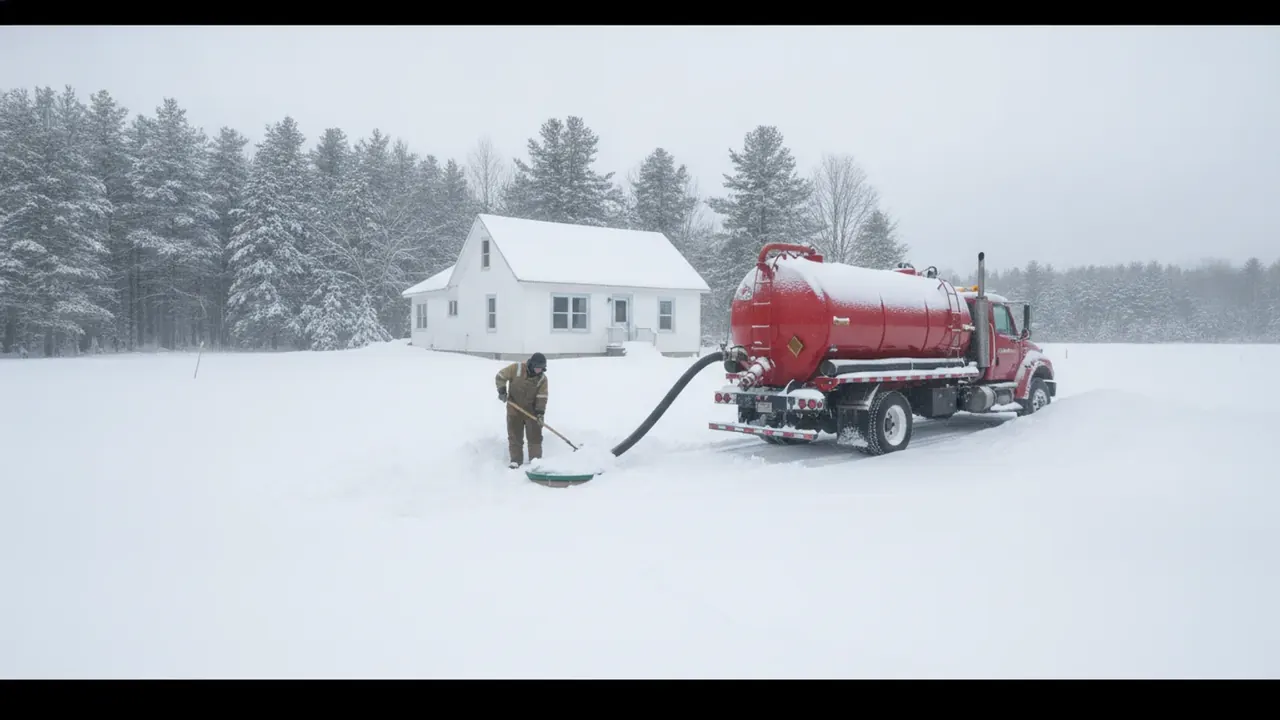
You’re heading south in November, or you’ve inherited a house in Hermon that nobody will live in until spring, and one question keeps coming up: what happens to the septic system with no one home? The short answer is that a vacant house septic system is usually fine. A tank and field can sit idle for months without harm. The things that actually go wrong are frozen pipes, a dead power supply to an alarm or pump, and a few small mistakes you can head off in an afternoon.
This guide is for year-round houses left empty, for snowbirds and for estates waiting on probate. Closing a seasonal camp is a different job, covered in our guide to winterizing a septic system when closing a camp. If you’re not sure the tank is due, you can book a pump-out or inspection or call (207) 300-9238 before you leave.
What happens to a septic tank when nobody is home
A septic system is a tank plus a drain field (the buried area of gravel or soil where the liquid finally soaks away). With a house in daily use, wastewater flows in all day. The solids settle to the bottom as sludge, grease floats as scum, and the liquid in the middle moves out to the field.
When the flow stops, almost nothing changes in the tank itself. The water level stays where the outlet sets it. The sludge layer stays put. The bacteria that break down waste slow down in the cold and with no fresh food, but they don’t die off. They live in the sludge and in the soil under the field, and they ramp back up within days to weeks after you return. You don’t need an additive to restart them.
The drain field gets a long rest, and months of rest don’t shorten its life. Conventional drain fields last roughly 20 to 30 years. The worries are physical: water that freezes, power that fails, and pipes that crack.
Should you pump before you leave?
Usually no, unless the tank is already due. Most households pump every 3 to 5 years, and an empty house doesn’t speed that up or slow it down. If your last pump-out was two years ago, pumping now just spends $350 to $550 early on a tank that has room.
There are three situations where pumping before you leave makes sense:
- The tank is due or overdue. If you can’t remember the last pump-out, or it’s been more than 4 or 5 years, do it before you go. A nearly full tank is the one that can push solids toward the field, and nobody will be home to notice slow drains. Our post on how often to pump a septic tank in Maine walks through the factors.
- The house is being sold or handed over. Buyers often ask for a recent pump-out and inspection on record, and it is easier to get that done before the snow than during a January closing.
- You can’t get the cover open in winter. If the cover is buried under a driveway or a drift, getting to it in January costs more. Digging for a buried cover is an added fee, and a winter surcharge of $100 to $300 can apply on top of the routine price. A riser (a pipe that brings the access lid up to ground level) removes the digging problem for good.
If you do pump, do it in the fall, before the ground freezes. Septic tank pumping at the routine price covers a 1,000 to 1,500 gallon tank with an accessible cover. Waiting for deep frost adds the surcharge and the risk of a frozen lid.
A pumping visit can also include a look at the inlet and outlet, and we can tell you what we saw.
The real risks: frozen lines, dead power and a flooded chamber
Here’s where vacant houses actually run into trouble. Think about the whole path, from the fixtures in the house to the field.
Frozen pipes and running water inside the house. A burst supply line in an unheated house is the most expensive thing that can happen, and most of that damage is to the house itself. The septic risk comes from water that runs into a drain for weeks: a toilet flapper that sticks, a dripping tap, or a basement floor drain that is plumbed to the tank and catches a leak. A tank that gets hundreds of gallons a day of extra water can push solids toward the field and flood it. That’s a field problem that costs far more than any pump-out.
Frozen sewer line or tank inlet. If there’s no flow, there’s no warm water moving through the line from the house to the tank. In a cold, snow-free winter, the frost goes deep. A shallow line with a low spot can freeze and hold water. You may not know until you come back and the toilet won’t drain. Our post on whether a septic system can freeze in Maine explains why snow cover is your friend and why a bare, plowed driveway over the tank is the opposite.
Frozen pump chamber or alarm without power. Some Penobscot County systems, especially on ledge or high water table lots, use a pump to push effluent uphill to the field. With no one using water, a dead pump matters less than it would with a full house. The trouble is that nothing is warning anyone: a chamber that takes in groundwater or snowmelt can still fill, the water in it can freeze around the float switches, and the alarm panel may be on a circuit that is off. We go deeper on what happens to your septic during a power outage.
A gravity system has no pump to fail with the power. It mostly needs the pipes to stay thawed.
Here’s how those failure points compare:
| What can go wrong | Why it happens in an empty house | What to do before you leave |
|---|---|---|
| Running water floods the tank | A stuck toilet, a drip, or a leak into a floor drain | Shut the main, and keep the heat on low or drain the plumbing |
| Sewer line or inlet freezes | No warm flow, shallow pipe, no snow cover | Keep the cover and path unplowed and snow-covered |
| Pump chamber stops, no alarm | Power outage or breaker off | Leave the pump circuit on, test the alarm, have someone check |
| Alarm sounds with nobody home | Float switch tripped or pump failed | Give a neighbour or caretaker the panel location and our number |
| Slow drains on return | Dry traps, stale water, a cold-damaged line | Run fixtures gradually and watch the first week |
Water off or heat on: which is better for a vacant house?
Both, in a sense. The goal is no uncontrolled water in the system while nobody’s home.
Shut the main water valve. If a supply pipe cracks, the water stops at the main instead of running for weeks. Shutting the main also stops a slow toilet leak from pushing water into the tank all winter. A constantly running toilet is the single easiest way to overload a tank with no one there.
Keep the heat on low if you can. The right setting depends on the house. If you’d rather not heat an empty house, drain the plumbing fully: open the taps, drain the water heater, and put non-toxic RV-style antifreeze in the traps.
Don’t leave a tap dripping to keep a line from freezing. On septic, that sends a constant trickle into the tank and field for months. If nobody will be inside for months, water off at the main is the safer default.
Alarm panels and power with nobody home
If your system has a pump and an alarm panel, ask yourself three questions before you lock the door.
- Is the panel on a circuit that will stay on? A breaker that gets flipped off with everything else will silence the alarm and shut the pump. Label it so nobody turns it off by mistake.
- Does anyone hear it? An alarm in an empty house tells nobody anything unless your panel has a remote alert or someone checks. Our guide to the septic tank alarm going off in Maine covers what the signals mean.
- What happens in an outage? Short outages are fine. A multi-day outage in a cold snap is where an empty house is exposed.
Say you have a 1990s house in Glenburn with a pump that sends effluent to the field, closed up from December to April. A January ice storm drops the power for three days. The risk isn’t the outage itself. It’s the same storm bringing down a tree and nobody noticing for six weeks. That’s why a person, not a device, is the plan.
Who checks the house, and what to ask them to do
Pick a neighbour, family member or caretaker and give them a short list. They don’t need to know septic.
- Walk the yard after snow melt and look for wet, soft or unusually green spots over the tank and field.
- Check for a sewer smell near the tank cover or vent.
- Look at the alarm panel light, if you have one.
- Check the house for water on floors, and confirm the main stays off.
- Don’t drive or plow over the tank and field. Compacted, plowed snow lets frost go deeper.
Write down the name of your septic company and keep our number, (207) 300-9238, where they can find it. Emergency response is same-day or next-morning, Sundays included. Emergency or after-hours service runs $650 to $850, which is roughly 1.5 to 2 times the routine price, so catching a problem early on a weekday saves money. For more on the emergency side, see our emergency septic service page.
For an estate house with relatives out of state, find the septic records before you go. The HHE-200 design form, if one is on file with the town or the state, usually shows the tank size and layout, and it tells a caretaker where the cover is.
What to do when you come back
The first week back matters more than the first minute. Bring the system up gradually.
- Turn the water back on slowly. Open the main, then walk the house for leaks before you touch a fixture. A hissing sound or a wet ceiling is a reason to shut it off again.
- Flush every toilet and run each tap briefly. This refills the traps and clears stale water.
- Spread the laundry out. Run one load a day for the first few days instead of five loads in an afternoon. After a long rest, the system does best when the load comes back in steps.
- Watch for slow drains and gurgling. A drain that runs slowly or a toilet that gurgles after a winter away can mean a partial freeze or a pipe that shifted.
- Walk the field. In April a wet spot is hard to tell from spring runoff. Look again a week later.
- Test the alarm panel, if you have one.
If anything backs up into the house, stop using water and call. Sewage backing up is a call-now situation: (207) 300-9238.
If everything runs normally, you’re done. If you’re unsure, a septic inspection costs $200 to $500 and gives you a straight answer on the tank, the baffles and the filter. If the field itself is the worry, see our drain field repair page for what that involves and who does the work.
For general care, the EPA has a plain-language page: How to Care for Your Septic System. For permits or repairs, your local plumbing inspector (LPI) is the right call.
Frequently Asked Questions
Should I pump my septic tank before leaving for the winter?
Usually only if the tank is already due. Most households pump every 3 to 5 years, and an empty house doesn’t change that schedule. A tank that is nearly full is the one to pump before you leave, because nobody will be there to notice a problem.
Will the bacteria in my septic tank die if nobody uses it?
No. The bacteria slow down but they survive in the sludge and the soil, and they build back up within days to weeks once wastewater starts flowing again. You don’t need to add anything when you return.
Should I shut off the water or leave the heat on in a vacant house?
Keep the heat on low enough to protect pipes, or drain the plumbing fully if the house will be cold. Shutting the water at the main limits a burst pipe and stops a running toilet from sending clean water to the tank all winter. A frozen supply line is a bigger risk than the septic system itself.
What should I do when I come back to a house that sat empty?
Turn the water back on, check for leaks, then run fixtures and spread laundry over a few days instead of all at once. Watch for slow drains, gurgling or a wet spot over the field. If you see sewage backing up, call a septic company the same day.